

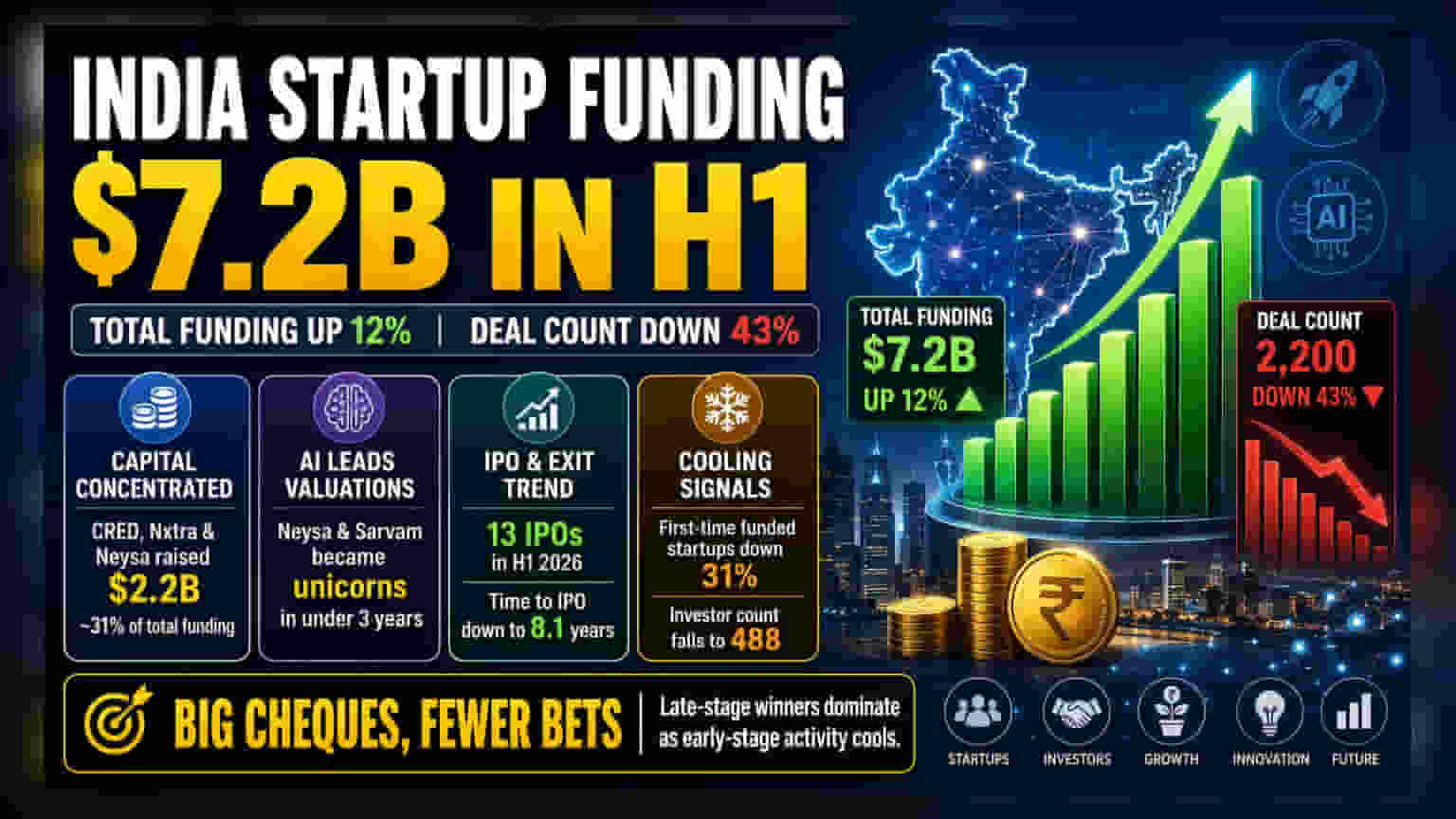
Indian tech startups raised $7.2 billion in the first half of 2026, a 12% annual increase, even as total deal volumes fell sharply by 43%. While AI-focused firms reached unicorn status quickly, the ecosystem shows signs of cooling with fewer new startups receiving funding and a decline in institutional investor participation.
What Happened
The Indian technology startup sector recorded a total funding of $7.2 billion during the first half of 2026, marking a 12% rise compared to the previous year. While the total capital inflow grew, the number of funding deals experienced a sharp decline of 43%, falling to 652. This disconnect suggests that while money is still flowing into the sector, it is increasingly concentrated among a smaller group of well-established companies rather than spread across a wide range of startups. Investors are showing a preference for larger, more established bets in a tighter funding environment.
The Concentration of Capital
Investment has become highly selective, with a significant share of the total capital going to just three companies. CRED, Nxtra, and Neysa secured a combined $2.2 billion in funding, which represents nearly 31% of the total capital raised in the first half of the year. This trend shows that investors are prioritizing high-conviction, late-stage bets in a market where capital is harder to access for smaller or newer ventures.
AI Startups and Valuation Speed
Artificial intelligence has emerged as the strongest theme for valuations. New unicorns, particularly Neysa and Sarvam, achieved billion-dollar valuations in less than three years. This speed of growth stands out when compared to other recent unicorns like KreditBee, Skyroot, and Square Yards, which took between eight and twelve years to reach the same status. This indicates that AI companies are currently attracting massive investor interest and premium valuations in a significantly shorter period than companies in other sectors.
IPO and Exit Trends
Exits for investors showed slight improvement, with 13 companies completing initial public offerings (IPOs) in the first half of 2026, compared to 12 in the same period last year. Significant public market debuts included Fractal Analytics at a $1.7 billion market capitalization, Amagi, and Shadowfax. The time required for a company to move from its first funding round to an IPO has decreased to 8.1 years, down from 14.5 years. Additionally, the ecosystem saw 58 major acquisitions, such as Adani Energy Solutions buying IntelliSmart for $319 million and upGrad acquiring Unacademy for $216 million.
Signs of a Cooling Ecosystem
Despite the positive headlines about total funding and exits, there are signs that the broader startup environment is cooling. The number of unique institutional investors participating in the ecosystem has dropped to 488, down from a peak of 824 in early 2024. Furthermore, the number of companies moving toward unicorn status has declined by 47%, and startups receiving their first round of funding fell by 31% to 218. This suggests that while top-tier companies continue to raise large sums, the base of the startup pyramid is shrinking.
What Investors Should Track
Investors tracking this sector should watch the IPO pipeline and institutional investor sentiment. The increasing reliance on a few large funding rounds and the decline in new, first-time funded startups indicate a potential slowdown in early-stage activity. The key monitorable will be whether the current trend of faster public listings continues to provide liquidity for early-stage investors and if institutional interest stabilizes.