

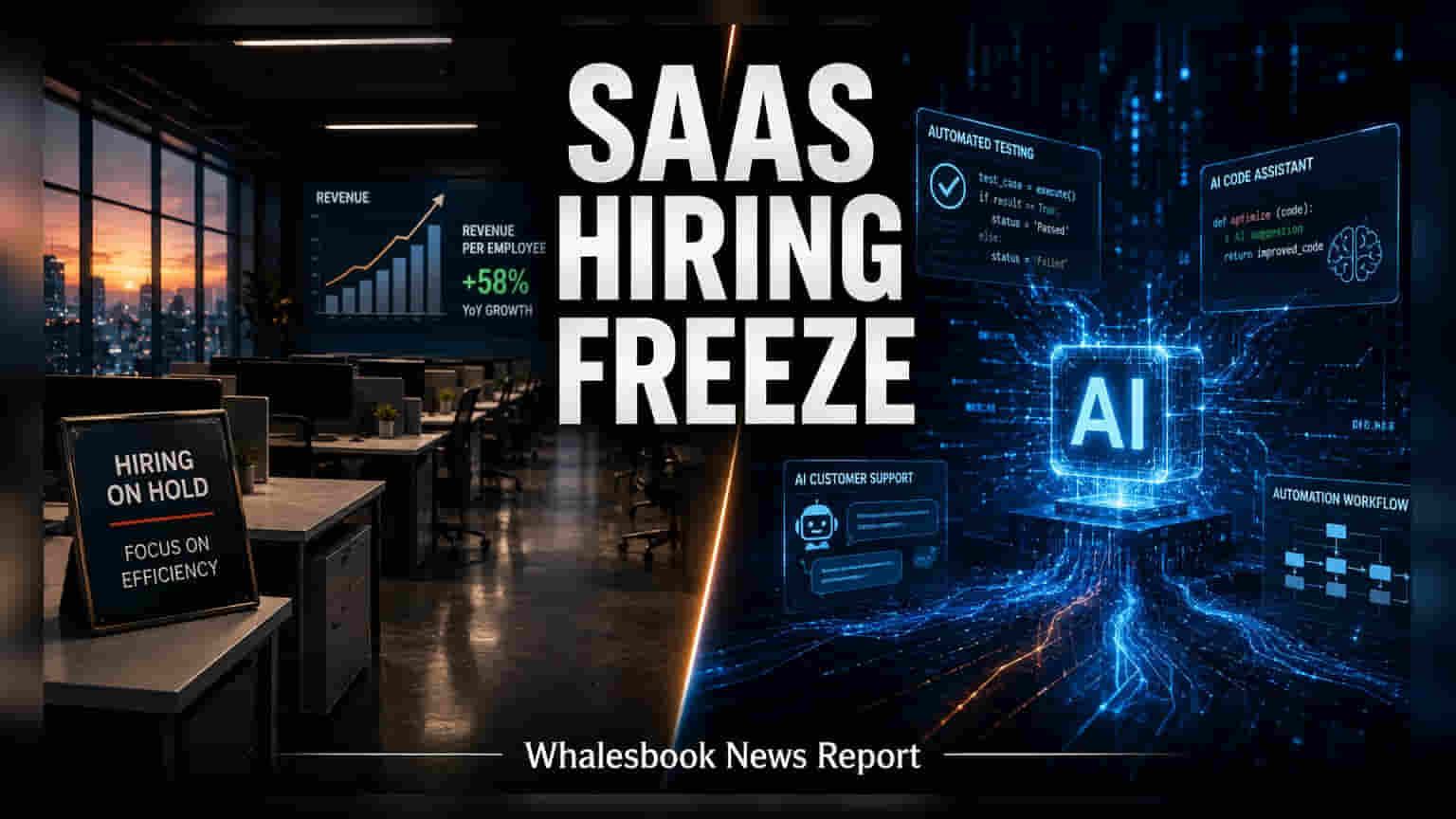
Indian SaaS companies are changing how they grow by prioritizing AI-driven automation over adding new employees. This shift aims to boost profit margins by increasing revenue generated per worker. While overall revenue continues to climb, hiring for entry-level roles in testing and customer support has dropped, signaling a long-term change in the sector's business model.
The business model for Indian software-as-a-service (SaaS) companies is undergoing a significant transformation. For years, these firms measured their growth by how many employees they added to their teams. Today, that model is changing as companies disconnect revenue growth from headcount expansion. Instead of increasing staff to meet higher demand, firms are relying on AI and automation to handle tasks, aiming to prove they can scale operations without increasing costs at the same rate.
The Rise of Revenue per Employee
Investors are now paying close attention to a metric known as revenue per employee. In the past, a growing payroll was often seen as a sign of a healthy, expanding business. Now, the market favors companies that can keep costs low while increasing sales. By replacing manual processes with AI tools, SaaS firms are attempting to show that they can generate more money for every person on their payroll. This focus on efficiency is intended to protect profit margins, even as the global demand environment fluctuates. Companies are finding that they can maintain or improve their output by utilizing AI for code maintenance, automated testing, and customer service tasks that were previously handled by large teams.
Changing Talent Demand
This shift in strategy has created a divergence in the job market. Hiring for entry-level roles, particularly in quality assurance and general customer support, has seen a sharp decline. Automation tools can now provide 24/7 service and error-checking at a fraction of the cost of a large human workforce. Consequently, companies are cutting back on these traditional roles. However, demand has not disappeared entirely; it has moved to more specialized positions. Firms are aggressively seeking experts in generative AI, large language models, and cloud infrastructure. This means that while there are fewer total job openings, the competition for highly technical, senior-level talent remains intense.
Operational and Regulatory Risks
While this pivot toward AI-native infrastructure offers potential efficiency gains, it also introduces new risks that investors should consider. There is an execution risk: if an AI system fails or produces low-quality output, it can damage client trust and lead to higher long-term costs. Furthermore, the regulatory environment is becoming more complex. Legislation such as the EU AI Act requires companies to invest in engineering and compliance refactors, which could impact operational focus and capital spending. Additionally, the broader economic impact of stagnant entry-level hiring cannot be ignored, as it may influence middle-class consumption patterns and the overall talent pipeline for the industry.
In the coming quarters, the key monitorable for investors will be the operating margins and the growth in revenue per employee as reported in financial statements. While the shift to AI efficiency is aimed at long-term profitability, shareholders should monitor whether these companies can maintain high-quality customer outcomes and navigate the changing global regulatory requirements without incurring hidden implementation costs.