

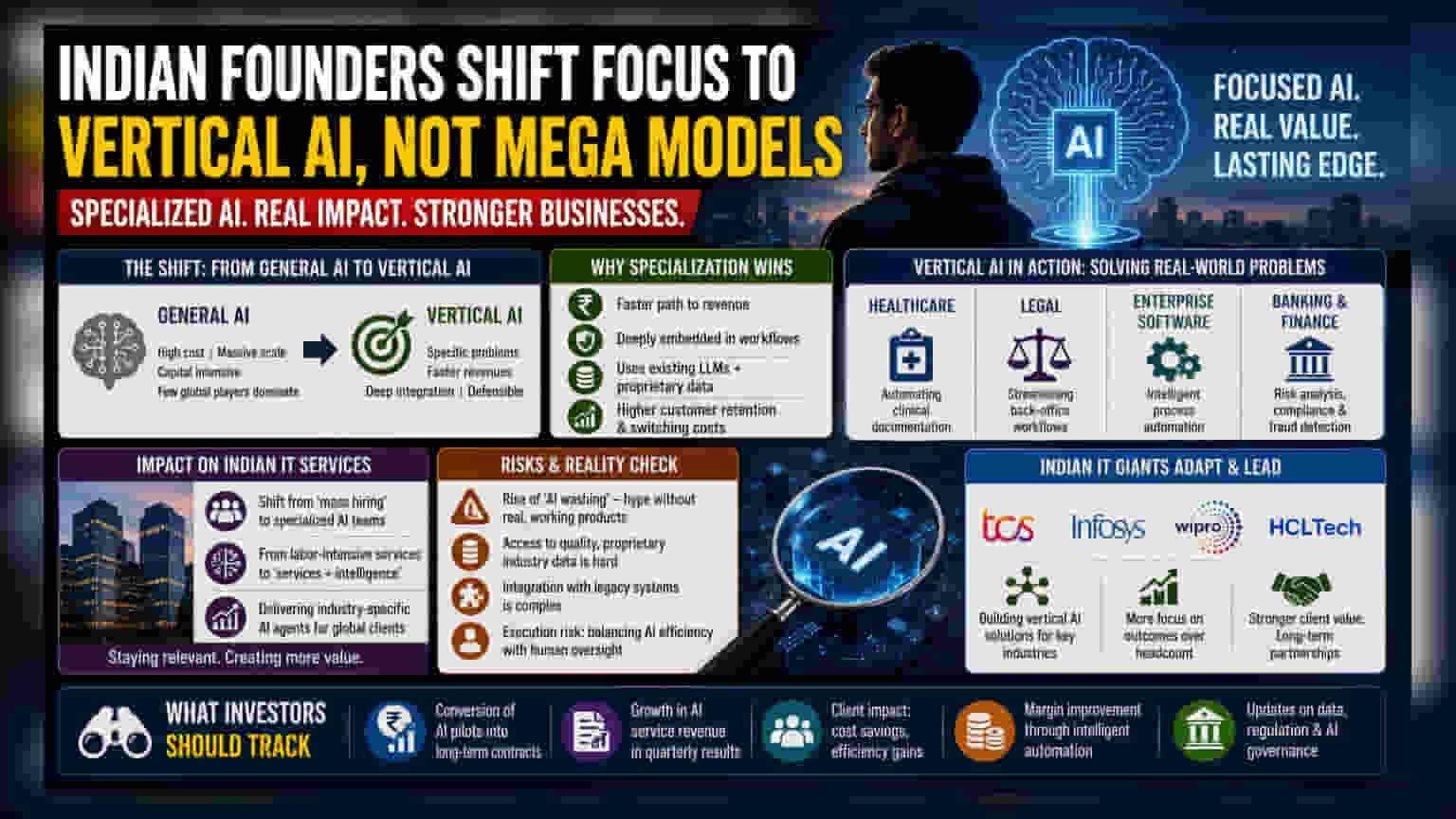
Indian entrepreneurs in Silicon Valley are shifting focus from building general-purpose AI models to creating specialized 'vertical' AI for industries like healthcare and enterprise software. This move toward solving specific business problems rather than broad, expensive model development is a key strategy for sustainable growth, influencing how tech companies and IT services firms approach the AI market.
What Happened
Indian founders in Silicon Valley are increasingly moving away from the race to build general-purpose, massive AI models. Instead, they are concentrating on 'vertical AI'—tools built to solve specific problems within narrow industries like healthcare, legal services, and enterprise software. This shift marks a change in strategy for the next wave of AI startups, moving from high-cost, broad-base model development to creating precise, actionable software that integrates directly into existing business workflows.
Why Specialization Matters
Building a general-purpose AI model is capital-intensive and often dominated by a few global technology giants. For new startups, competing directly in this space involves significant risks and high costs. By focusing on vertical AI, founders are instead building software that performs a specific task exceptionally well, such as automating clinical documentation for hospitals or streamlining back-office legal workflows.
This approach is often more attractive to investors because it generates revenue faster and creates 'defensibility.' When an AI tool is deeply embedded in a company’s workflow, it becomes harder for that company to switch to a competitor. These niche applications also allow startups to use existing large language models as a base while adding their own proprietary data to solve industry-specific challenges, which general models cannot do effectively on their own.
Impact on Indian IT Services
This trend is not limited to startups; it is also reshaping how large Indian IT services firms view their AI strategies. For the last two years, investors were concerned that AI automation might disrupt the core outsourcing model of Indian IT giants. However, these firms are now actively shifting their focus from 'mass hiring' to building specialized AI teams and integrating vertical AI solutions for their global clients.
Major companies in the sector are moving toward a 'services plus intelligence' model. Instead of just offering labor-intensive IT maintenance, they are implementing industry-specific AI agents that can handle complex operations in sectors like banking, logistics, and healthcare. This shift allows them to maintain relevance and potentially improve their value proposition to clients who are looking for real-world results rather than just AI experimentation.
Business Risks and Reality Check
While the pivot to specialized AI offers a clearer path to revenue, it comes with risks. The market is currently seeing a rise in 'AI washing,' where companies exaggerate their AI capabilities without having a working product that actually delivers value. For investors, the risk lies in distinguishing between companies with real, scalable industry solutions and those using AI as a marketing buzzword.
Additionally, successful vertical AI requires high-quality, proprietary industry data, which can be difficult to acquire. Companies that lack deep domain expertise or fail to integrate well with existing legacy software may struggle to move beyond pilot projects. Execution risk remains high as businesses refine their approach to balancing AI efficiency with human oversight.
What Investors Should Track
Investors should look beyond the hype of AI adoption and focus on measurable business outcomes. Key monitorables include whether companies—whether startups or established IT firms—are converting their AI 'pilots' or trial projects into actual long-term service contracts. Track the growth of specific AI service revenue lines in quarterly reports and watch for management commentary on how these specialized tools are helping clients save costs or improve operational efficiency.