

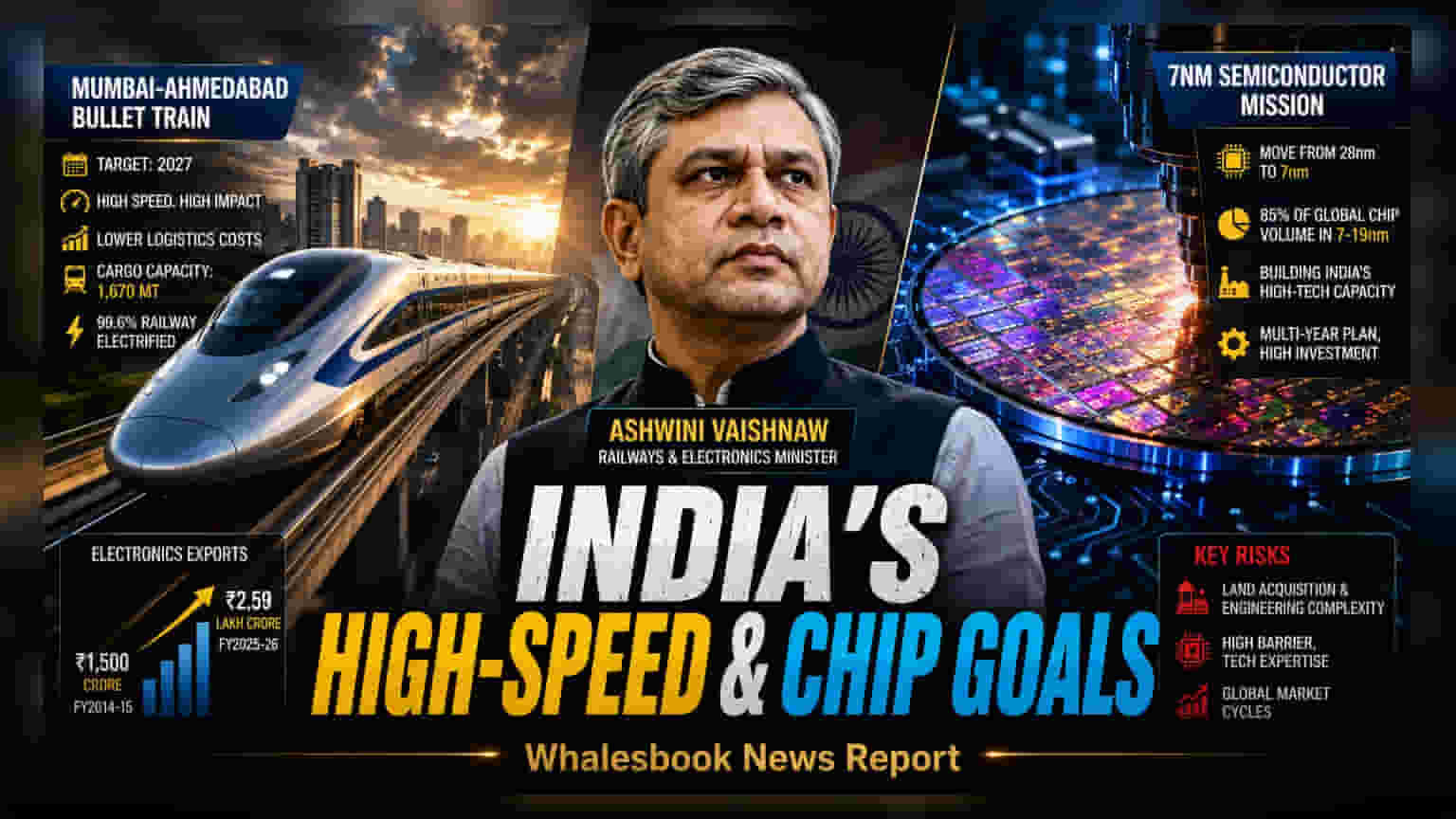
Minister Ashwini Vaishnaw has reaffirmed two core strategic priorities: operationalizing the bullet train project by 2027 and scaling semiconductor production to the 7-nanometer process. Supported by a massive surge in electronics exports to ₹2.59 lakh crore in FY2025-26, the government aims to deepen the manufacturing ecosystem. Investors may track the execution timelines and capital spending requirements in the infrastructure and technology sectors.
Union Minister for Railways and Electronics and Information Technology, Ashwini Vaishnaw, has outlined a clear industrial roadmap for India, centering on two massive infrastructure and technology milestones: the Mumbai-Ahmedabad bullet train project and the development of 7-nanometer (7nm) semiconductor manufacturing capacity. These objectives reflect a push toward technological independence and high-value manufacturing capabilities.
The Semiconductor Strategy
The move toward 7nm semiconductor production is a key step in India’s industrial strategy. Currently, the industry focuses on 28nm processes, but the minister noted that moving to the 7nm level is vital because approximately 85% of global semiconductor chip volume sits within the 7nm to 19nm range. By building this capacity, India aims to capture a much larger slice of the global high-tech electronics supply chain. This transition is expected to be a multi-year effort, requiring significant investment in fabs and related ecosystems, while also managing the complexities of global supply chain dependencies.
Bullet Train and Logistics Goals
On the infrastructure front, the Mumbai-Ahmedabad high-speed rail project is moving toward an initial rollout target of 2027. Beyond passenger mobility, the government is focusing on the broader impact of logistics on industrial competitiveness. Improved railway operations and infrastructure efficiency are intended to lower logistics costs for domestic industries. Cargo carrying capacity has risen to approximately 1,670 million tonnes, and with railway network electrification now at 99.6%, the focus is shifting toward speed and operational reliability to support manufacturing hubs.
Electronics Export Growth
The minister highlighted that India’s manufacturing success is not sudden but the result of a deliberate, phased strategy. Electronics exports have seen a massive rise, climbing from ₹1,500 crore in FY2014-15 to ₹2.59 lakh crore in FY2025-26. This growth trajectory was built by starting with simple assembly, moving to sub-modules, and finally focusing on deep component manufacturing. This model provides a blueprint for how the government intends to approach the semiconductor sector and other high-tech industries.
Risks and Monitorables
While these goals are ambitious, investors should keep in mind the risks inherent in large-scale projects. Infrastructure ventures like the high-speed rail corridor face challenges related to land acquisition, civil engineering complexity, and long-gestation periods that require sustained capital injection. In the semiconductor space, the primary risks involve the high barrier to entry, the need for advanced technical expertise, and sensitivity to global market cycles. Success will depend on the government’s ability to attract private participation, maintain steady policy support, and execute complex technical projects on time. The key monitorable for the market will be the commissioning milestones for the bullet train and tangible progress reports on the semiconductor fabrication facilities.