

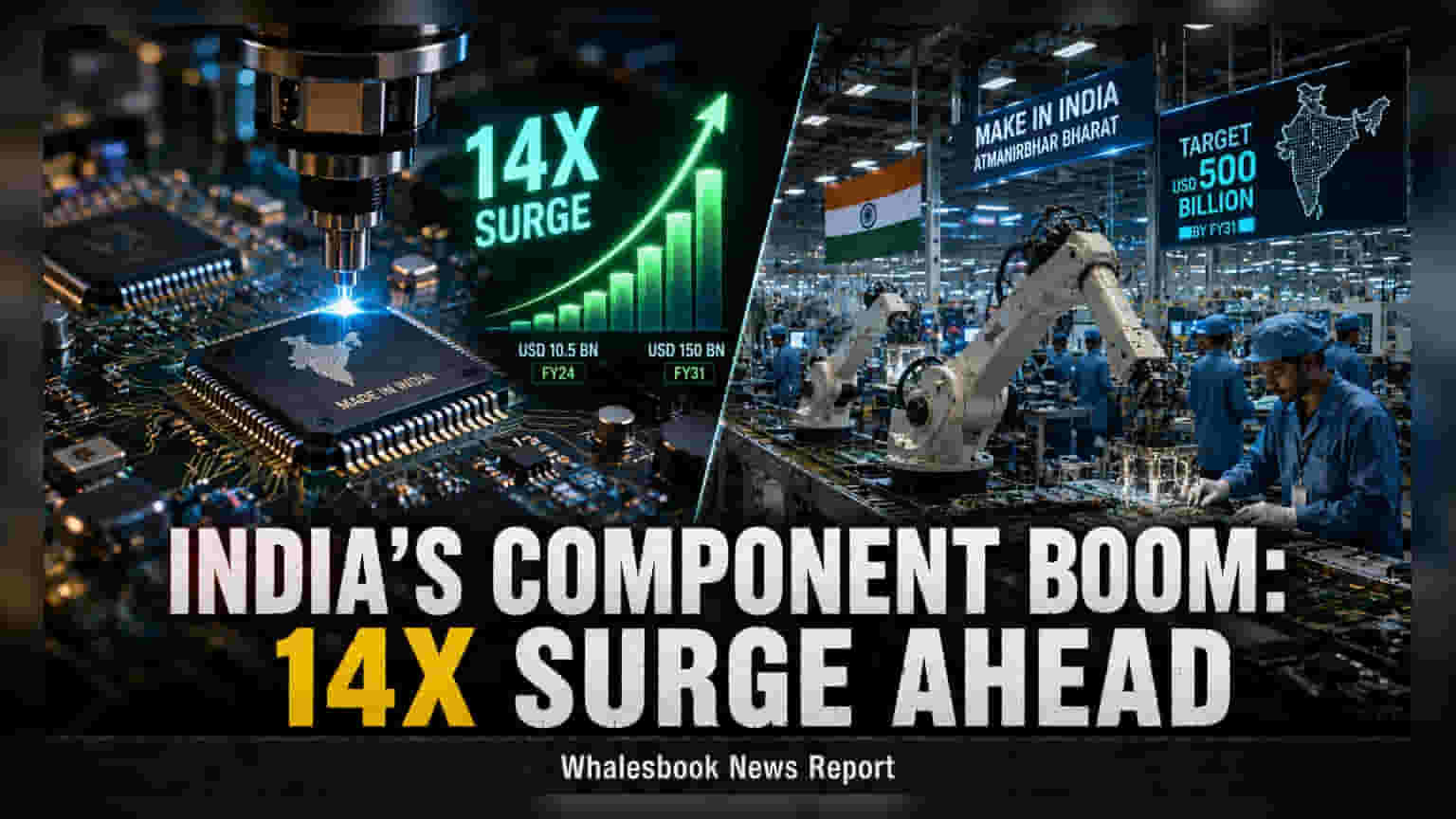
India plans to grow its electronics manufacturing sector to USD 500 billion by FY31, with a major focus on components. The component segment is expected to surge 14-fold to USD 150 billion. While this signals a shift toward higher value addition, investors should monitor import dependence and project execution risks.
India’s electronics manufacturing industry is preparing for a period of rapid growth, with total sector output targeted to reach USD 500 billion by fiscal year 2031. A critical pillar of this growth is the electronic component segment, which is projected to expand 14 times, growing from USD 10.5 billion in FY24 to USD 150 billion by FY31. This expansion is designed to shift the country from simple assembly toward deeper value addition, effectively creating a more self-reliant supply chain.
The government is actively supporting this transition through schemes like the new Rs 62,500-crore Mobile Phone Manufacturing Scheme and the Electronics Component Manufacturing Scheme. These policies aim to encourage companies to produce critical components domestically rather than relying on imports. Several listed companies, including Syrma SGS and Centum Electronics, have already secured approvals under these incentive programs, marking a first step toward building local manufacturing capacity.
While the growth forecast for mobile phone production is also strong—expected to reach USD 159 billion by FY31—the component sector is growing at a faster rate. This shift is essential because global electronics assembly often depends on importing costly parts. By manufacturing these parts domestically, the goal is to capture more value within the country.
Investors should remain aware of the practical challenges in this transition. Despite government support, the industry continues to depend on imports for essential items like semiconductor equipment, specialty chemicals, and raw materials. Building a competitive ecosystem also requires long-term policy support and high-quality research and development. There is also the inherent risk of execution, where companies must successfully scale their operations to compete with established global suppliers.
Looking ahead, the key things for investors to watch are the actual levels of value addition achieved by these manufacturers and their ability to sustain operations as incentive schemes evolve. Tracking how companies manage their raw material costs and their success in integrating with the global supply chain will provide a clearer picture of their long-term growth.