

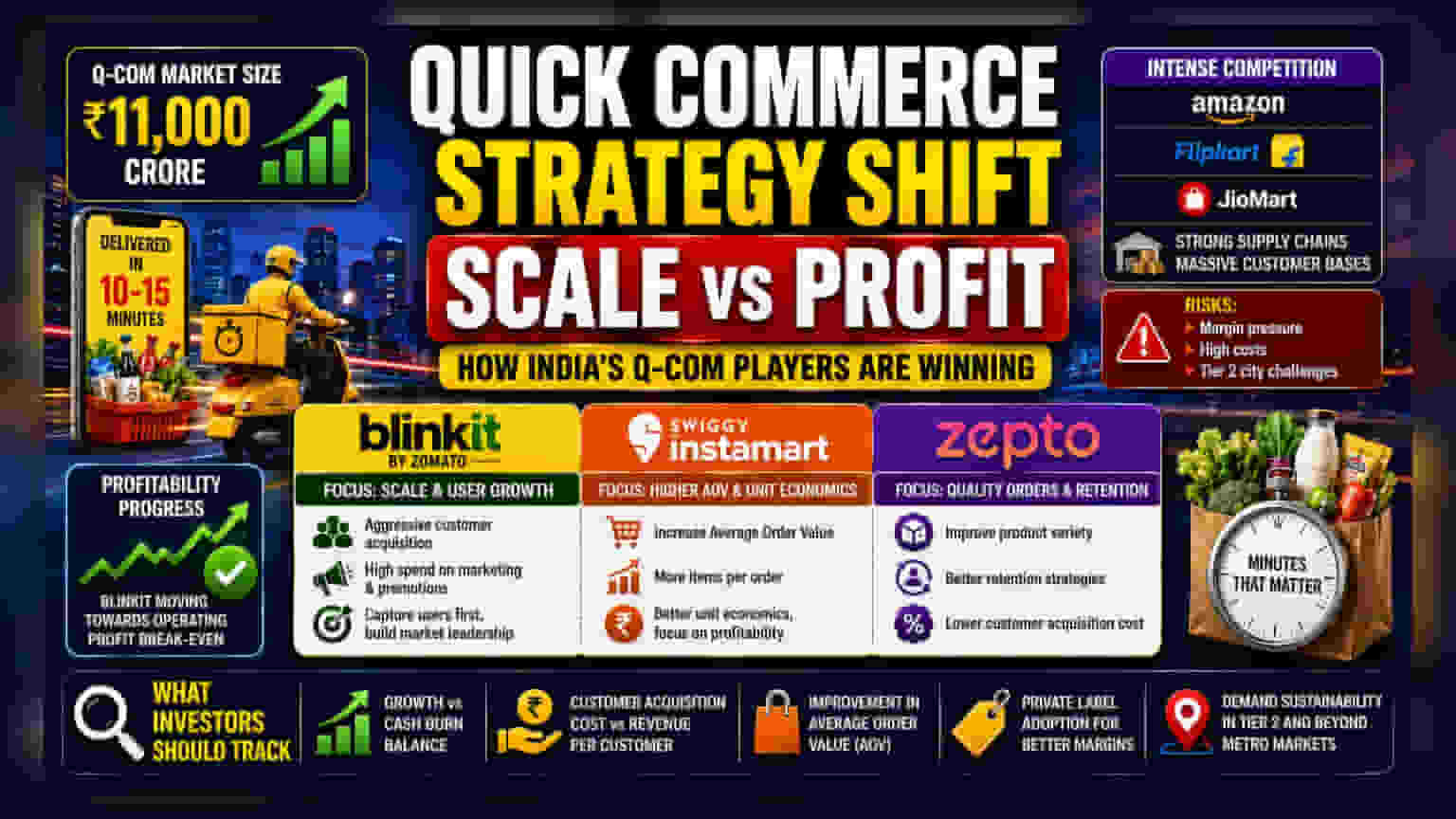
The Indian quick commerce market has reached Rs 11,000 crore in volume, driving a fierce battle for dominance. While Zomato’s Blinkit prioritizes user growth, Swiggy and Zepto are focusing on profitability and larger order sizes. This divergence reflects the industry's struggle to balance rapid expansion with sustainable earnings.
What Happened
The Indian quick commerce sector—delivering groceries and household items in minutes—is witnessing a major shift in business strategies. With the market estimated at Rs 11,000 crore, leading platforms like Zomato (through its Blinkit arm), Swiggy Instamart, and Zepto are choosing different paths to capture market share. While the goal for all is to lead the fast-growing delivery space, their methods are diverging: some are prioritizing massive user growth, while others are focusing on making every order more profitable.
Scale Versus Profitability
Companies are split between two main tactics. Zomato, through its Blinkit brand, has maintained an aggressive focus on bringing in new customers. This strategy aims to grow the total user base quickly, even if it requires high spending on marketing and promotions. The belief here is that capturing a large number of users first will build a dominant market position.
In contrast, Swiggy Instamart and Zepto are focusing on the quality of their orders. Their strategy centers on increasing the Average Order Value (AOV), which simply means encouraging customers to spend more on each delivery. By getting customers to add more items to their carts, these companies aim to improve their unit economics—or how much money they make per order—rather than just chasing the total number of users. Zepto, for instance, has worked on improving product variety and retention to lower the costs associated with acquiring new customers.
The Profitability Challenge
For investors, the most critical question remains sustainability. Running a quick delivery network is expensive because it involves maintaining many small warehouses (dark stores) and paying for a large delivery fleet. While Blinkit has shown progress toward breaking even at the operating profit level, overall profitability remains a challenge across the sector. Companies must find a way to balance the heavy cost of running these networks with the money coming in from customers.
Broader Competition and Risks
Competition is not limited to these three players. Large e-commerce giants like Amazon, Flipkart, and JioMart are also expanding their footprint in quick deliveries. These integrated players have a major advantage: they already have massive supply chains and existing customer bases. If they scale up their quick-delivery offerings, it could squeeze margins for the pure-play quick commerce companies.
Additionally, the push into Tier 2 cities brings new risks. While these markets offer growth, the consumer behavior and purchasing power are different compared to large metros. Adapting the business model—which is designed for dense urban areas—to smaller cities may not yield the same efficiency or volume immediately.
What Investors Should Track
As this sector evolves, investors should watch for the balance between growth and cash burn. The key monitorables include how much these companies spend to acquire users versus the revenue they generate from existing customers. Future performance will likely depend on whether they can improve margins through private-label products, which offer better profits than selling third-party brands, and whether they can maintain demand as they move into smaller cities.