

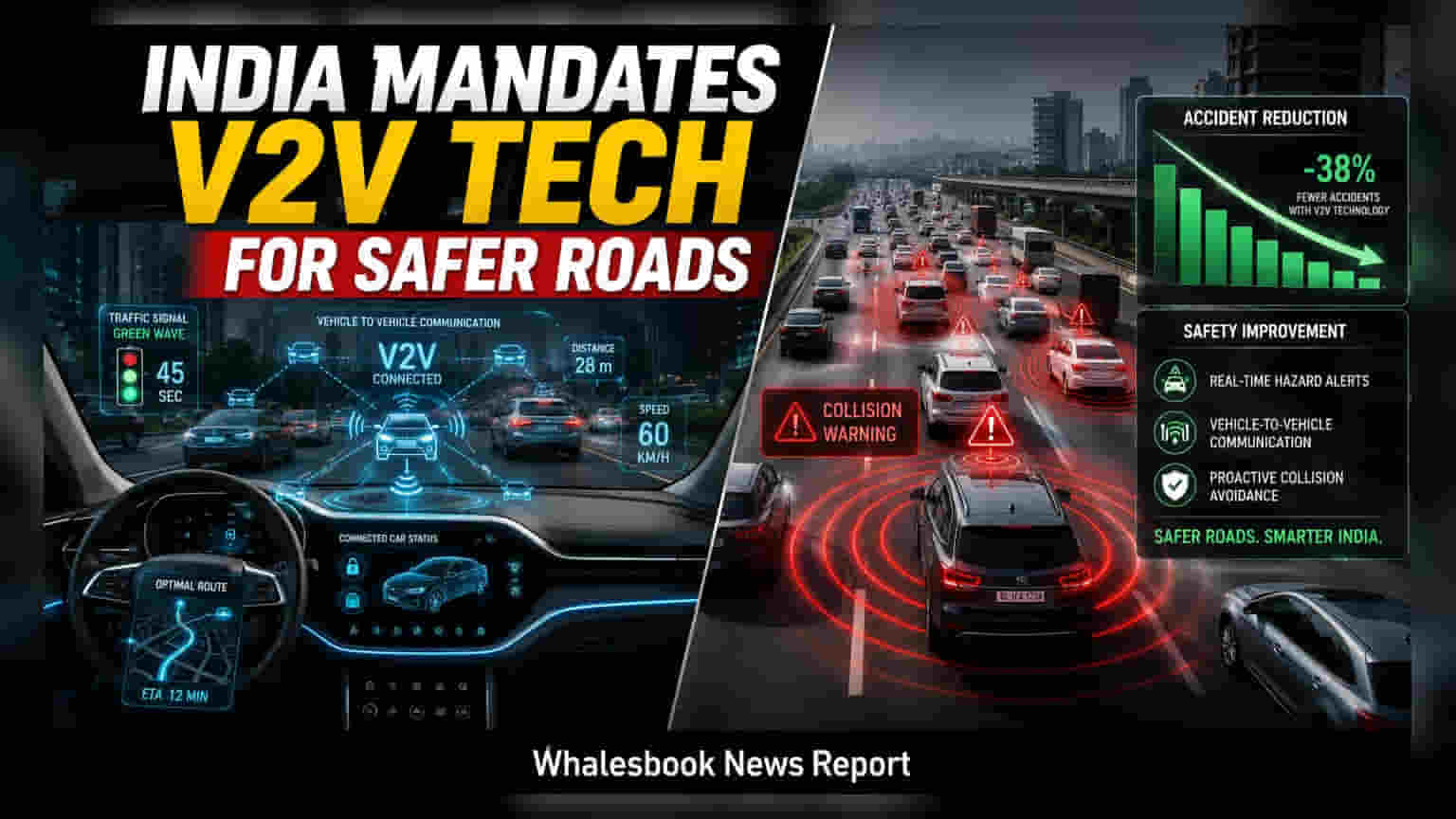
The Ministry of Road Transport and Highways has proposed mandatory vehicle-to-vehicle (V2V) communication systems for select vehicle categories starting October 2027. This initiative aims to improve road safety by enabling real-time data sharing between cars. For investors, the move signals a shift in the automotive supply chain toward advanced safety electronics.
The Ministry of Road Transport and Highways has released a draft notification proposing a mandatory rollout of vehicle-to-vehicle (V2V) communication technology for various vehicle categories. This initiative aims to transform road safety in India by enabling vehicles to share real-time data, such as speed, positioning, and acceleration. By allowing cars to "talk" to one another, the system provides warnings about hazards outside the driver’s immediate line of sight, such as sudden braking or potential collisions ahead.
Implementation Timeline and Standards
The government has laid out a phased implementation plan to help the automotive industry adapt. Vehicles manufactured on or after October 1, 2027, must comply with the AIS-230 standard if they are equipped with V2V systems. Starting October 1, 2028, these communication systems will become mandatory across specific categories of L, M, and N vehicles. To support this, the Department of Telecommunications has already cleared the 5.875 GHz to 5.925 GHz frequency band for V2V and Intelligent Transportation System (ITS) applications, removing the need for separate licenses for this technology.
Impact on the Automotive Supply Chain
This policy shift is set to influence the automotive component sector, particularly companies involved in electronics and advanced driver assistance systems (ADAS). As manufacturers work to meet the AIS-230 requirements—which cover radio performance, cybersecurity, and GNSS positioning—there will likely be an increased demand for specialized hardware and software components. Companies currently supplying sensors, connectivity modules, and vehicle-integrated software may see new growth opportunities. However, the financial impact will depend on the cost of integration and whether manufacturers pass these expenses to consumers or absorb them into their profit margins.
Risks and Market Monitorables
For investors, the primary monitorable is the execution timeline. The government is currently accepting comments on the draft, and the final notification will dictate the exact scope and cost structure. A significant risk involves the readiness of the local supply chain to meet these high-tech standards within the two-year window. Furthermore, as the industry moves toward higher-value tech products, investors should watch how profit margins across auto component manufacturers are affected by the necessary research and development spending. Unlike traditional mechanical auto components, this transition introduces risks related to software reliability, cybersecurity compliance, and the ability of vendors to scale production for advanced connected vehicle solutions.