

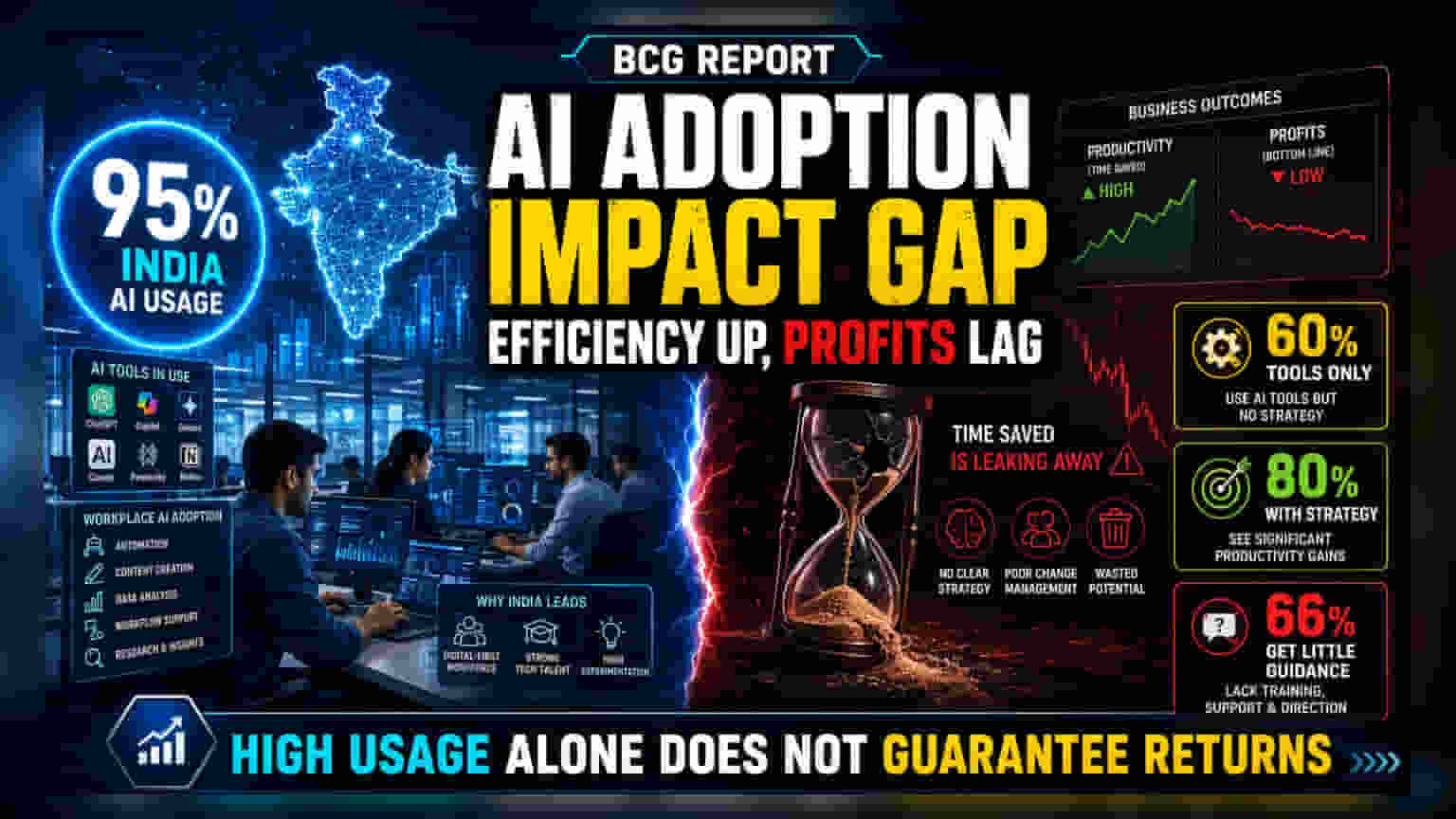
Indian firms are the world’s most frequent users of workplace AI, yet many struggle to convert this into bottom-line business growth. A new BCG report suggests that companies often use AI for individual efficiency rather than redesigning business processes. For investors, the real test is whether companies can track time savings and effectively reinvest them into more strategic, value-creating tasks.
What Happened
A new report by the Boston Consulting Group (BCG) reveals a significant gap between how companies adopt artificial intelligence and the actual business results they achieve. The study, which surveyed over 11,700 employees across 14 countries, highlights that simply deploying more AI tools does not guarantee better financial performance. While India has emerged as a global leader in workplace AI adoption—with 95% of frontline employees using AI at least several times a week—many firms are finding it difficult to translate this increased efficiency into tangible business outcomes.
The Efficiency-Profit Gap
The central issue identified in the report is what can be described as "time leakage." When employees use AI to complete tasks faster, the time they save is often lost on low-value tasks rather than being reinvested into strategic work that drives profit. BCG found that 66% of frontline employees receive little or no guidance on how to use the time saved by AI. Furthermore, 58% of employees admitted they do not redirect this saved time into higher-value business activities.
For investors, this data is critical. It suggests that high AI adoption rates in a company do not automatically translate to improved profit margins or higher productivity. Instead, the real measure of success is whether a company has a system in place to track these efficiency gains and push them toward revenue-generating or cost-saving activities.
Why Strategy Outperforms Tools
BCG’s findings show a clear difference in results based on how companies approach AI. Organizations that rely solely on "tool deployment"—giving employees access to software without a clear plan—achieve a 60% business impact. In contrast, companies that combine AI tools with a well-defined AI strategy report an 80% measurable business impact.
This indicates that competitive advantage comes not from the technology itself, but from organizational redesign. Companies that are integrating AI agents into workflows and setting clear management guidelines are better positioned to turn technology spending into actual returns. Reliance on AI primarily for individual productivity, without broader leadership, appears to limit the long-term financial benefits.
The Risk Of Organizational Readiness
A major risk factor for businesses is the lack of employee training and governance. Only 36% of respondents feel they are adequately trained for the AI-driven changes in their roles. As companies integrate AI agents into workflows, the lack of management guidelines creates a risk of operational errors, accountability confusion, and poor execution. If employees are not trained to manage and direct AI tools effectively, the promised efficiency gains may remain theoretical rather than practical.
What Investors Should Monitor
Investors looking at the impact of AI on corporate performance should shift their focus from "adoption numbers" to "execution quality." When companies announce investments in AI, the most important monitorable is how they plan to measure and reinvest the time savings generated by these tools.
Look for management commentary that specifically explains how AI is changing business processes and impacting margins, rather than generic claims about software usage. Additionally, track whether the company is investing in workforce retraining, as this is a primary indicator of whether they can successfully navigate the shift from using AI as a basic tool to using it as a core driver of business outcomes.