

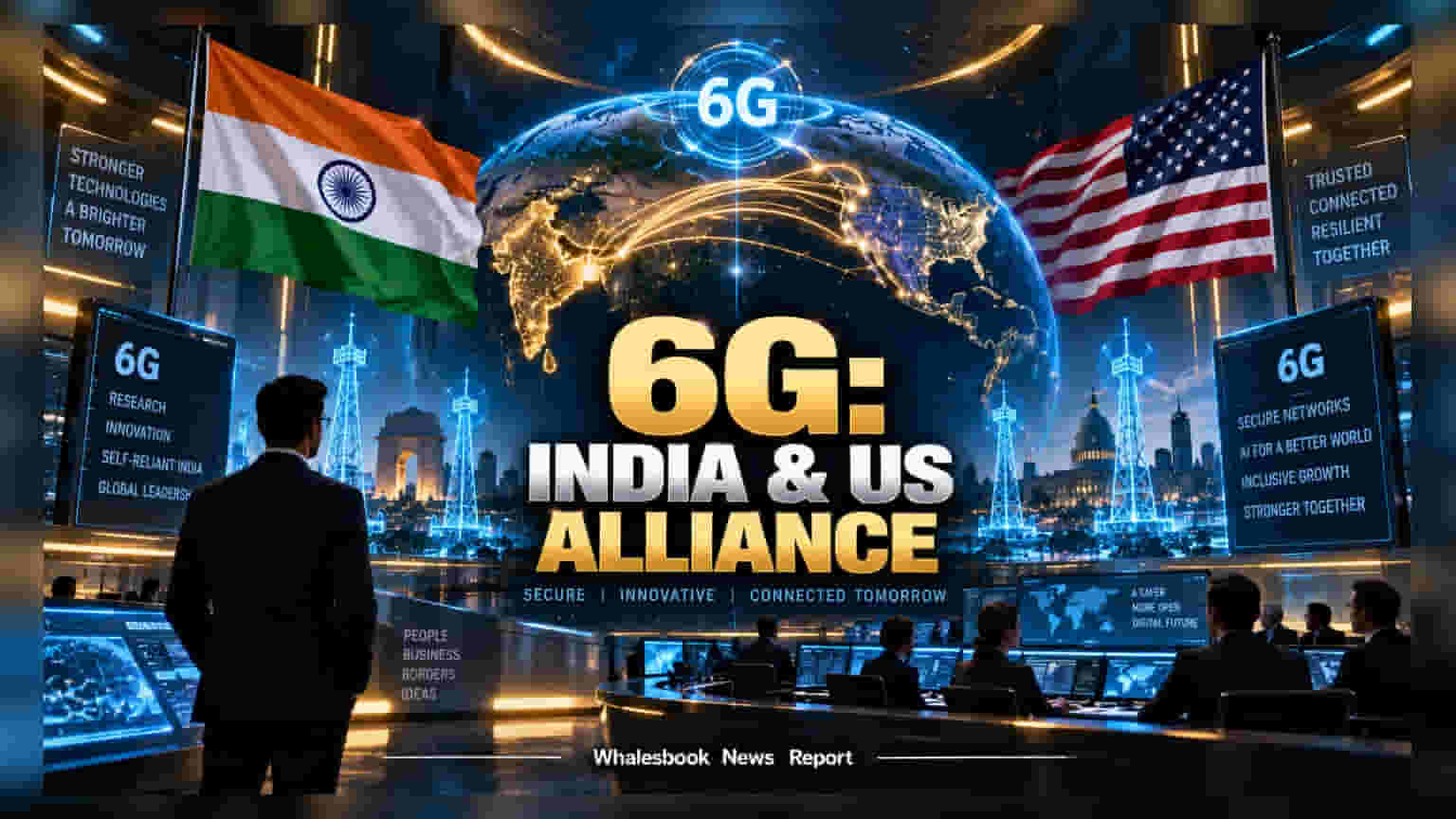
India has joined a 25-nation, US-led initiative to set global security standards for 6G networks. While this aligns with India's long-term 'Bharat 6G Mission', it involves no immediate funding or commercial contracts for local telecom companies. Investors should note that 6G is an early-stage technology and does not change the current financial outlook for the sector.
India has officially joined a 25-nation, US-led coalition focused on establishing global security and innovation standards for 6G wireless networks. The agreement was formalized during the G20 Innovation Ministerial in North Carolina, where discussions between Indian and US officials highlighted a shared objective to ensure that future connectivity standards prioritize security and trusted artificial intelligence.
The partnership aims to align international strategy before the 6G technology rollout, which is expected to occur in the 2030s. By participating in this initiative, India seeks to influence the architectural design of these next-generation networks, ensuring they are interoperable and secure across multiple nations. This move complements the existing 'Bharat 6G Mission' and the 'Bharat 6G Alliance,' which were established to drive domestic research and development in this space.
From an investor perspective, it is important to distinguish between diplomatic alignment and commercial impact. Official updates regarding this coalition have confirmed that there is no immediate new funding, specific commercial deployment projects, or guaranteed spectrum allocations attached to this partnership. Consequently, this development does not have a direct, short-term impact on the revenue or profit margins of Indian telecom companies.
The Indian telecom sector continues to face significant challenges that are independent of long-term technology initiatives like 6G. High competition remains a primary factor impacting pricing power and profitability for major service providers. Furthermore, companies in this space carry substantial debt and must manage ongoing spectrum payment obligations. Because 6G is currently in the early stages of global development, any commercial returns or infrastructure deployment costs are still years away.
For shareholders, the core fundamentals of the telecom industry—such as average revenue per user, debt-to-equity levels, and domestic market share—remain the most relevant indicators to track. While this global coalition is a significant policy development for India’s long-term position in the technology sector, it does not alter the near-term financial reality for telecom operators. Investors may continue to monitor domestic updates regarding R&D progress, future government policies, and the sector's ability to reduce debt burdens while maintaining service quality in the existing 5G environment.