

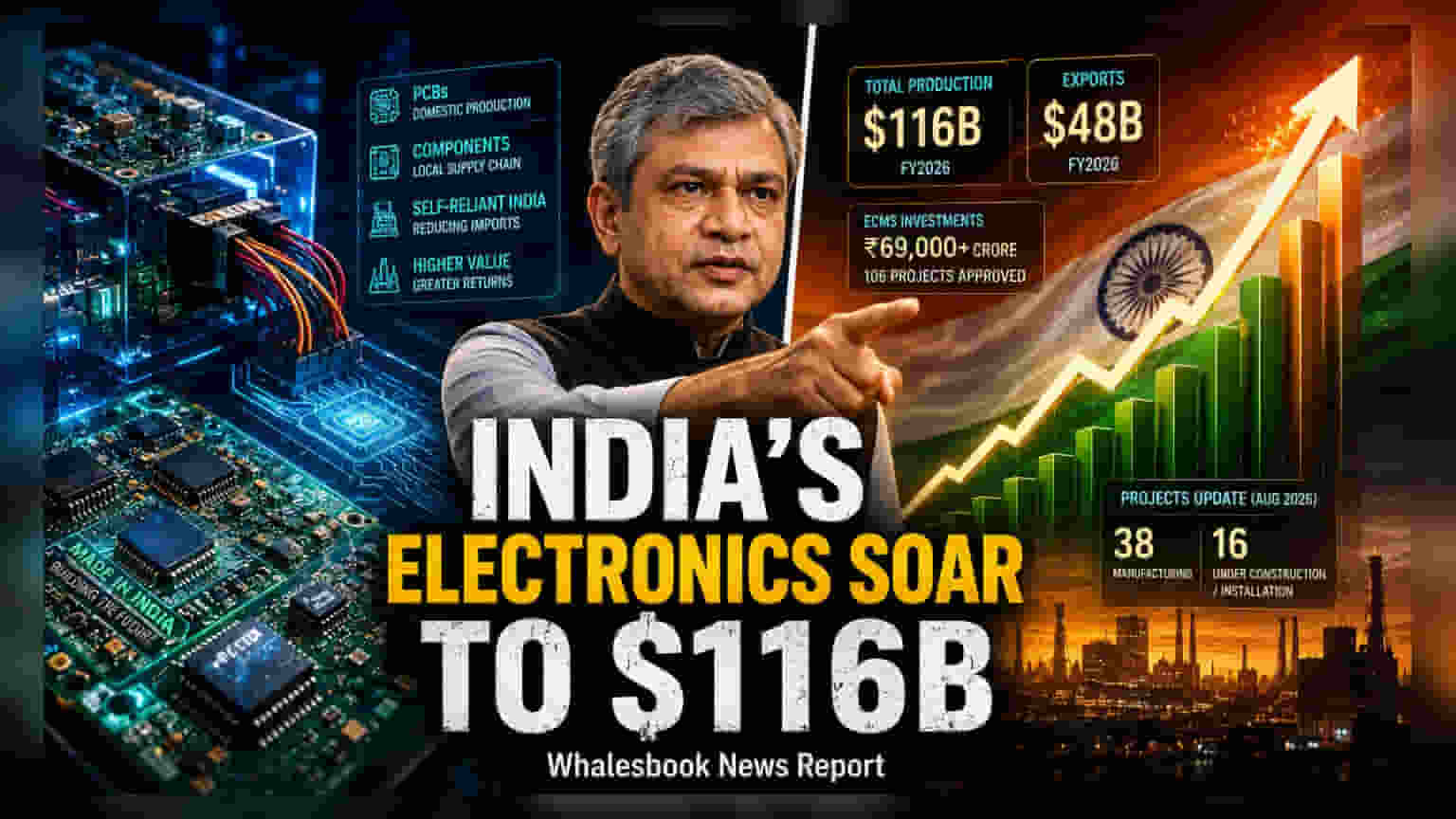
India’s electronics production surpassed $116 billion in FY26, with exports reaching $48 billion. The government is now pivoting from assembling finished goods to developing a domestic supply chain for parts. Investors are watching how this move toward component manufacturing, backed by over ₹69,000 crore in investments, could improve profit margins and reduce reliance on expensive imports.
India's electronics manufacturing sector has reached a key milestone, with total production crossing $116 billion in fiscal year 2026. Exports from the sector have also grown significantly to $48 billion. This growth marks a major change in strategy, as the focus shifts from simply assembling finished products like mobile phones to building a deep, domestic supply chain for electronic components and materials.
For many years, the Indian electronics story was driven by final assembly, which often involved thin profit margins and a heavy reliance on imported parts. The current phase, supported by the Electronics Component Manufacturing Scheme (ECMS), aims to change this by encouraging the local production of items like printed circuit boards (PCBs), enclosures, speakers, and antennas. By manufacturing these parts within India, companies can capture more value and reduce the cost and risk associated with importing essential materials.
Investment activity is reflecting this shift. The ECMS has attracted over ₹69,000 crore in project investments, significantly outperforming the initial target of ₹59,000 crore. There are 106 approved projects under this scheme, and their progress is a critical monitorable for the sector. As of August 2026, 38 of these projects have already started manufacturing, while another 16 are currently in the construction or installation phase.
Despite this progress, the sector faces hurdles. While India has achieved near self-reliance in simpler areas like electronic enclosures, it still depends heavily on global suppliers for high-end raw materials. Achieving true competitiveness requires not just factory capacity, but also investments in research, design, and high-quality testing standards. Investors looking at this space should track the operational timeline of the remaining 16 projects currently under construction, as their success will determine how quickly India can replace imports with domestic supplies.
Furthermore, the sector remains sensitive to global demand and intense competition from established manufacturing hubs. Success will depend on the ability of Indian manufacturers to meet international quality standards consistently while keeping costs low. As the ecosystem matures, the ability of companies to move up the value chain—from basic assembly to the complex manufacturing of precision components—will be the key factor for long-term growth and margin stability.