 Whalesbook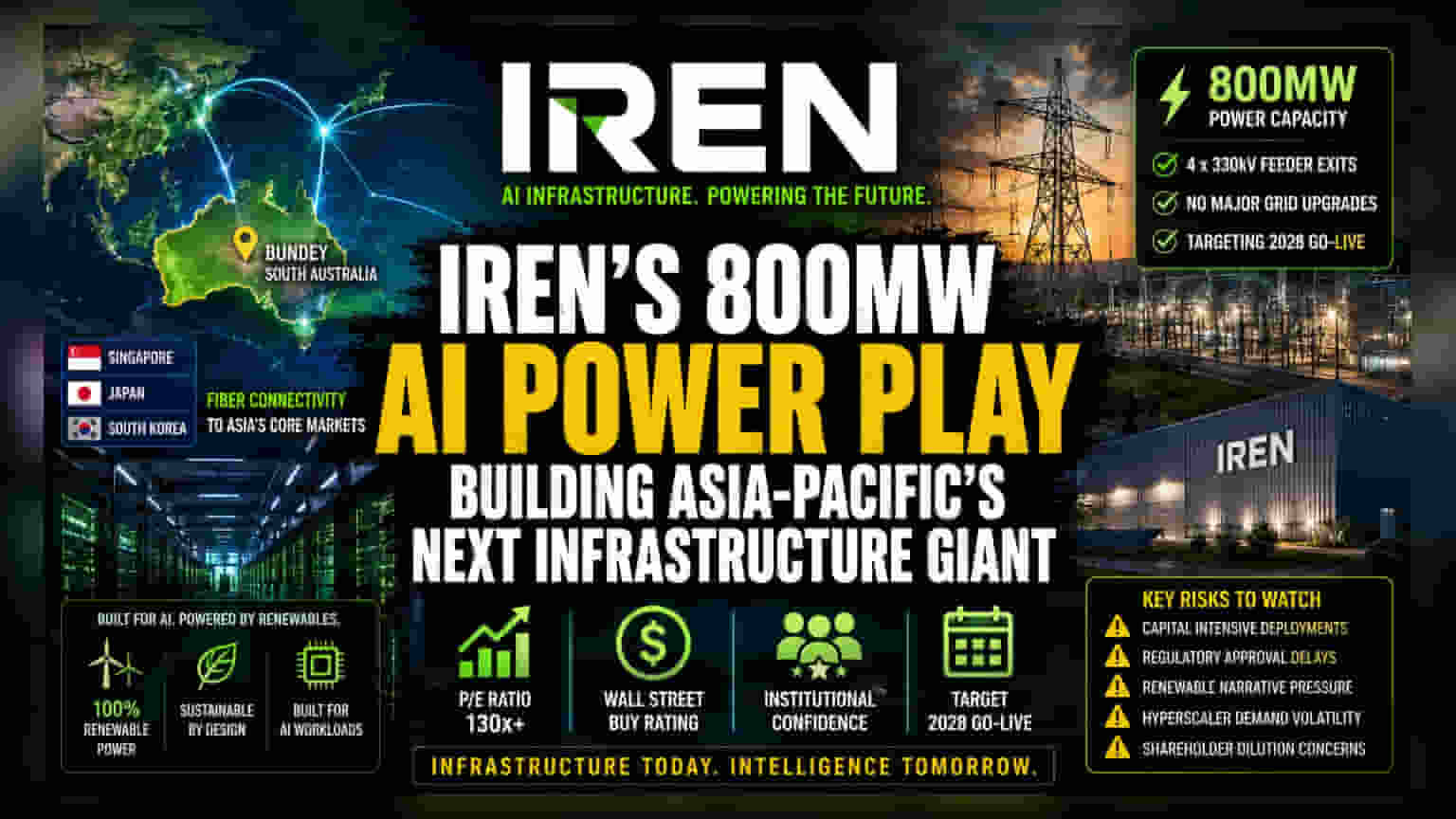


The Infrastructure Play
Following the securing of a transmission connection agreement in Bundey, South Australia, IREN is cementing its role as a core infrastructure developer in the Asia-Pacific region. By utilizing four 330kV feeder exits at a local utility substation, the company aims to support an 800MW load without requiring expensive grid modifications. This tactical acquisition of power capacity reflects the broader industry shift where access to reliable energy, rather than just raw computing power, defines competitive advantage in the AI era.
Scaling Against Sector Peers
IREN’s move aligns with a broader industry migration—often seen among former bitcoin miners like CoreWeave and Applied Digital—to pivot operations toward high-performance computing. While the company maintains a valuation premium, with a trailing P/E ratio exceeding 130x, this expansion addresses the critical regional gap in AI infrastructure. Unlike traditional data center REITs that focused on commodity storage, IREN is leaning into purpose-built, renewable-powered facilities designed for heavy AI training and inference. The project's proposed fiber connectivity to Singapore, Japan, and South Korea positions it as a direct competitor for data sovereignty and latency-sensitive workloads in the region.
Risk Factors and Execution Hurdles
Despite the bullish reception, investors remain wary of the capital-intensive nature of these deployments. IREN has previously faced skepticism from short sellers who questioned the feasibility of its pivot from bitcoin mining, and the company has historically utilized equity-linked financing to fund its rapid scaling. Any significant delays in regulatory approvals or failure to maintain its "100% renewable" grid narrative could lead to margin compression. Furthermore, the reliance on hyperscaler demand creates potential long-term vulnerability; if AI demand cools or if hardware efficiency gains outpace infrastructure requirements, companies acting as pure-play landlords may struggle to maintain the current growth-stock valuation multiples. Past leadership decisions to raise billions in equity have also sparked concerns regarding shareholder dilution, an ongoing narrative that analysts continue to monitor closely.
Future Outlook
Looking toward the 2028 target, IREN is now in the parallel phase of early engineering and regulatory procurement. The company's ability to execute on this timeline will be a litmus test for management’s credibility in delivering large-scale, multi-year projects. With a consensus Buy rating from Wall Street and elevated price targets, the market is pricing in near-perfect execution, leaving little margin for error in the complex deployment of this Australian site.