

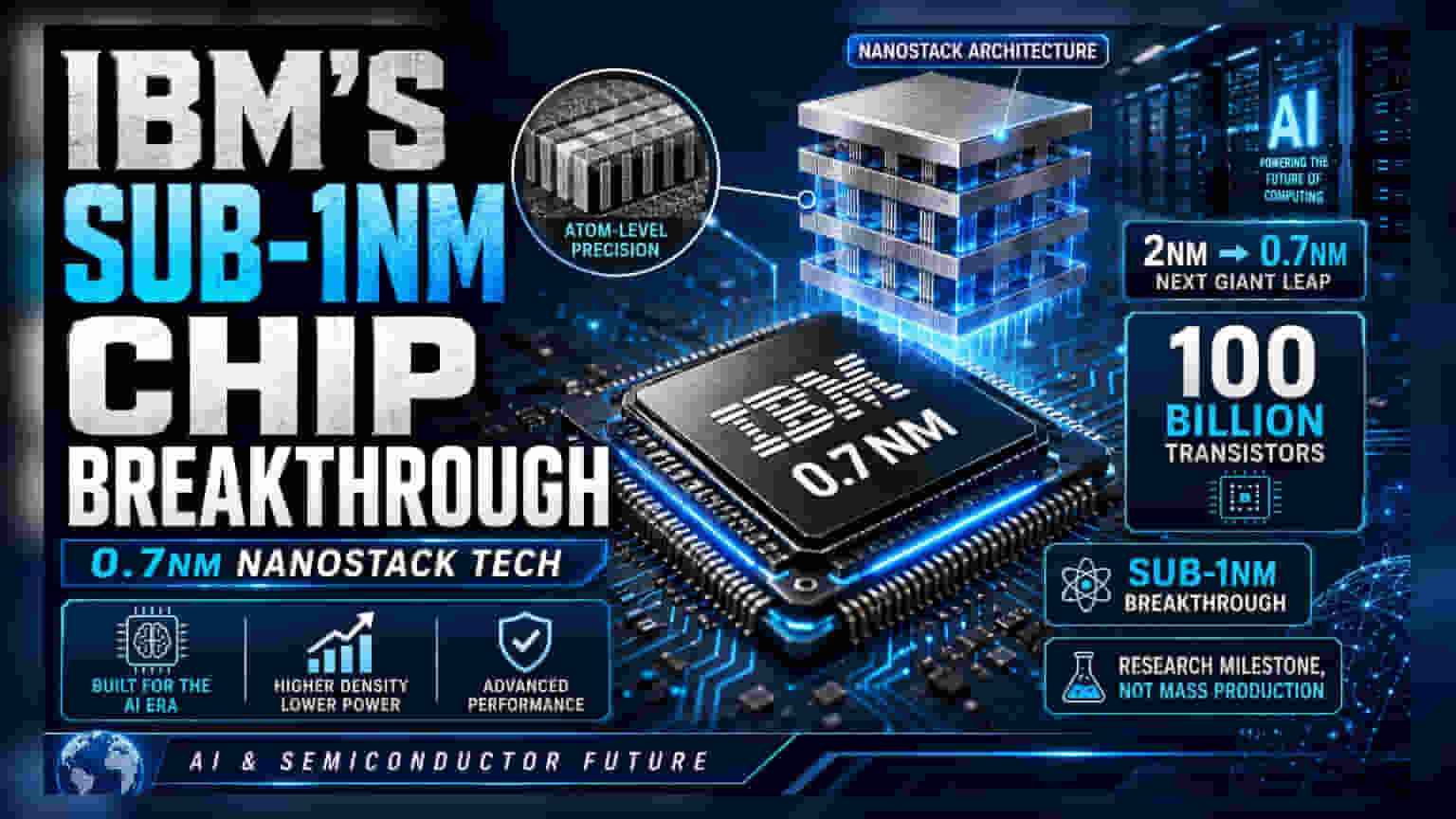
IBM has unveiled a 0.7nm chip design using 'Nanostack' architecture to double transistor density. While a landmark research milestone for AI and computing, commercial production is years away. For investors, the development underscores the future direction of the global semiconductor industry, even as current manufacturing focus remains on mature nodes.
What Happened
IBM has announced a major semiconductor research breakthrough, unveiling what it describes as the world's first sub-1 nanometer (nm) chip technology. The new design uses a 0.7nm process node, which the company claims can fit nearly 100 billion transistors onto a fingernail-sized area. This is roughly double the density of the 2nm chips IBM introduced in 2021. The core innovation is a new 3D architecture called “Nanostack,” which vertically stacks and staggers transistors instead of just placing them on a flat surface.
The Business Reality
It is important for investors to understand that IBM is not a semiconductor manufacturer. The company sold its mass-manufacturing business years ago and now operates primarily as a research and intellectual property (IP) powerhouse. IBM develops these advanced chip designs in its research facilities and licenses the technology to global manufacturing partners, such as Intel, Samsung, or other foundries. This means the announcement is a technical milestone for the industry's future rather than an immediate revenue-generating product for IBM's balance sheet. Commercial production of this technology is estimated to be at least five years away.
Why This Matters For The Industry
The semiconductor industry has been struggling with the physical limits of shrinking transistors, a concept known as Moore’s Law. As transistors get closer to the size of individual atoms, they face issues like electrical leakage and overheating. IBM's Nanostack architecture attempts to bypass these limits by building upwards in 3D rather than just outwards. For the AI sector, which currently demands massive computing power and energy efficiency, this technology could eventually allow for chips that deliver up to 50% more performance or 70% better energy efficiency compared to current standards. This could be vital for future cloud infrastructure and AI data centers that are struggling with power constraints.
Challenges And Manufacturing Risks
While the research is promising, the path to mass manufacturing is extremely difficult. Making chips at the 0.7nm scale requires atomic-level precision. The manufacturing process faces significant hurdles, including high production costs, yield issues—where many chips on a wafer might end up defective—and the complexity of the new materials required. Because this technology is still in the experimental research phase, there is no guarantee that it will be easily adopted by major global manufacturers without significant investments in new, ultra-precise equipment.
The Indian Semiconductor Context
For Indian investors following the domestic semiconductor sector, it is important to distinguish between this cutting-edge research and India's current manufacturing strategy. India is primarily focusing on establishing a foundation in mature nodes—typically 28nm to 65nm—which are essential for automotive, telecom, and industrial electronics. While advanced node breakthroughs like IBM’s are important for the global technological trajectory, they represent a 'far horizon' for the industry. India’s current investments are geared toward building a reliable, high-volume supply chain for established technologies rather than competing at the bleeding edge of sub-1nm research.
What To Watch Next
Investors tracking the semiconductor sector should look for updates on which manufacturing foundries decide to license and adopt the Nanostack architecture. The key monitorable will be the timeline for pilot testing and whether these partners can solve the complex manufacturing challenges associated with atomic-level chip stacking. For now, this remains a long-term indicator of where the high-performance computing industry is heading.