

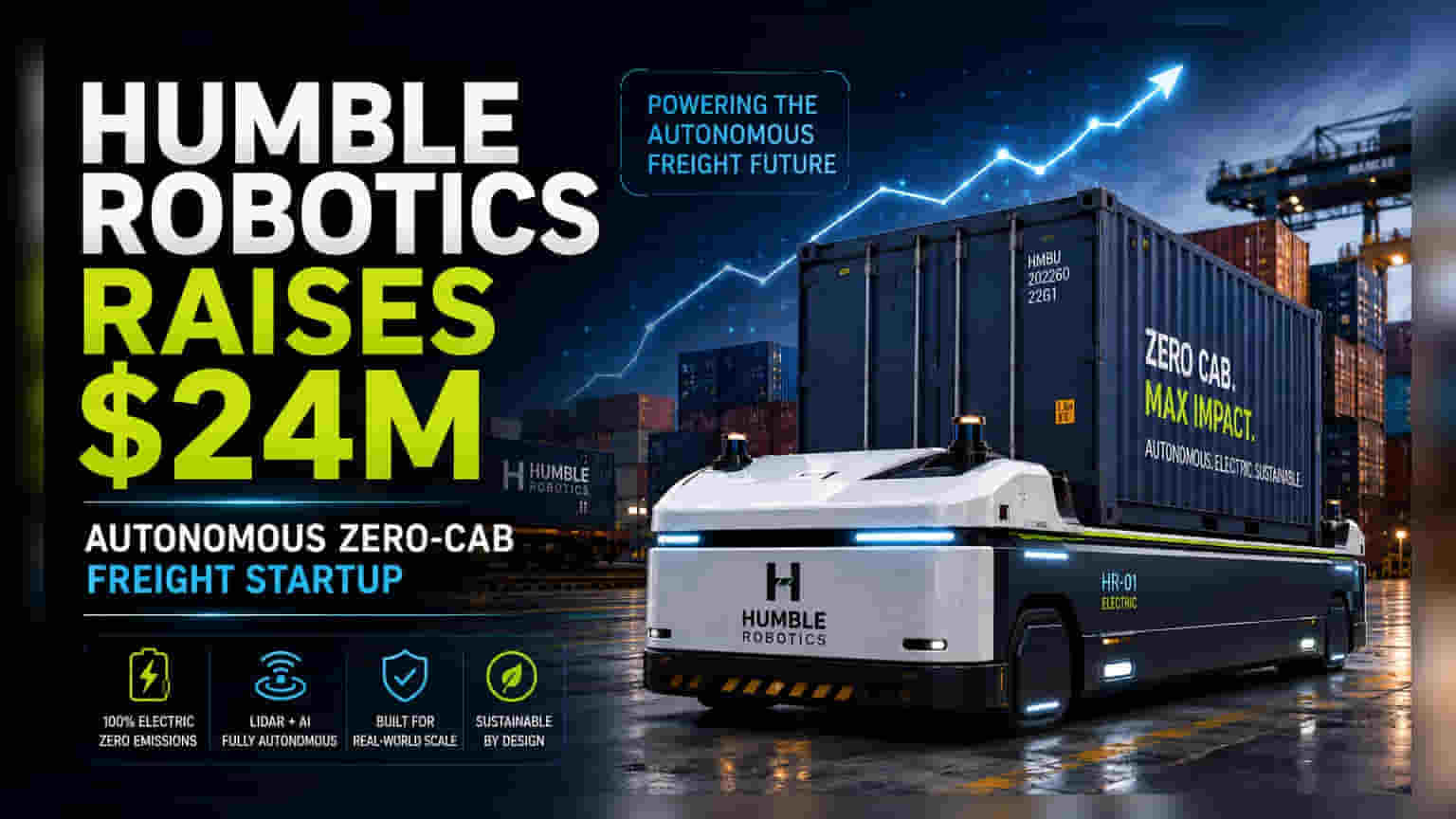
Humble Robotics has secured $24 million in seed funding to develop fully autonomous, cabless electric freight haulers. Led by industry veteran Eyal Cohen, the startup aims to solve logistics inefficiencies by designing vehicles from the ground up. While the investment signals renewed interest in deep tech, the company faces significant hurdles regarding regulatory approval, infrastructure, and the high capital demands of the autonomous vehicle sector.
What Happened
Humble Robotics, a San Francisco-based startup, has officially emerged from stealth mode after securing $24 million in seed funding. The round was led by Eclipse Capital with participation from Energy Impact Partners and others. Founded by Eyal Cohen, a veteran of the autonomous vehicle industry with experience at companies like Otto, Uber, and Waabi, Humble Robotics is focused on building fully autonomous, electric, and cabless freight haulers. The company intends to use the capital to accelerate vehicle development, expand its autonomy stack, and launch initial pilot projects.
Why This Matters For The Logistics Sector
The autonomous trucking industry has long sought to address chronic issues like driver shortages, fuel cost volatility, and rising operational expenses. Unlike many existing approaches that involve retrofitting traditional trucks with autonomous software, Humble Robotics is taking a "clean-sheet" design approach. By eliminating the driver's cab entirely, the company aims to reduce vehicle weight and improve payload capacity. The "Humble Hauler" is designed as a universal platform for dock-to-dock logistics in controlled environments such as warehouses, railyards, and seaports, utilizing vision-language-action (VLA) models for decision-making.
The Business Reality Check
While the technology promises efficiency, the autonomous trucking sector remains capital-intensive and faces a complex path to widespread commercialization. Many previous attempts in this space have struggled with the "valley of death"—the difficulty of scaling from pilot programs to profitable, reliable, and safe commercial operations.
Developing a vehicle that can navigate complex real-world logistics scenarios without a human safety driver onboard creates significant engineering and regulatory challenges. Autonomous trucking firms must navigate a patchwork of state and federal regulations that vary significantly, and in the event of an accident, liability frameworks remain complex. Furthermore, the reliance on electric charging infrastructure at logistics hubs means the company’s success is partially tied to the broader build-out of commercial EV support systems.
Competitive Landscape
The autonomous freight market remains highly competitive, with established players like Aurora, Kodiak Robotics, and Daimler Truck (working with partners like Torc Robotics) already testing on public roads. Humble Robotics distinguishes its strategy by focusing on a specific vehicle architecture—cabless and electric—rather than just the software layer. Investors and industry observers will be watching whether this hardware-first strategy can achieve the necessary unit economics and safety certification required to scale beyond niche environments like ports and industrial yards.
What Investors Should Track Next
For those following the autonomous trucking sector, the key monitorables will be the startup's ability to clear regulatory hurdles for its cabless design, the success of its initial pilot deployments, and its ability to manage cash flow given the high capital requirement of manufacturing and software development. Furthermore, any strategic partnerships with logistics operators or retailers will be critical signals of commercial viability in a crowded market.