 Whalesbook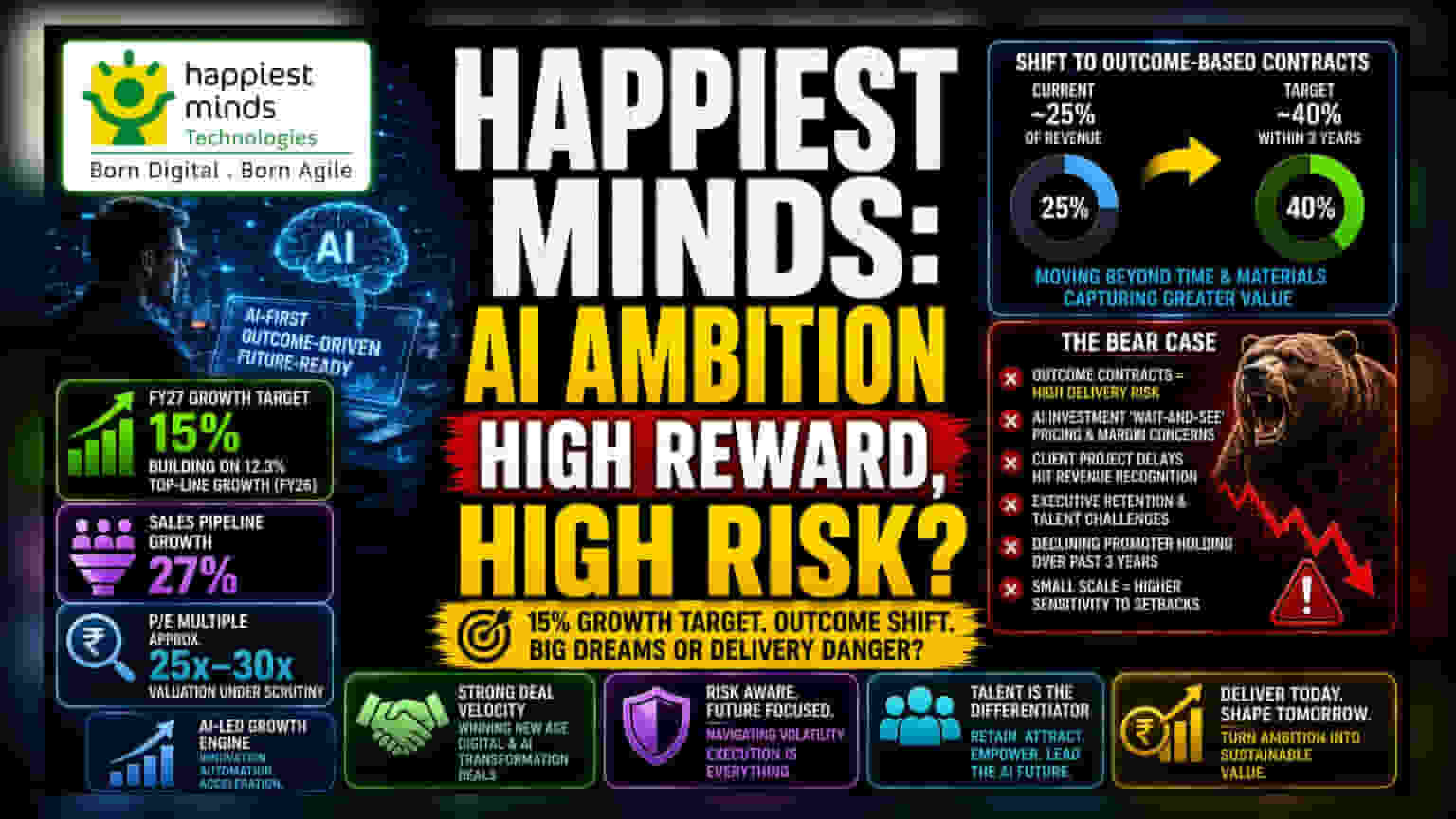


The Valuation and Growth Dynamics
Happiest Minds Technologies has set an ambitious internal target of 15% growth for FY27, building on a fiscal year that saw 12.3% top-line expansion. Despite this optimism, the company faces a complex market environment; its stock has contended with significant volatility over the past year, trading at a P/E multiple of approximately 25x–30x. The company's reliance on high-growth, high-risk AI segments contrasts with more stable, traditional IT service competitors, placing its valuation under scrutiny as it seeks to justify its premium through consistent deal-win velocity.
Scaling the AI-First Framework
The core of the company's forward-looking strategy involves transforming its delivery architecture. By moving beyond traditional time-and-materials engagement models, leadership aims to capture more value through outcome-based contracts. Currently, non-time-and-material agreements comprise roughly 25% of revenue, with management projecting a trajectory toward 40% within three years. This shift is not merely contractual; it necessitates a fundamental recalibration of how the company manages operational delivery, as outcome-based models tie revenue recognition directly to measurable client business results rather than billable hours.
Sectoral Headwinds and Structural Risks
The industry is currently navigating a period of "wait-and-see" regarding Generative AI investment. While Happiest Minds reports a 27% increase in its sales pipeline, the broader IT sector remains cautious about the economics of AI consumption. Key concerns include the lack of standardized pricing frameworks for AI tools and potential margin compression if token consumption costs are not effectively optimized. Furthermore, unlike larger peers with diverse, multi-billion dollar portfolios, Happiest Minds’ smaller scale increases its sensitivity to individual client project delays, such as those that impacted its banking license revenue recognition in FY26.
The Forensic Bear Case
Investors remain wary of several structural risks. First, the transition to outcome-based contracts introduces higher delivery risk; should AI implementation fail to yield the promised business metrics, the company risks significant revenue erosion. Second, historical concerns regarding executive retention—specifically the firm's hard-line stance against "moonlighting," which resulted in employee terminations—could pose challenges for talent acquisition in a competitive, AI-specialized labor market. Additionally, with promoter holdings having seen a downward trend over the past three years, institutional investors are closely monitoring the firm's capital allocation and governance. Finally, the company's reliance on achieving its "aspirational" 15% target requires flawless execution in a macroeconomic environment where enterprise IT spending is being scrutinized with unprecedented intensity.