

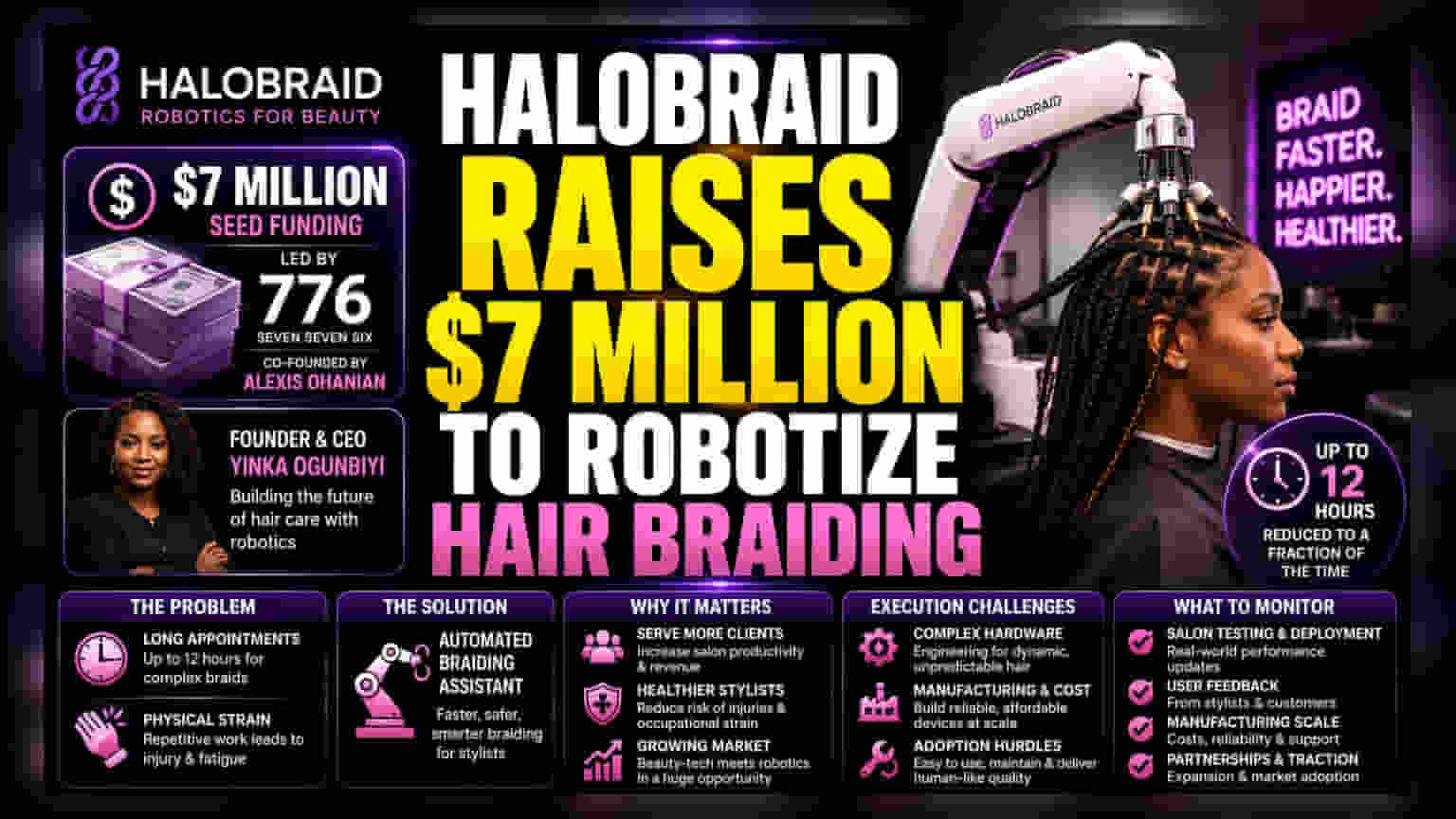
Robotics startup HaloBraid has secured $7 million in seed funding led by Seven Seven Six to develop an automated braiding assistant. The company aims to reduce the long, labor-intensive process of manual hair braiding, which can take up to 12 hours. The capital will support product development and salon partnerships, targeting a market where efficiency and stylist health are becoming key priorities.
What Happened
HaloBraid, a robotics startup focused on the beauty industry, has raised $7 million in a seed funding round. The investment was led by Seven Seven Six, the venture firm co-founded by Alexis Ohanian. The startup, led by founder Yinka Ogunbiyi, is building an automated braiding assistant. The core goal of the company is to use robotics to reduce the amount of time required to braid hair, a process that can currently take up to 12 hours for complex styles like knotless or box braids.
The Business Problem and Solution
The business model revolves around solving two specific issues in the hair care market: time and physical labor. For the client, long appointment times are a significant barrier. For the stylist, the repetitive, manual nature of braiding leads to occupational health risks, such as carpal tunnel syndrome and physical strain. By developing a device that can assist in the braiding process, the company aims to help stylists complete services faster. This could potentially allow salons to serve more clients daily, thereby improving their revenue generation capacity while reducing the physical toll on workers.
The Hardware Execution Challenge
While the market potential is clear, the transition from concept to a commercially viable product is difficult for hardware startups. Unlike software businesses, which can scale quickly with minimal physical assets, robotics companies must navigate complex manufacturing and quality control requirements. Hair is a dynamic, unpredictable material, which makes the robotics engineering behind such a device highly challenging.
Investors will likely watch how the company manages 'execution risk.' This includes the ability to build a machine that is safe for customers, reliable in a salon environment, and affordable enough for widespread adoption. If the maintenance, cleaning, and technical support requirements are too high, it could impact the business’s ability to gain traction in the competitive beauty industry.
Market Potential and Adoption
Beauty-tech is a growing space, and automating manual tasks has historically yielded efficiency gains in various sectors. However, adoption depends heavily on the 'stylist experience.' If the machine is slow to set up, requires complex training, or does not produce results that match the quality of human hands, salons may be hesitant to adopt the technology. The company’s focus on forming partnerships with salons will be a critical step in testing these dynamics in the real world.
What to Monitor Next
The company is currently in the product development phase. Future updates to track include the successful testing and deployment of the device in actual salon environments. Investors and observers will also monitor the company's ability to manufacture the device at scale and manage the costs associated with hardware production. Another key factor will be user feedback—both from professional stylists regarding ease of use and from customers regarding the comfort and quality of the final braid.