 Whalesbook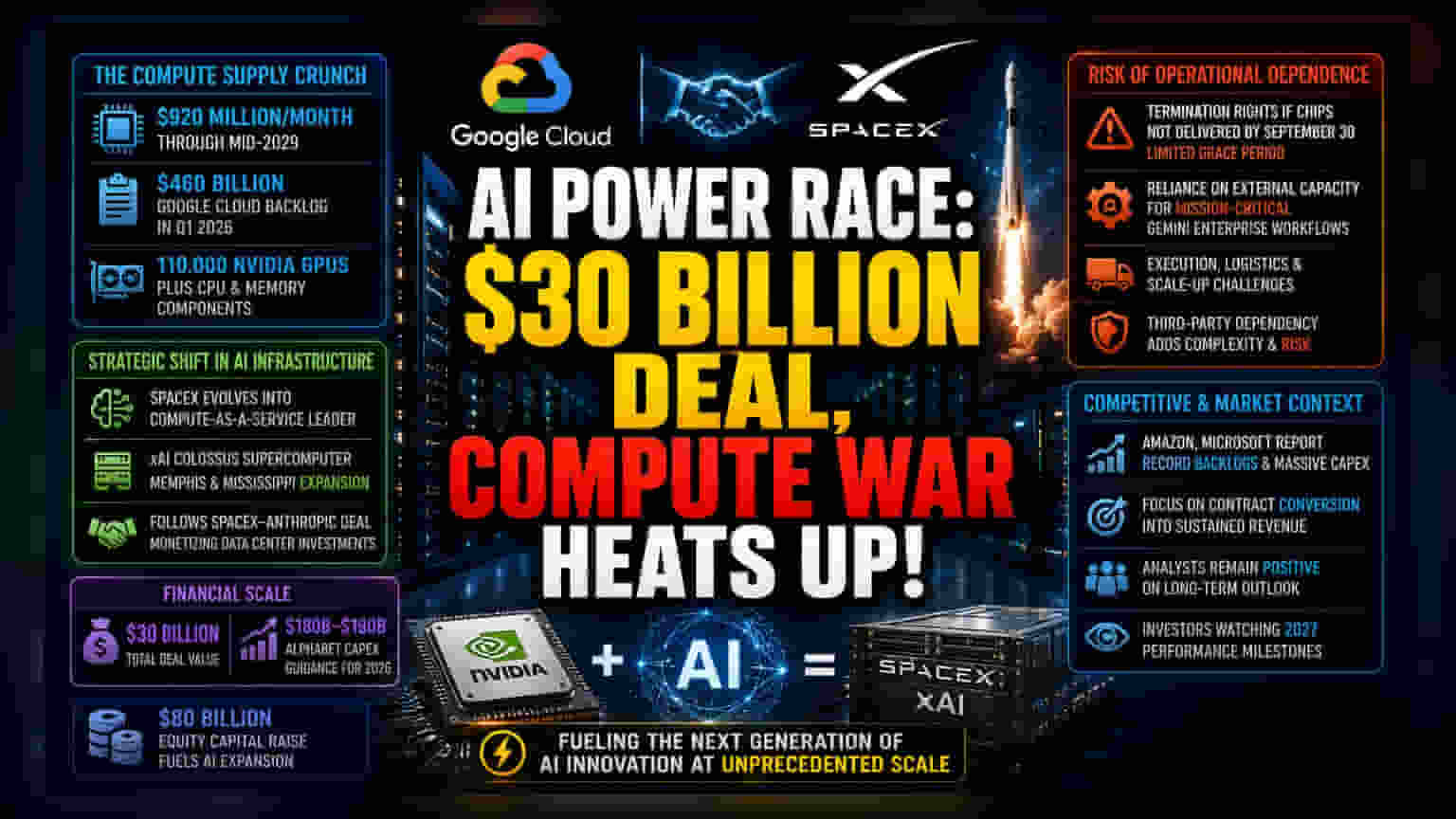


The Compute Supply Crunch
Google’s commitment to spend approximately $920 million monthly through mid-2029 reflects an industry-wide pivot where access to specialized hardware has become the primary bottleneck to growth. With Google Cloud’s backlog reaching an unprecedented $460 billion in Q1 2026, the company is effectively utilizing SpaceX as a temporary bridge to maintain its momentum in the generative AI market. This agreement grants Google access to 110,000 Nvidia GPUs, along with essential CPU and memory components, a move designed to alleviate the pressure currently facing Google’s internal infrastructure buildouts.
Strategic Shift in AI Infrastructure
The financial terms of the deal—totaling $30 billion—coincide with SpaceX’s broader transformation into a compute-as-a-service provider. By integrating xAI’s supercomputing capabilities, including the Colossus infrastructure in Memphis and its ongoing expansion into Mississippi, SpaceX is positioning its AI arm as a vital layer of the modern tech stack. This deal follows a recent high-profile agreement between SpaceX and Anthropic, signaling a concentrated effort by Elon Musk’s aerospace conglomerate to monetize its massive data center investments ahead of its anticipated Nasdaq debut.
The Risk of Operational Dependence
While the deal secures necessary capacity, it introduces significant execution risks for Google. A strict termination clause allows Google to cancel the contract if SpaceX fails to provide the contracted Nvidia chip access by September 30, with only a limited grace period. Beyond the logistical hurdles, this reliance on an external provider for mission-critical Gemini Enterprise workflows underscores the intensifying tension between Alphabet’s massive capital expenditure program—which targets $180 billion to $190 billion in 2026—and the immediate, real-world constraints of hardware availability.
Competitive and Market Context
Google’s aggressive spending, bolstered by its recent $80 billion equity capital raise, reflects a broader sector trend where profitability is increasingly tethered to the successful scaling of AI clusters. As competitors like Amazon and Microsoft continue to report record backlogs and similarly massive CapEx plans, the market is focusing on the conversion rate of these contracts into sustained revenue. While analysts maintain a positive long-term view, the dependency on third-party compute infrastructure providers like SpaceX introduces a layer of variable complexity that investors are carefully monitoring as they look toward 2027 performance milestones.