 Whalesbook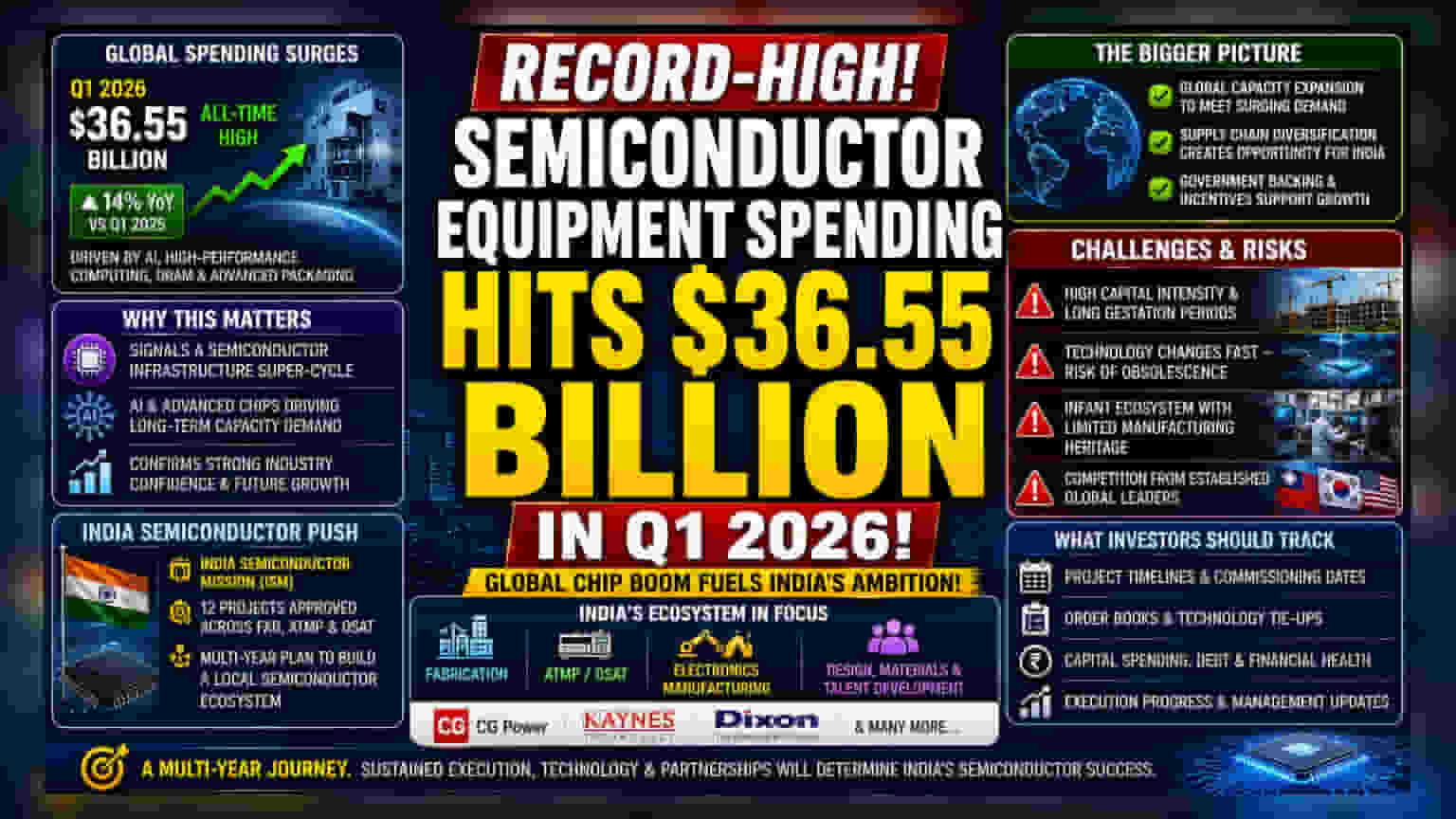


Global semiconductor equipment spending reached a record $36.55 billion in Q1 2026, up 14% as AI and high-end computing demand soar. For Indian investors, this surge reflects a massive global infrastructure build-out. India’s push through the Semiconductor Mission (ISM) aims to integrate the nation into this value chain. However, building chip fabs is capital-intensive with long gestation periods. Investors should track project execution and the progress of local firms entering the electronics and semiconductor ecosystem.
What Happened
Global spending on semiconductor manufacturing equipment hit an all-time high of $36.55 billion in the first quarter of 2026, according to industry data from SEMI. This represents a 14% increase compared to the same period last year. The surge is primarily driven by a massive, ongoing industry investment to expand chip manufacturing capacity, largely fueled by the relentless demand for artificial intelligence, high-end computing, DRAM memory, and advanced packaging technologies.
Why This Matters For Investors
This record-breaking spending indicates that the global semiconductor industry is in the middle of a significant infrastructure super-cycle. Semiconductor companies worldwide are spending heavily to upgrade factories and build new facilities to meet the future demand for AI chips and other advanced electronics. For investors, this confirms that the global semiconductor industry is banking on long-term growth, despite potential cyclicality in demand.
For the Indian market, this global trend creates a specific context. As the world diversifies its chip manufacturing base to reduce dependency on specific regions, India is attempting to secure a place in the global supply chain. The government’s India Semiconductor Mission (ISM) has already approved 12 projects, covering fabrication, packaging, and assembly. This is part of a multi-year effort to build a local ecosystem for chip design, material science, and manufacturing.
The India Semiconductor Context
India’s strategy involves not just large-scale fabrication, but also expanding capabilities in assembly, testing, and packaging (ATMP/OSAT). Several Indian companies and joint ventures, including firms like CG Power, Kaynes Technology, and Dixon Technologies, are involved in or expanding into electronics manufacturing and semiconductor-related services.
While the government support through incentives is a supporting factor, India faces the challenge of starting from a base that lacks decades of established manufacturing heritage compared to hubs like Taiwan, South Korea, or the United States. Integrating into the global semiconductor value chain is a long-term goal that will require sustained investment, talent development, and reliable infrastructure.
Challenges And Risks
Investors must understand that semiconductor manufacturing is one of the most capital-intensive businesses in the world. Building a semiconductor fabrication plant, or 'fab,' requires billions of dollars in initial investment and several years before it begins commercial production. This introduces significant execution risk for the companies involved.
There is also the risk of technological obsolescence. Semiconductor technology changes rapidly, and new facilities must remain competitive to be profitable. Furthermore, India’s local semiconductor ecosystem is still in its infancy. Companies entering this space face stiff competition from well-established global giants that have already achieved economies of scale and possess deep proprietary knowledge. Investors should watch for project delays, cost overruns, and the ability of Indian companies to secure and maintain technology partnerships with global semiconductor leaders.
What Investors Should Track
For those following this sector, the most important monitorables are project timelines and actual commissioning dates for the approved projects under the India Semiconductor Mission. It is also useful to track the order books and technological tie-ups of Indian companies involved in the semiconductor and electronics supply chain. Keep an eye on management commentary regarding capital spending, debt levels, and the progress of their facility build-outs. Understanding that this is a multi-year development story, rather than a short-term trend, is crucial for maintaining a balanced perspective.