

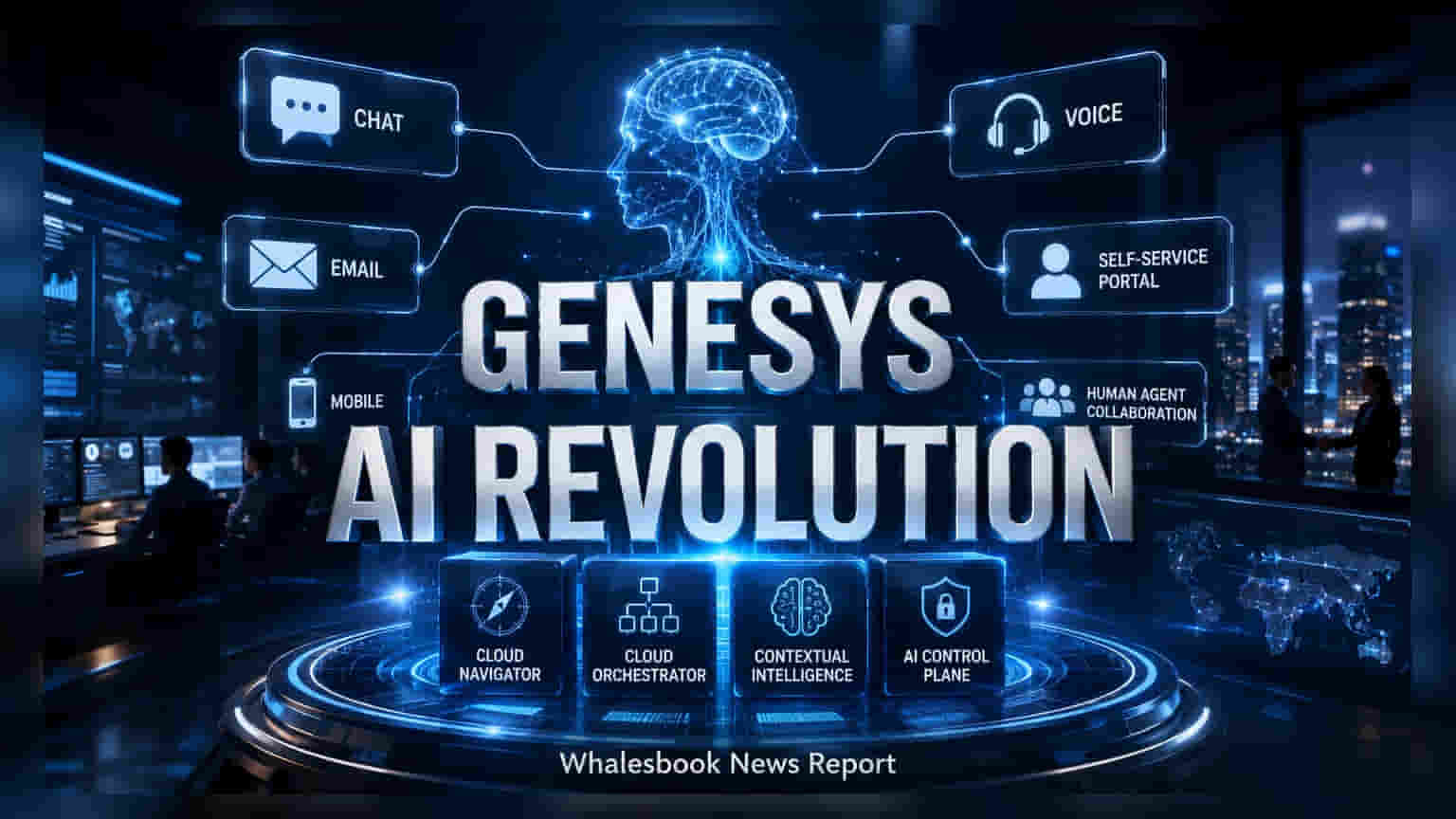
Global customer experience firm Genesys has launched an 'agentic' AI suite to automate complex service journeys, marking a pivot toward autonomous enterprise systems. Investors should note that this company is a private global entity and is distinct from the Indian-listed Genesys International Corporation Limited.
At its annual Xperience 2026 conference, global customer experience technology provider Genesys unveiled a new suite of AI tools designed to manage autonomous service interactions. The platform, which includes components such as Cloud Navigator, Cloud Orchestrator, Contextual Intelligence, and an AI Control Plane, aims to move beyond simple chatbots by allowing AI to reason, make decisions, and execute tasks across enterprise systems and human teams.
It is essential for Indian investors to distinguish this development from the Indian stock market. Genesys, the global company behind this AI suite, is a private international entity and is not the same as Genesys International Corporation Limited, which is a publicly traded mapping and geospatial services company listed on the NSE and BSE. Market participants should ensure they do not confuse these two separate organizations when reviewing technology-related headlines.
From a business perspective, the announcement highlights a broader shift in the customer service sector toward agentic AI. Unlike traditional AI that simply responds to queries, this new generation of technology is designed to understand user intent, maintain the history of an interaction, and orchestrate complex resolutions without constant human intervention. The company aims to consolidate these functions into a unified operating system to improve operational efficiency for large enterprises.
While the technology offers significant potential to reduce overhead and improve resolution rates, it also introduces specific challenges. The implementation of autonomous agents requires organizations to have robust existing processes; poorly documented workflows can lead to inefficient AI performance. Furthermore, governance remains a significant factor. Integrating AI into critical service layers creates potential risks regarding data security, the possibility of voice cloning or fraud, and the need for strict compliance guardrails to ensure customer interactions remain safe and accurate.
Industry analysts and market observers are watching how quickly enterprises adopt these autonomous models. For the CX sector, the focus is moving from simple automation to full-journey management. The general release of the initial components, such as Cloud Navigator, is scheduled for the fiscal quarter ending January 2027, with broader capabilities like Cloud Orchestrator expected to follow. Future updates from the sector will likely track the actual return on investment for businesses that deploy these autonomous tools and the impact on long-term operational efficiency.