

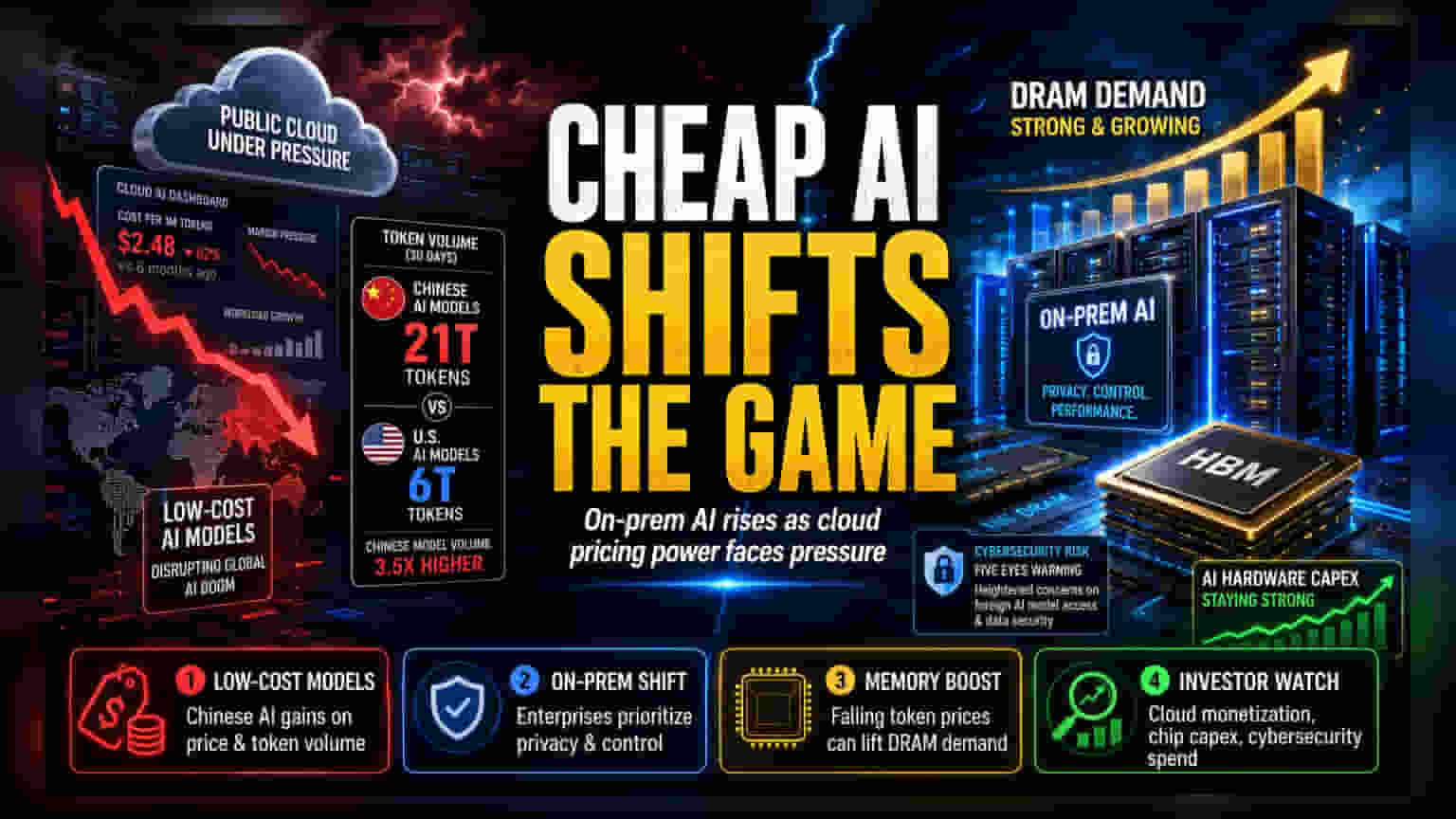
Research firm Jefferies warns that cheaper, high-capacity Chinese AI models are challenging U.S. tech giants, potentially disrupting the current AI investment trend. Enterprise clients are increasingly prioritizing data privacy and on-premise AI systems. This shift is steering market attention away from major cloud AI players toward semiconductor and hardware manufacturers like Samsung and SK Hynix.
What Happened
Recent reports from Jefferies indicate that the global artificial intelligence boom is facing a new hurdle: competition from cheaper, high-capacity Chinese AI models. While the market has been focused on U.S. leaders, Chinese models—such as the recently launched GLM-5.2—are gaining traction by offering lower costs per processed unit, or "token." Market data shows that Chinese models on platforms like OpenRouter processed over 21 trillion tokens in the week ending June 21, 2026, significantly outpacing the roughly 6 trillion tokens processed by top U.S. models during the same period.
The Shift to On-Premise AI
There is a growing trend among enterprise clients to move AI workloads away from public clouds and back to private, on-premise servers. This shift is largely driven by concerns over data privacy. New models, such as the GLM-5.2, are reportedly capable of handling complex tasks within these private settings without sacrificing quality. This move away from public cloud services could impact the revenue growth trajectory of major U.S. AI companies that rely on cloud subscriptions. For investors, this suggests that the "tokenmaxxing" phase—where companies simply chase the highest volume of AI processing—may be reaching a point of fatigue.
Impact on Tech Hardware
While software and cloud-based AI providers face potential disruption, the outlook for semiconductor and hardware manufacturers appears more stable. Jefferies notes that falling token prices are expected to drive up demand for DRAM, or dynamic random-access memory, which is a key component for these systems. This supports a positive outlook for the memory chip industry.
Major global players are responding to this trend with aggressive capital spending. For example, Taiwan Semiconductor Manufacturing Company (TSMC) is expected to increase its capital expenditure to $56 billion in 2026 and further to $65-70 billion in 2027. AI-related projects are already contributing 31% to the company's revenue this year. Global investment strategies are shifting toward hardware firms like SK Hynix, Kioxia, and Samsung Electronics to capitalize on this infrastructure demand.
Cybersecurity and Enterprise Risks
Beyond the competitive landscape, there is a rising focus on the security implications of advanced AI. The Five Eyes Alliance has issued warnings about the increased risk of cyberattacks facilitated by AI advancements. This development is forcing organizations to prioritize cybersecurity investments. For the Indian IT services sector, this trend is a key monitorable. As global enterprises shift toward on-premise AI deployments and tighten their digital security, companies that provide cybersecurity consulting, integration, and infrastructure management may see changes in demand patterns.
What Investors Should Track
Investors should keep an eye on how enterprise AI spending evolves over the coming quarters. The primary monitorables include the rate of adoption for on-premise versus public cloud AI solutions and the actual return on investment for major AI-heavy companies. Additionally, the capital expenditure plans of major semiconductor manufacturers, such as TSMC, remain a vital indicator of global tech industry health. Finally, any changes in global cybersecurity regulations or corporate spending patterns will influence the long-term prospects for IT services and hardware companies.