

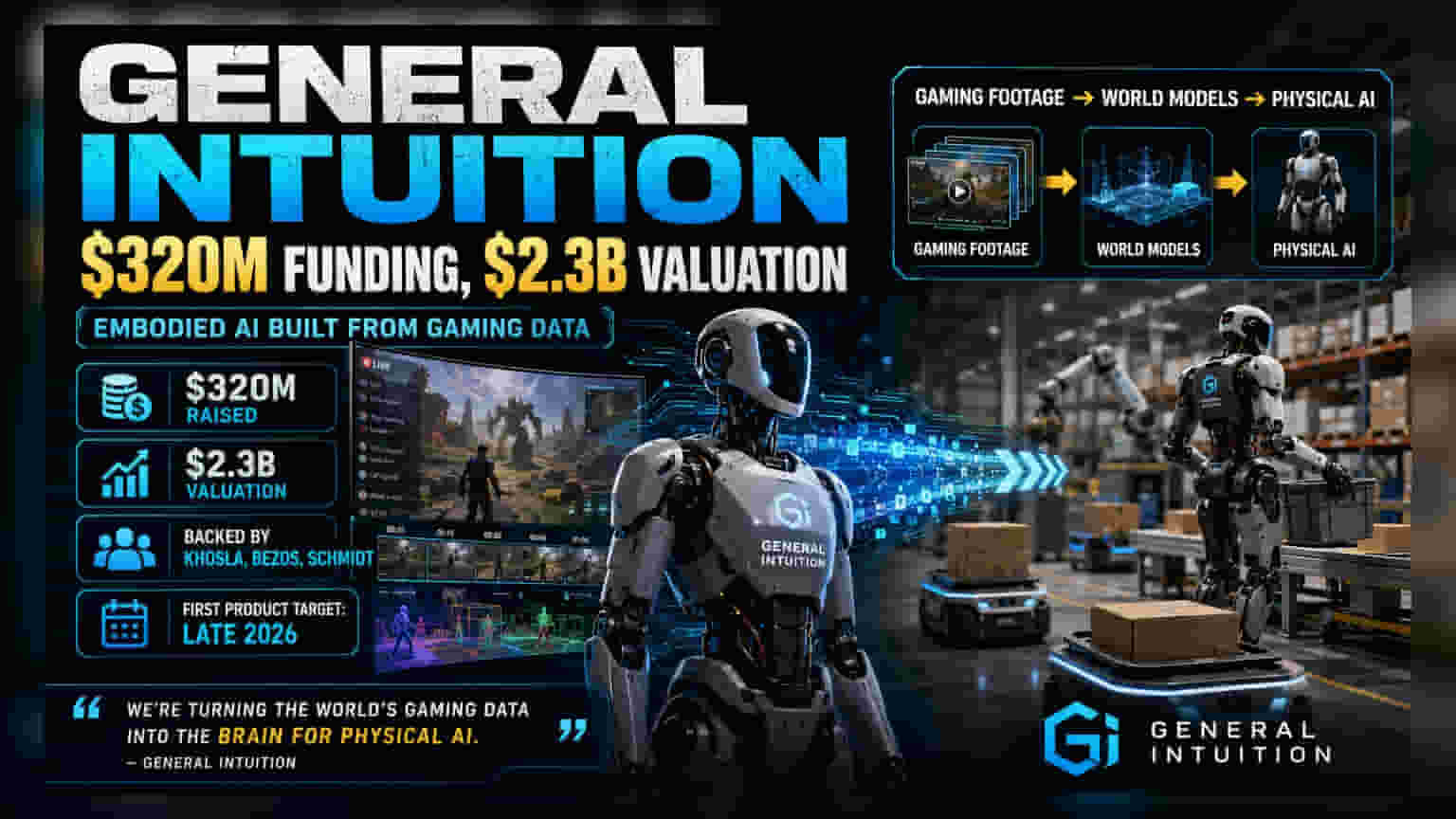
General Intuition, an AI startup spun out of the gaming platform Medal, has raised $320 million at a $2.3 billion valuation. The company uses billions of hours of video game footage to train 'embodied' AI agents designed to operate in the physical world. This investment highlights the growing investor appetite for AI models that can reason about space, time, and real-world interactions.
What Happened
General Intuition, a New York-based artificial intelligence laboratory, has secured $320 million in a new funding round, pushing its valuation to $2.3 billion. The round was led by Khosla Ventures, with participation from major investors including General Catalyst, Jeff Bezos, and Eric Schmidt. The startup, which spun out of the gaming video platform Medal only months ago, is focused on building 'embodied AI'—models that can physically navigate and interact with the real world, rather than just generating text or images.
The Business Logic: Gaming As A Training Ground
General Intuition's core strategy is to use video game footage as a high-quality data source. By analyzing billions of hours of gameplay from Medal—where users record and share their gaming moments—the company aims to teach AI agents to understand cause-and-effect, physics, and spatial reasoning. The company argues that traditional large language models, which are mostly text-based, lack the fundamental understanding of how the physical world works. By training on gameplay where human actions are embedded in the video, the startup hopes to create more reliable 'world models' that can be applied to physical robotics.
Why The Valuation And Interest Are High
This funding comes amid a record-breaking surge in venture capital flowing into robotics and embodied AI startups in 2026. Investors are increasingly shifting focus from general-purpose chatbots to specialized 'agentic' AI that can perform real-world tasks. The involvement of heavyweight investors like Jeff Bezos and Eric Schmidt underscores a broader bet on the infrastructure of physical AI. For investors, this marks a shift in the AI narrative: the value is moving from models that can write poetry or code to those that can potentially operate machines, drones, or autonomous systems.
Risks And Implementation Challenges
While the valuation reflects high optimism, the company faces significant execution hurdles. Scaling compute power is expensive, and translating virtual gameplay data into real-world physical performance is a notoriously difficult engineering challenge. Unlike software that runs on servers, physical robots operate in unpredictable environments where errors can lead to hardware damage or safety issues. Additionally, the company is still in the early stages of proving its technology outside of simulation, meaning the gap between research models and commercial deployment remains a key monitorable.
What Investors Should Track
Investors following the AI and robotics space should watch for three main triggers in the coming months. First, the company’s product timeline: it has pledged to launch its first commercial product by late 2026. Second, the ability to secure meaningful partnerships with hardware or industrial robotics companies, which would validate whether their gaming-trained models actually work in factories or warehouses. Finally, watch for broader sector trends in embodied AI; companies with unique 'data moats'—like General Intuition’s access to billions of hours of game footage—are often prioritized by investors in an increasingly crowded AI startup landscape.