 Whalesbook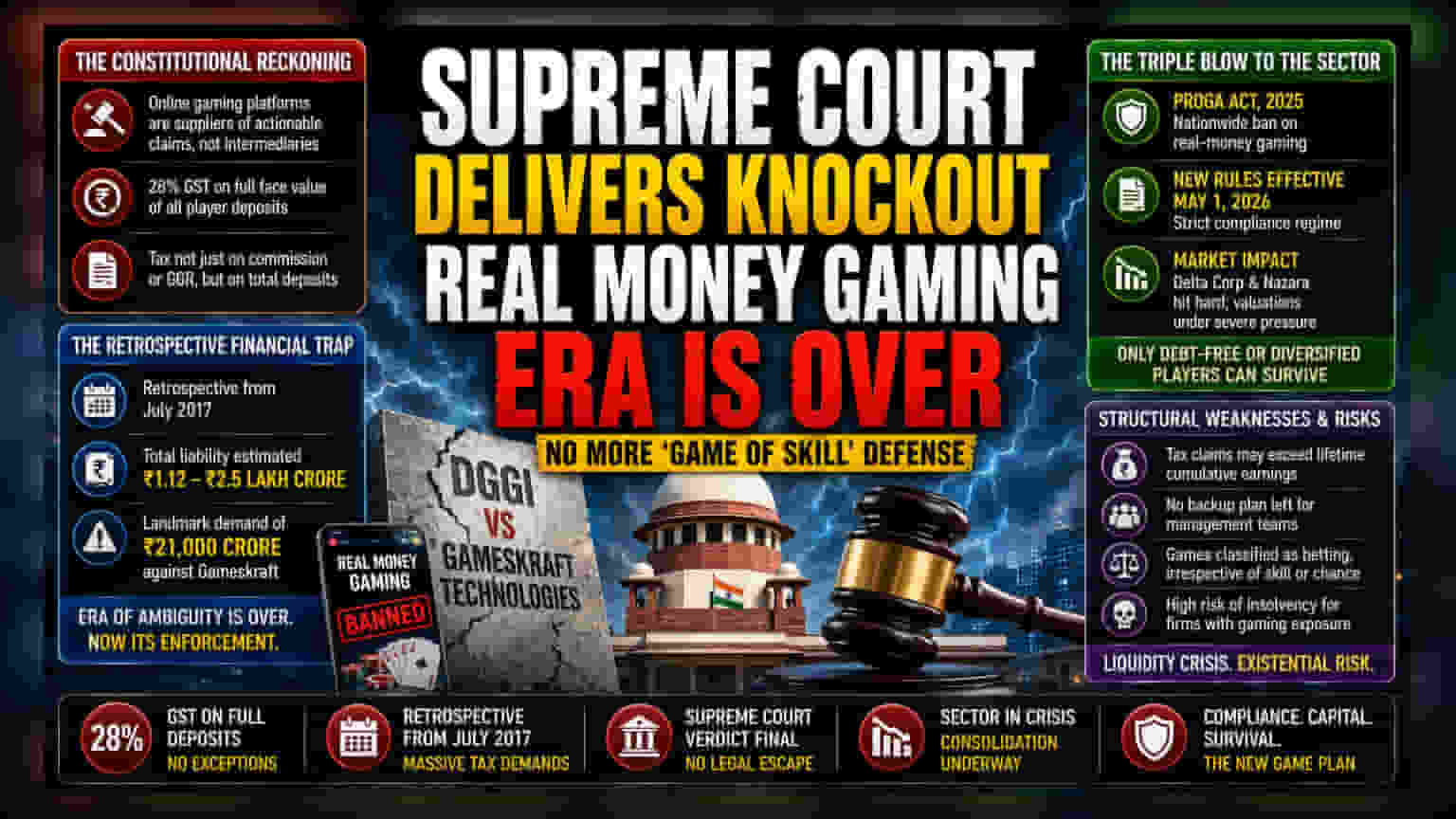


The Constitutional Reckoning
The recent verdict from the Supreme Court of India regarding the Directorate General of GST Intelligence (DGGI) versus Gameskraft Technologies marks a definitive end to the "game of skill" defense that once shielded the real-money gaming sector from aggressive taxation. By ruling that online gaming platforms act as suppliers of actionable claims rather than mere intermediaries, the court has effectively dismantled the industry’s primary business model. The judgment mandates that the 28% Goods and Services Tax (GST) must be applied to the full face value of all player deposits, rejecting the industry's longstanding practice of paying tax only on their service commission or Gross Gaming Revenue (GGR).
The Retrospective Financial Trap
Beyond the immediate tax hike, the court determined that the 2023 legislative amendments were clarificatory in nature, triggering a retrospective application of these tax demands back to July 2017. This interpretation exposes operators to a combined liability estimated between ₹1.12 lakh crore and ₹2.5 lakh crore. For platforms that operated on thin margins and relied on high-volume, low-fee models, this retroactive financial burden is mathematically impossible to sustain. The ruling effectively restores show-cause notices for thousands of crores, including the landmark ₹21,000 crore demand against Gameskraft, signaling that the era of regulatory ambiguity has been replaced by a period of rigorous enforcement and likely mass insolvency.
The Triple Blow to the Sector
This fiscal ruling does not exist in a vacuum; it arrives as the third strike against an industry already reeling from the Promotion and Regulation of Online Gaming Act (PROGA) of 2025 and new regulatory rules that came into force on May 1, 2026. These regulations impose a nationwide prohibition on real-money gaming activities, cementing the court's view that such operations are res extra commercium—outside the protection of commercial rights. With listed entities like Delta Corp and Nazara Technologies already experiencing significant market volatility and valuation compression, the sector is currently undergoing a painful consolidation where only firms with zero debt or massive non-gaming revenue diversification can feasibly survive.
Structural Weaknesses and Risk Factors
The survival of many platforms is now jeopardized by a liquidity crisis. Unlike traditional technology companies, these operators face an existential threat where the total tax claim may exceed their lifetime cumulative earnings. Management teams that previously banked on legal challenges to protect their business models are now left without a secondary defense strategy. Furthermore, the court’s classification of these games as betting, irrespective of whether they involve skill or chance, removes any remaining legal barriers to state-level prohibitions. As the government continues its drive to extract past liabilities, the risk of bankruptcy remains elevated for any firm with substantial exposure to the now-prohibited real-money gaming vertical.