

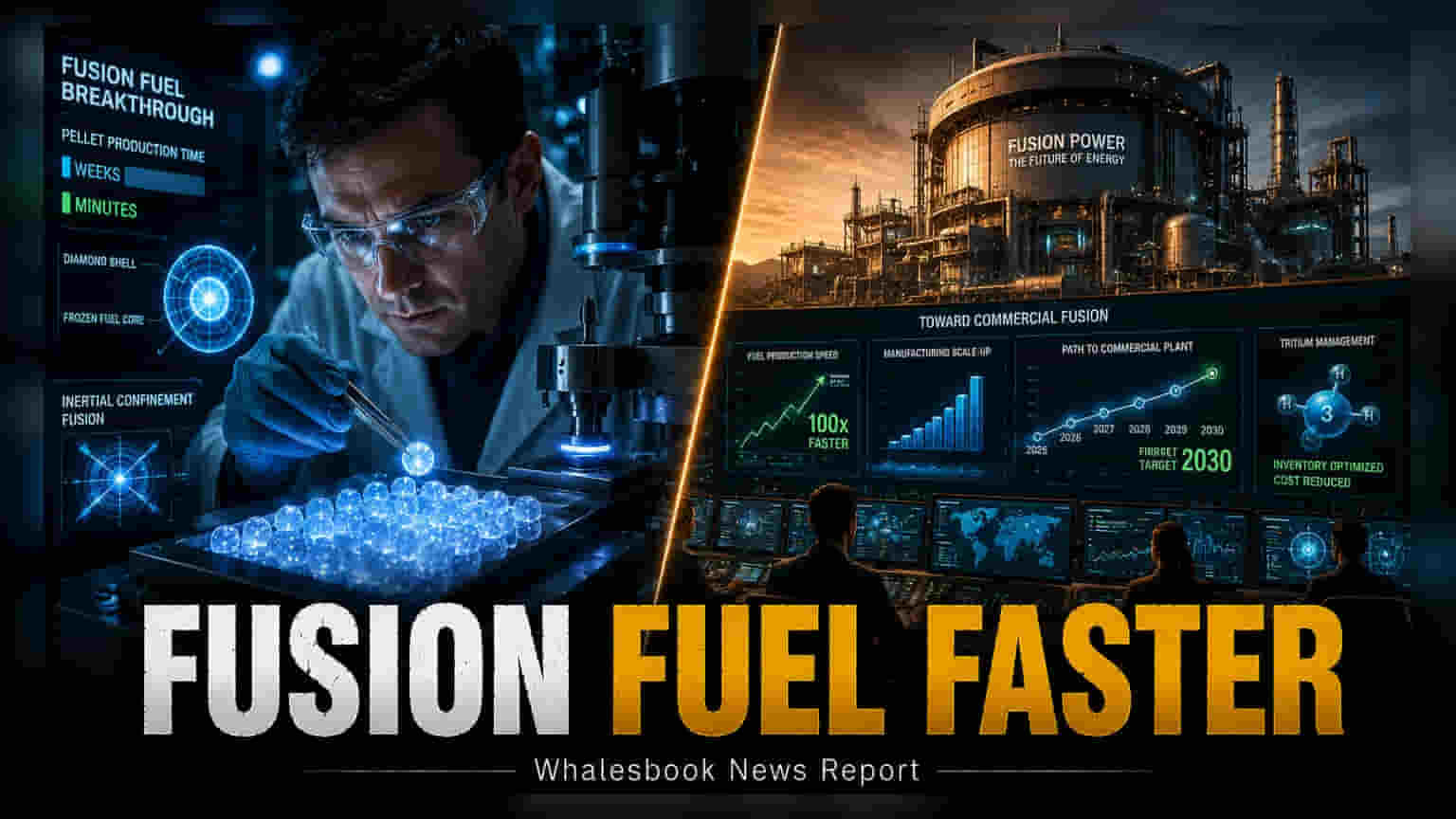
Inertia Enterprises, a U.S. fusion energy startup, has cut fuel pellet manufacturing time from days to minutes. This technical milestone supports its goal of commercializing fusion power. Investors should note that Inertia Enterprises is a private company and is not listed on Indian stock exchanges such as the NSE or BSE.
Inertia Enterprises, a fusion energy startup based in the United States, has announced a technological breakthrough in its fuel production process. The company stated that it can now manufacture critical fuel pellets in a matter of minutes, a significant improvement over the days or weeks previously required for similar production.
This development addresses a major bottleneck in the pursuit of commercial fusion power. Fuel pellets are essential for inertial confinement fusion, the process being commercialized by the firm. Previously, the complexity of creating these pellets—which require a spherical diamond shell to hold frozen hydrogen isotopes—made the process slow and costly. By accelerating this manufacturing speed, the company aims to move from laboratory-scale experiments toward the industrial volumes needed for a future power plant.
Indian investors should be aware that Inertia Enterprises is a private, venture-backed company based in the U.S. It is not listed on the National Stock Exchange (NSE) or the Bombay Stock Exchange (BSE). Any Indian companies with similar names are entirely unrelated to this venture. Because it is a private entity, there is no public stock to trade, and information on its financial performance is limited to private funding updates, such as its recent Series A round led by investors including Bessemer Venture Partners.
The technological challenge remains significant. Fusion energy is highly capital-intensive, requiring massive long-term investment before any potential revenue is generated. While Inertia Enterprises is targeting 2030 for the construction of its first power plant, the path to commercialization is filled with risks, including the need to prove that these pellets can hold up under real-world industrial conditions and the challenge of scaling up tritium production. Tritium is a rare and expensive material necessary for the fusion reaction, and reducing the time required to produce and process these pellets helps manage the inventory and storage requirements of this costly fuel.
Moving forward, the company intends to scale its manufacturing infrastructure and collaborate further with the National Ignition Facility. Investors interested in the broader fusion sector should track milestones related to the actual operational efficiency of these plants rather than just laboratory production speed. The next important steps for the company will involve proving that its manufacturing process can be replicated at a much larger scale, maintaining consistency in pellet quality, and meeting stringent safety and regulatory requirements for energy generation.