

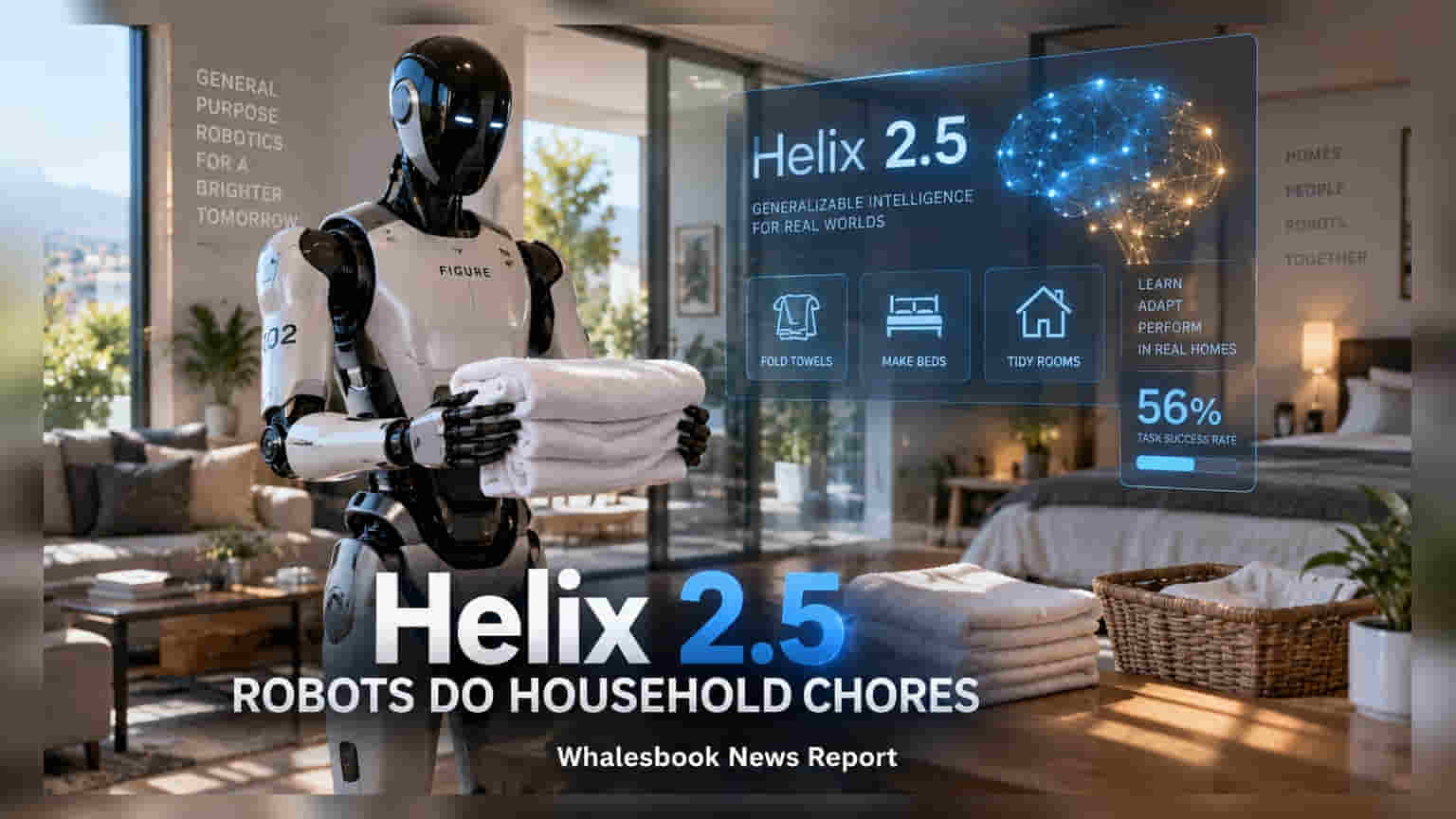
US-based Figure AI has tested its humanoid robots in 30 residential homes using the new Helix 2.5 neural network. The experiment achieved a 56 percent task success rate without site-specific training. For investors, this marks a shift in robotics from rigid, programmed tasks to adaptable AI, though significant challenges remain before these machines can reach commercial viability.
Figure, a US-based robotics firm, recently conducted a notable trial in California where its humanoid robots performed chores in 30 residential homes without any prior site-specific training. These robots were tasked with household activities such as folding towels, tidying rooms, and making beds. This test represents a push to move robotics beyond factory settings and into environments that were not previously mapped or programmed for the machine.
The intelligence driving these robots is a neural network model called Helix 2.5. Unlike traditional robotics, which typically require specific, often manual, programming for every new layout or task, the system uses a dataset called Index. This approach aims for what engineers call generalizable robotics, allowing the robot to apply learned behaviors to new, unfamiliar environments. In this test, the system achieved a 56 percent success rate in completing tasks from start to finish.
While this result shows progress, the 56 percent success rate also highlights the practical limitations of current technology. A failure rate of nearly 44 percent implies that these robots still require significant refinement before they can be considered reliable for commercial, unattended use. For investors and market observers, this indicates that while the field of general-purpose robotics is advancing, the technology remains in the experimental phase. There is a wide gap between proving a concept in 30 homes and achieving the consistency, safety, and operational speed required for real-world deployment in households or industrial settings.
This experiment is part of a broader shift in the global automation sector toward AI-driven hardware. Major tech firms and venture capital groups are increasingly investing in companies that aim to create machines capable of performing a variety of tasks, rather than single-purpose robots designed for one specific function. The ability of a robot to handle unstructured environments could eventually lower the costs of automation in supply chains, manufacturing, and eventually, service industries.
The next steps for this technology will likely involve improving the reliability of these systems and extending their operational uptime. Investors and sector analysts will continue to monitor how these companies manage battery life, processing speed, and the safety protocols required for machines to operate in human spaces. As the robotics sector evolves, the focus will remain on whether these firms can move from research-based demonstrations to scalable, cost-effective, and safe commercial products.