 Whalesbook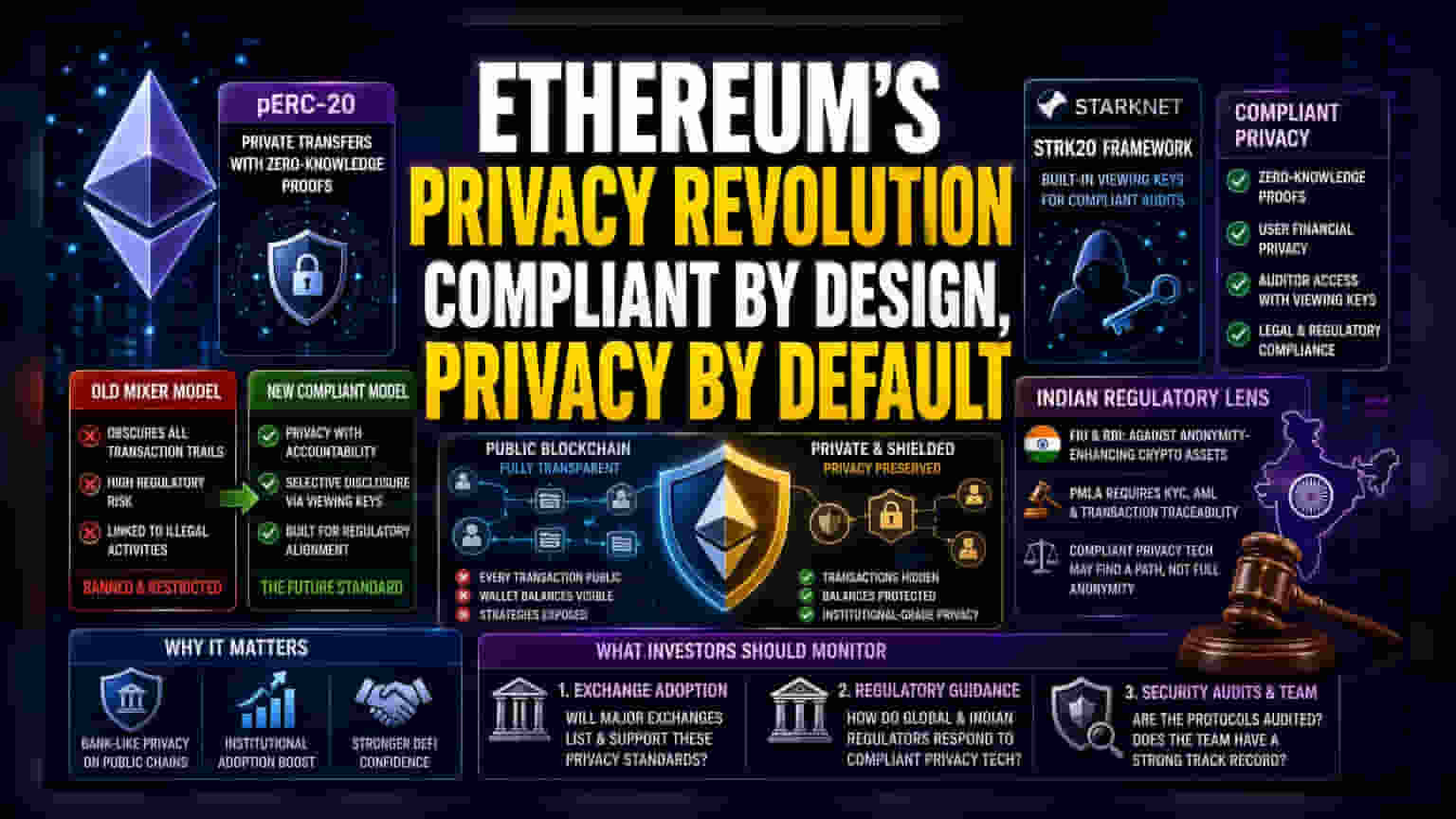


Ethereum developers are introducing new privacy frameworks like pERC-20 and Starknet’s STRK20, aiming to shield transaction data while maintaining auditability. For investors, this marks a potential shift toward 'compliant privacy,' though navigating the regulatory landscape remains a primary hurdle.
What Happened
The Ethereum ecosystem is witnessing a significant push toward financial privacy, with new initiatives like the pERC-20 proposal and Starknet’s STRK20 framework taking center stage. Unlike traditional public blockchains, where every transaction and wallet balance is visible to anyone, these new technologies use advanced cryptographic methods—specifically zero-knowledge proofs—to allow users to "shield" their balances and transaction details. The core goal is to enable private transfers and decentralized finance (DeFi) activities without stripping away the ability to audit transactions when required by law.
The Shift to 'Compliant Privacy'
Historically, privacy-focused crypto projects were often viewed with suspicion by regulators. Technologies that obscured the trail of money were frequently linked to money laundering or illicit activities, leading to bans and strict warnings from authorities globally. The new wave of Ethereum-based developments, particularly Starknet's STRK20, attempts to address this by moving away from the "mixer" model. Instead, these systems embed "viewing keys" directly into the asset's framework. This feature allows specific transaction history to be shared with auditors or regulators, provided there is a valid legal request. Developers argue that this creates a balance, giving users the financial privacy of a bank account while ensuring that bad actors cannot hide behind absolute anonymity.
The Indian Regulatory Context
For Indian investors, understanding the distinction between these new standards and traditional "privacy coins" is vital. The Financial Intelligence Unit (FIU) of India and other regulatory bodies have previously issued strong directives against anonymity-enhancing crypto assets, often flagging them as high-risk for money laundering. Regulations under the Prevention of Money Laundering Act (PMLA) require crypto service providers to maintain strict KYC and AML standards. Any asset that provides total, unbreakable anonymity is generally seen as a non-starter in the current Indian regulatory framework. Consequently, whether these new "compliant" privacy frameworks will be accepted by domestic platforms or face the same restrictions as older privacy tokens remains a critical question for the industry.
The Investor Perspective
Institutional investors have often cited the lack of privacy on public blockchains as a reason to stay away from DeFi, fearing that competitors could track their trading strategies or treasury activities in real-time. If these new standards gain traction, they could potentially bridge that gap, making decentralized finance more palatable for professional capital. However, the technology is still in its early stages. The primary risk is not just technical; it is regulatory. Even with compliance features built-in, regulators may adopt a "wait and see" approach. There is also the challenge of adoption—if major exchanges, which are the gatekeepers of liquidity, decide not to list these assets due to compliance fears, their utility could be severely limited.
What Investors Should Monitor
Investors tracking this space should watch for three key developments. First, look for how major centralized exchanges and liquidity providers react to tokens built on these privacy standards. Their support or rejection will be a major signal for the asset's viability. Second, observe the stance of global and local regulators; official guidance on "compliance-ready" privacy tech will carry more weight than industry claims. Finally, pay attention to the security audits of these protocols. As with any new cryptographic implementation, bugs or vulnerabilities could lead to significant financial loss, making code audits and the track record of the development teams essential monitorables for any interest in this sector.