

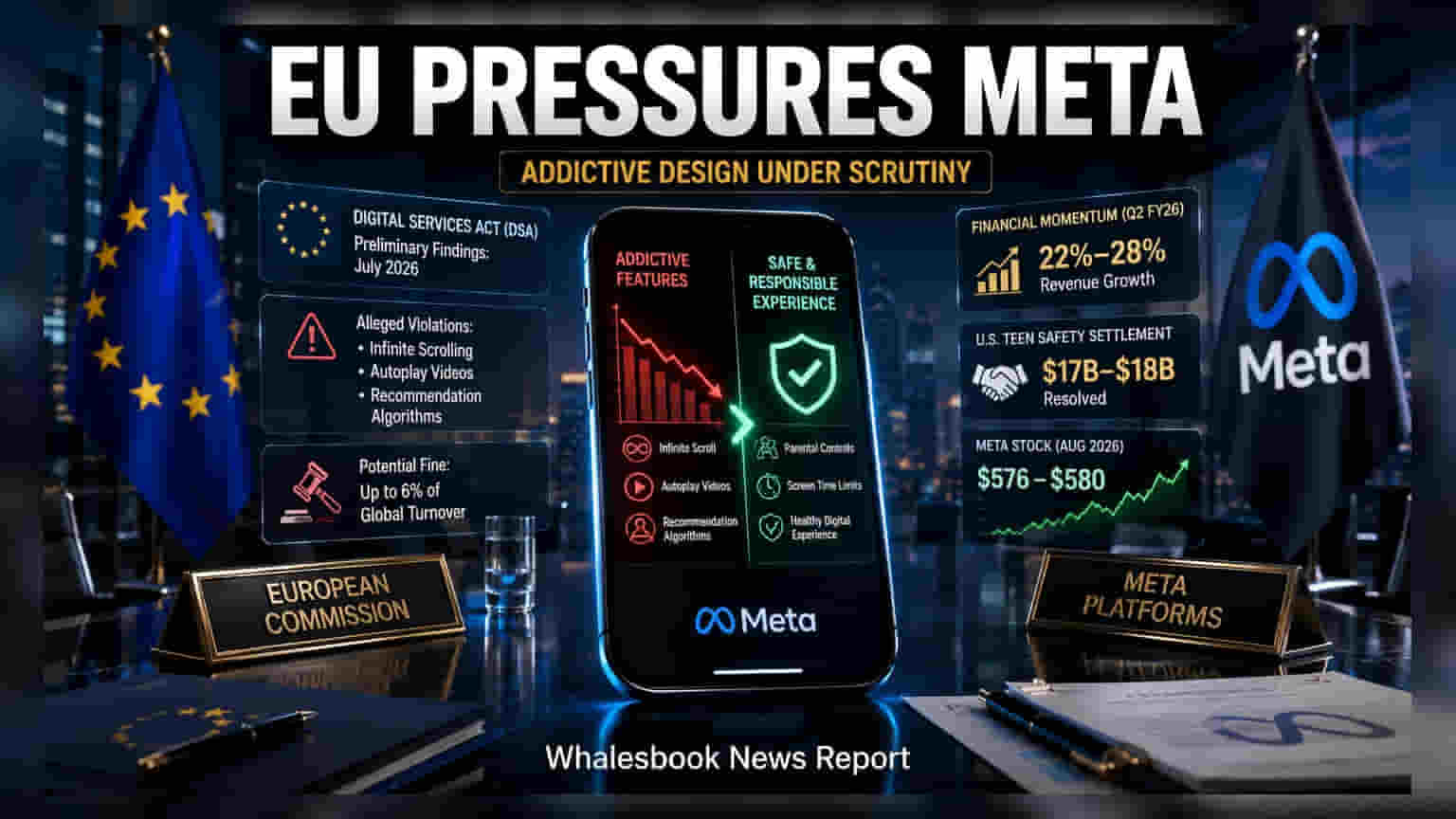
The European Commission has demanded Meta Platforms redesign Facebook and Instagram to reduce addictive design elements like infinite scrolling. This regulatory pressure carries a potential fine of up to 6% of global turnover. While the risk remains, the company’s stock has shown resilience following a massive $17-18 billion legal settlement in the U.S. that recently resolved major uncertainties.
The European Commission has intensified its scrutiny of Meta Platforms, demanding systemic changes to the architecture of Facebook and Instagram. Regulators allege that current interface features, such as infinite scrolling, autoplay videos, and certain recommendation algorithms, encourage addictive behavior. This push follows preliminary findings from July 2026, which flagged these design patterns as potential breaches of the Digital Services Act (DSA).
For investors, the primary concern lies in how these changes might affect Meta's core business model. The company generates revenue primarily through advertising, which relies heavily on user engagement metrics—essentially, how much time people spend on its platforms. If the EU mandates a reduction in time-spent features, it could influence engagement rates and, by extension, future advertising performance. However, the company has demonstrated strong financial momentum, reporting 22% to 28% revenue growth in its second-quarter results for 2026, largely driven by its AI-powered ad-targeting systems.
The Regulatory and Financial Stakes
The regulatory pressure under the Digital Services Act is significant because it grants the European Commission the authority to impose fines of up to 6% of a company’s worldwide annual turnover if violations are confirmed. While Meta remains in constructive dialogue with European authorities and has not yet accepted these allegations as final, the company is now faced with the task of proposing concrete commitments to modify its interface. The burden of proof is effectively on Meta to demonstrate that its platforms are not designed to exploit user behavior.
Despite these headwinds, the company’s stock has remained resilient, trading in the range of $576 to $580 as of late August 2026. A key factor supporting this stability is the recent resolution of a major U.S. teen safety case. Meta settled the dispute for an estimated $17 billion to $18 billion, a move that the market has largely viewed as a positive step in removing long-standing legal overhangs that previously clouded investor confidence.
What Investors Should Track Next
The current situation creates a balance between persistent regulatory risks in Europe and a cleaner legal balance sheet in the United States. Investors will be closely watching the specific proposals Meta submits to the European Commission. The core monitorable is whether the company can implement the required parental controls and screen-time management tools without significantly disrupting the user experience that drives its advertising revenue. As the company continues to focus on AI-driven growth, the ability to navigate these legislative mandates while maintaining operational efficiency will be the defining factor for its performance in the coming quarters.