

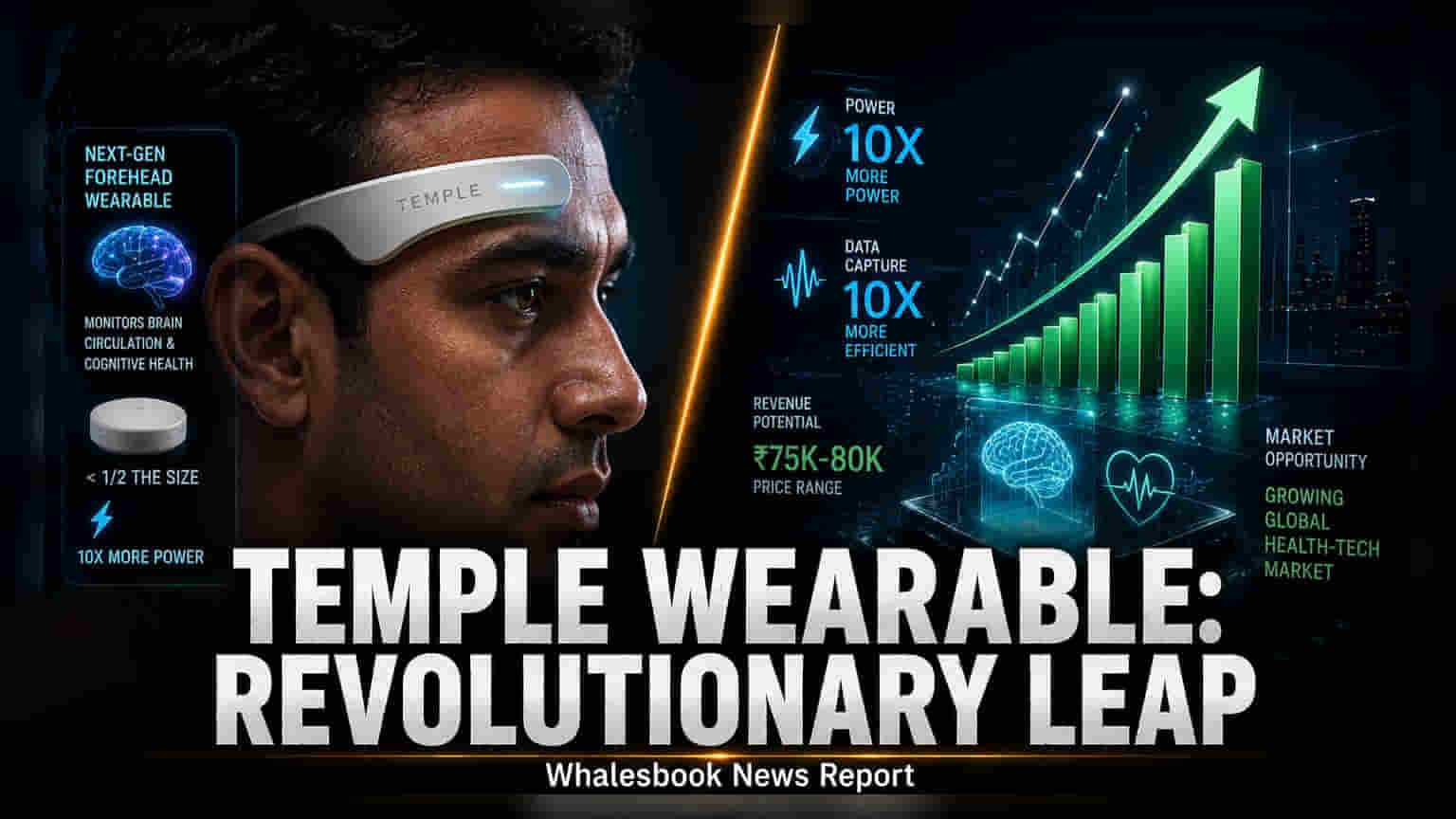
Deepinder Goyal’s private health-tech venture, Temple, has unveiled a significantly smaller and more powerful forehead-worn device, with a consumer launch expected by the end of 2026. With a valuation reaching approximately $375 million following recent secondary share sales, the company is preparing to enter a premium market segment. Although not a publicly traded stock, the project faces significant execution, regulatory, and adoption risks as it transitions from a high-end prototype to a commercial product.
Temple, the private health-tech startup founded by Zomato’s Deepinder Goyal, has announced a significant redesign of its forehead-worn health tracker. The new iteration is described as less than half the size of the previous model, with the company claiming a tenfold increase in power. This development marks a transition from experimental prototypes to a device intended for wider consumer release by the end of 2026. Unlike standard smartwatches that focus on notifications and general fitness, Temple’s device is designed specifically to capture physiological signals linked to brain circulation and cognitive function.
The venture operates as a private entity and is separate from publicly listed companies like Zomato. Despite its early-stage status, the company has attracted significant capital. Following a $54 million funding round in February 2026 at a $190 million valuation, Temple’s valuation climbed to roughly $375 million after subsequent secondary share sales and liquidity programs for employees in July 2026. Backers include prominent investment firms such as Peak XV Partners, Steadview Capital, and Info Edge Ventures.
While the project has generated attention, the path to mass-market adoption is complex. The device is expected to be priced in a premium range between ₹75,000 and ₹80,000. This high price point places it in a niche category, requiring the company to prove significant value to consumers who are already accustomed to more affordable health-tracking alternatives. Furthermore, independent medical validation for the device’s specific health claims remains pending, which is a critical step for consumer trust and potential regulatory approval.
From a business perspective, the transition from designing a unique hardware prototype to large-scale manufacturing and distribution is a major challenge for any startup. Known as execution risk, this involves managing supply chains, ensuring quality control at scale, and achieving consistent battery and sensor performance in a device worn on the forehead. The company has already initiated a controlled rollout to a select group of users, including athletes, to gather real-world data and usage feedback.
The health-tech sector is also subject to evolving regulations. As the company moves toward a commercial launch, it may face increased scrutiny regarding how it handles sensitive physiological data and how it markets the device’s health benefits. Investors and industry observers will be watching the upcoming pre-order process, the actual delivery timeline, and whether the company can secure the necessary scientific backing to justify its premium positioning in a competitive and crowded wearable market.