

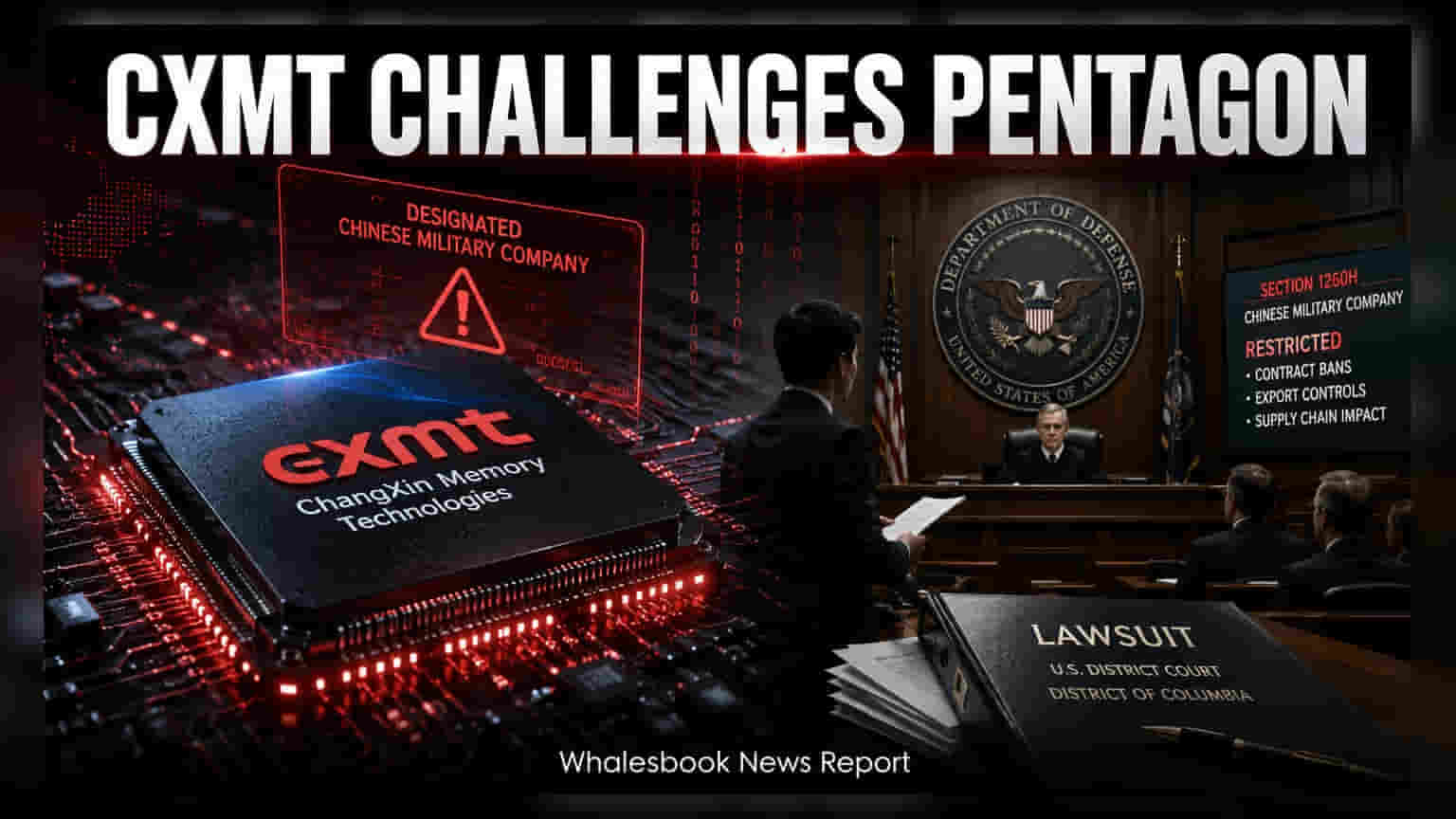
ChangXin Memory Technologies has launched a legal battle against the U.S. Department of Defense to challenge its classification as a Chinese military company. The lawsuit follows the chipmaker's recent July 2026 Shanghai stock market debut and robust financial results. While the company is not listed on Indian exchanges, the outcome of this case could impact global semiconductor supply chains and investor sentiment in the technology sector.
ChangXin Memory Technologies (CXMT) has initiated a lawsuit against the U.S. Department of Defense in the U.S. District Court for the District of Columbia. The company is formally challenging the Pentagon's decision to label it a "Chinese military company," a classification that subjects the firm to strict regulatory scrutiny and restricts its ability to secure certain U.S. government contracts. CXMT claims the designation is arbitrary and lacks a factual basis, arguing that its DRAM memory chips are manufactured exclusively for civilian applications such as smartphones, servers, and AI systems.
This legal challenge follows the semiconductor giant’s high-profile debut on the Shanghai Stock Exchange’s STAR Market on July 27, 2026. The company’s recent financial results highlight its rapid growth, with revenue for the first half of 2026 reaching 150.31 billion yuan and a reported net profit of 77.61 billion yuan. This massive growth has made CXMT a significant player in the memory chip industry, drawing attention from global analysts and investors.
The dispute centers on Section 1260H, a U.S. regulatory designation used to flag entities that the government believes may contribute to China's military capabilities. CXMT contends that its inclusion on this list has been handled inconsistently, citing previous instances where it was reportedly flagged and then removed by U.S. authorities before being reinstated. For the company, this label poses a material reputational risk and could complicate its long-term ambitions to expand its reach beyond the domestic market.
Although CXMT is not listed on Indian stock exchanges like the NSE or BSE, the litigation is relevant for investors tracking the global semiconductor sector. The memory chip market is notoriously cyclical, and the company's recent explosive growth is occurring against a backdrop of intense geopolitical friction between the U.S. and China. The lawsuit highlights the ongoing risks for semiconductor firms that rely on global technology access. Any escalation in trade restrictions or further blacklisting could affect supply chain stability and the broader tech environment, which often influences sentiment for technology-linked stocks in India and globally.
Investors are keeping an eye on the sustainability of the company's recent performance. As global memory chip capacity continues to increase, the potential for a margin squeeze or a cooling in market demand remains a key concern. Additionally, the company's heavy reliance on China’s goal of semiconductor self-sufficiency makes it sensitive to shifts in domestic policy and further international trade measures. The legal proceedings will be an important monitorable, as the final court ruling may set a precedent for how the U.S. Department of Defense manages such designations for other international technology entities.