

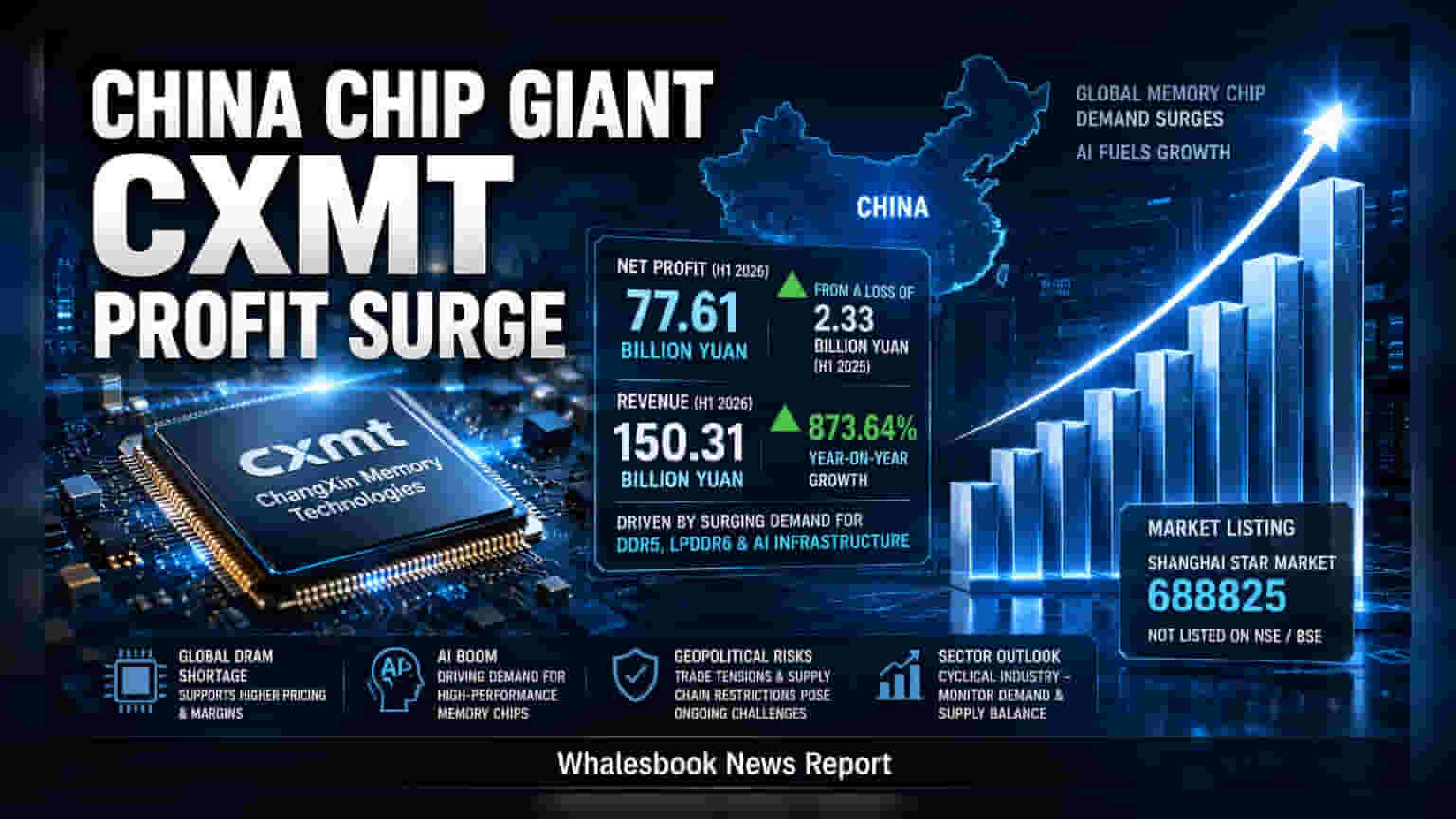
ChangXin Memory Technologies (CXMT) has swung to a net profit of 77.6 billion yuan for the first half of 2026, driven by an 873% revenue increase. This performance highlights the intense global demand for memory chips used in artificial intelligence. While the company is not listed on Indian exchanges, its rapid growth provides important signals about the health and trends of the global semiconductor market.
ChangXin Memory Technologies, a leading Chinese memory chip producer, has announced a significant financial turnaround for the first half of 2026. The company reported a net profit of 77.61 billion yuan, a stark recovery from the 2.33 billion yuan loss it recorded during the same period in 2025. This financial shift was supported by a massive 873.64% increase in revenue, which reached 150.31 billion yuan.
Drivers of the Performance
The explosive growth is largely attributed to the global boom in artificial intelligence and the resulting surge in demand for memory components. As AI technology continues to integrate into servers, mobile devices, and smart vehicles, the need for high-performance memory, such as DDR5 and LPDDR6 chips, has skyrocketed. A global shortage of dynamic random-access memory (DRAM) products has further allowed manufacturers like CXMT to command stronger pricing, boosting margins across the sector.
Global Market Context
For Indian investors, it is important to note that CXMT is listed on the Shanghai STAR Market (ticker: 688825) and is not available for direct trading on Indian exchanges like the NSE or BSE. However, the company’s performance serves as a key indicator for the global semiconductor sector. Investors tracking international tech stocks often watch memory chip producers to gauge demand levels for consumer electronics and server infrastructure. The strong results from CXMT may be seen as a reflection of the current supply-demand gap in the global memory market, which also impacts the earnings outlook for major global competitors like Samsung, SK Hynix, and Micron.
Potential Risks and Challenges
While the company’s recent growth is substantial, it faces several long-term risks. The semiconductor industry is historically cyclical, meaning that the current peak in demand and pricing may not last indefinitely. If the market becomes oversupplied, profit margins could come under pressure. Furthermore, the company explicitly highlighted the impact of geopolitical trade tensions in its regulatory filings. Escalating trade restrictions from various global powers pose a persistent threat to the company’s supply chain. Any future tightening of these regulations could disrupt the production of advanced chips, potentially affecting the company’s ability to maintain its current momentum.
Investors should monitor global semiconductor sector trends and supply chain updates as key indicators. The sustainability of this high-growth trajectory will likely depend on whether the global AI infrastructure demand continues to outpace the production capacity of memory chip manufacturers.