 Whalesbook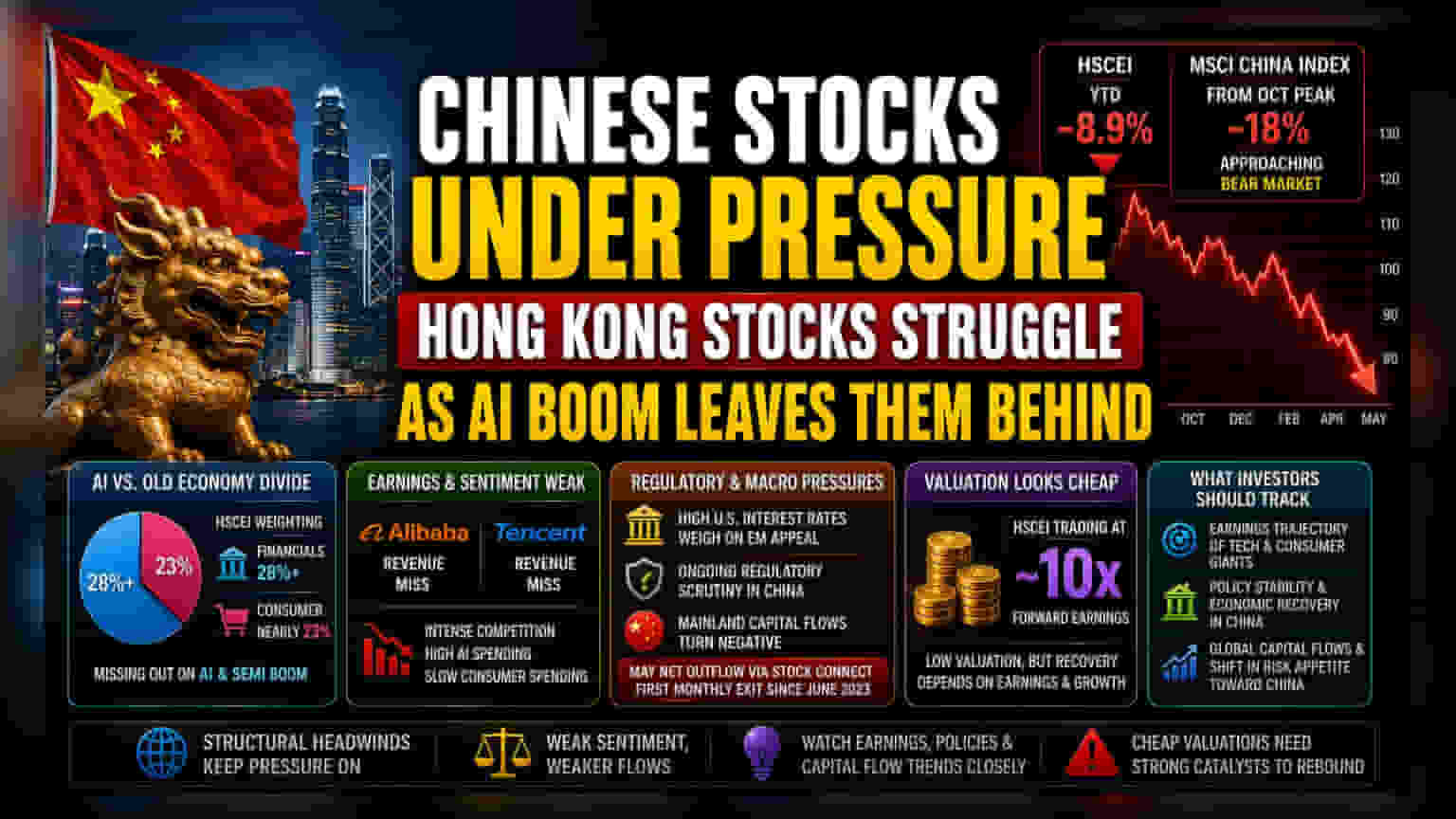


Hong Kong-listed Chinese stocks are falling as investors prioritize AI chipmakers in Taiwan and South Korea over traditional internet and consumer firms. Weak earnings, regulatory concerns, and capital outflows are putting pressure on the market.
What Happened
Hong Kong-listed Chinese stocks are facing a difficult period as the market landscape shifts. Major indices like the Hang Seng China Enterprises Index (HSCEI) have dropped nearly 9% so far this year. Meanwhile, the MSCI China Index is approaching bear market territory, having fallen roughly 18% from its October peak. This decline stands in sharp contrast to other Asian markets, particularly those with heavy exposure to the artificial intelligence and semiconductor sectors, which have attracted significant global capital.
The AI vs. Old Economy Divide
A primary reason for this divergence is the difference in index composition. While stock markets in Taiwan and South Korea are heavily weighted toward semiconductor companies—the current focus of global investor interest—Chinese indices are structured differently. Financial institutions make up more than 28% of the HSCEI, and consumer companies account for nearly 23%. Because these sectors are not direct beneficiaries of the AI boom, they are currently seeing less investor enthusiasm. This structural difference means that as global capital flows toward AI-related growth, traditional Chinese market benchmarks are being left behind.
Why Earnings and Sentiment Matter
Major internet and consumer companies, which were once the engines of growth for offshore Chinese equities, are struggling to maintain their momentum. Industry giants like Alibaba and Tencent reported recent quarterly results that missed revenue expectations. These companies are currently navigating a complex environment characterized by intense domestic competition, the need for heavy spending on artificial intelligence, and a general slowdown in consumer spending. When market leaders struggle to grow earnings, it places significant pressure on the overall index.
Regulatory and Macro Pressures
Beyond company-specific earnings, broader challenges are impacting investor confidence. There are ongoing concerns regarding the impact of sustained high interest rates in the United States, which can make emerging markets less attractive. Domestically, regulatory scrutiny remains a factor, with investors closely watching for policy updates from Beijing. Additionally, market data indicates that support from mainland Chinese investors is wavering. May saw a notable net outflow of capital through the stock connect program—a mechanism that allows mainland investors to trade Hong Kong-listed shares—marking the first monthly exit since June 2023.
The Valuation Question
Despite the recent decline, some market observers point to the valuation of Chinese equities. The HSCEI is trading at approximately 10 times forward earnings, which is relatively low compared to some other global benchmarks. Investors often look at lower valuations as a potential sign of value, though this alone does not guarantee a stock price recovery. Whether this cheap valuation can attract buyers will likely depend on improvements in the broader economic recovery and a clearer earnings outlook for major index constituents.
What Investors Should Track
As the situation unfolds, investors may monitor several key areas. First is the earnings trajectory of the major tech and consumer companies; consistent growth is needed to restore confidence. Second, the stability of regulatory policies and the economic environment in China will be critical for domestic consumption. Finally, market participants will likely watch for shifts in global capital flows and whether the valuation appeal of Chinese stocks becomes strong enough to counter the current lack of interest in "old economy" sectors.