

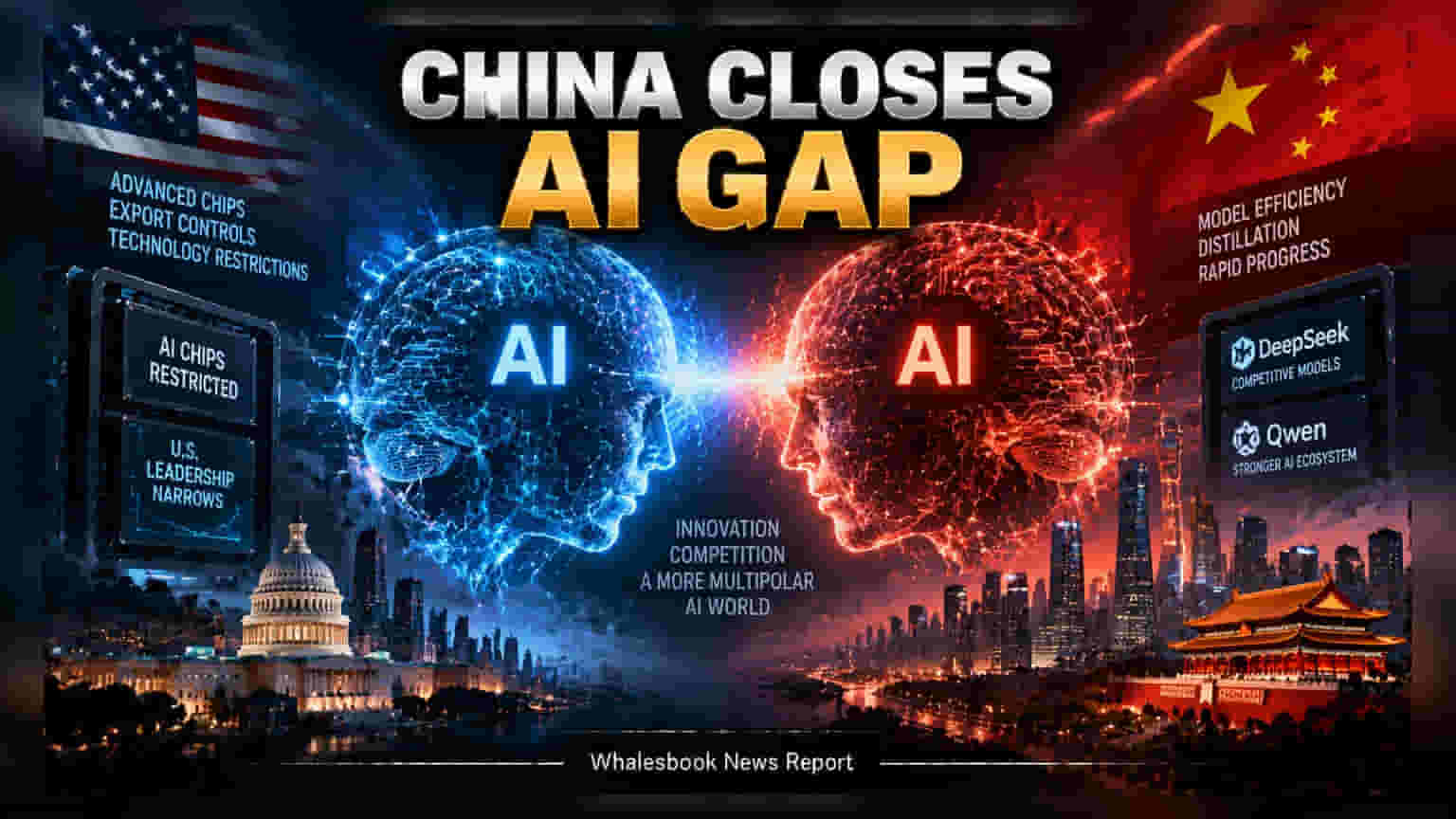
Artificial intelligence capabilities in China are catching up to US systems despite strict export controls on advanced chips. This shift suggests software innovation is becoming as vital as hardware, creating new geopolitical risks for global tech supply chains and investors monitoring the semiconductor sector.
The technological divide between the United States and China is shrinking, even as Washington continues to tighten restrictions on the export of advanced semiconductors. Data as of March 2026 shows that the performance gap between top-tier U.S. and Chinese artificial intelligence models has narrowed significantly, dropping to approximately 39 Arena points. This trend challenges the long-held assumption that export controls on hardware, such as advanced computing chips, would effectively halt China's progress in AI development.
Software Innovation Defying Restrictions
Chinese developers are increasingly compensating for hardware limitations by focusing on software efficiency. Startups and technology firms, including DeepSeek and Alibaba with its Qwen series, have released models that deliver results comparable to leading U.S. systems. This progress is largely driven by "model distillation"—a technique where developers train smaller, efficient models on the outputs of larger, powerful systems to achieve similar reasoning capabilities. By optimizing how these models process information, Chinese firms are proving that superior hardware is not the only path to creating powerful AI tools. This shift toward efficiency could change how global tech companies value hardware versus software capabilities in the long term.
Regulatory and Geopolitical Pressures
Washington remains focused on restricting the flow of technology to Chinese entities, with the U.S. Commerce Department actively working to close loopholes, including clarifying license requirements for exports to Chinese-headquartered companies operating in regions like Southeast Asia. For investors, these ongoing geopolitical tensions create significant uncertainty. The risk of secondary sanctions on countries or firms that facilitate the diversion of chips to China remains a key factor that could disrupt global supply chains and impact the performance of major semiconductor and tech stocks.
Meanwhile, China is navigating its own domestic challenges. The Ministry of State Security has emphasized the need to balance AI development with national security, pushing for a rigorous regulatory framework. While this drive for technological self-reliance encourages domestic innovation, it also subjects Chinese AI firms to strict oversight, which can complicate the operational landscape for investors looking at the region. Furthermore, China has officially rejected recent calls from global AI industry figures to slow down the development of frontier models, signaling that the race for supremacy will likely continue at its current pace.
Investors should monitor future diplomatic developments and policy shifts between the two nations, as any sudden changes in trade policy or export controls could have immediate effects on global tech valuations. The core monitorable remains the stability of the semiconductor supply chain and how effectively companies can maintain their competitive edge as the regulatory environment becomes more complex.