 Whalesbook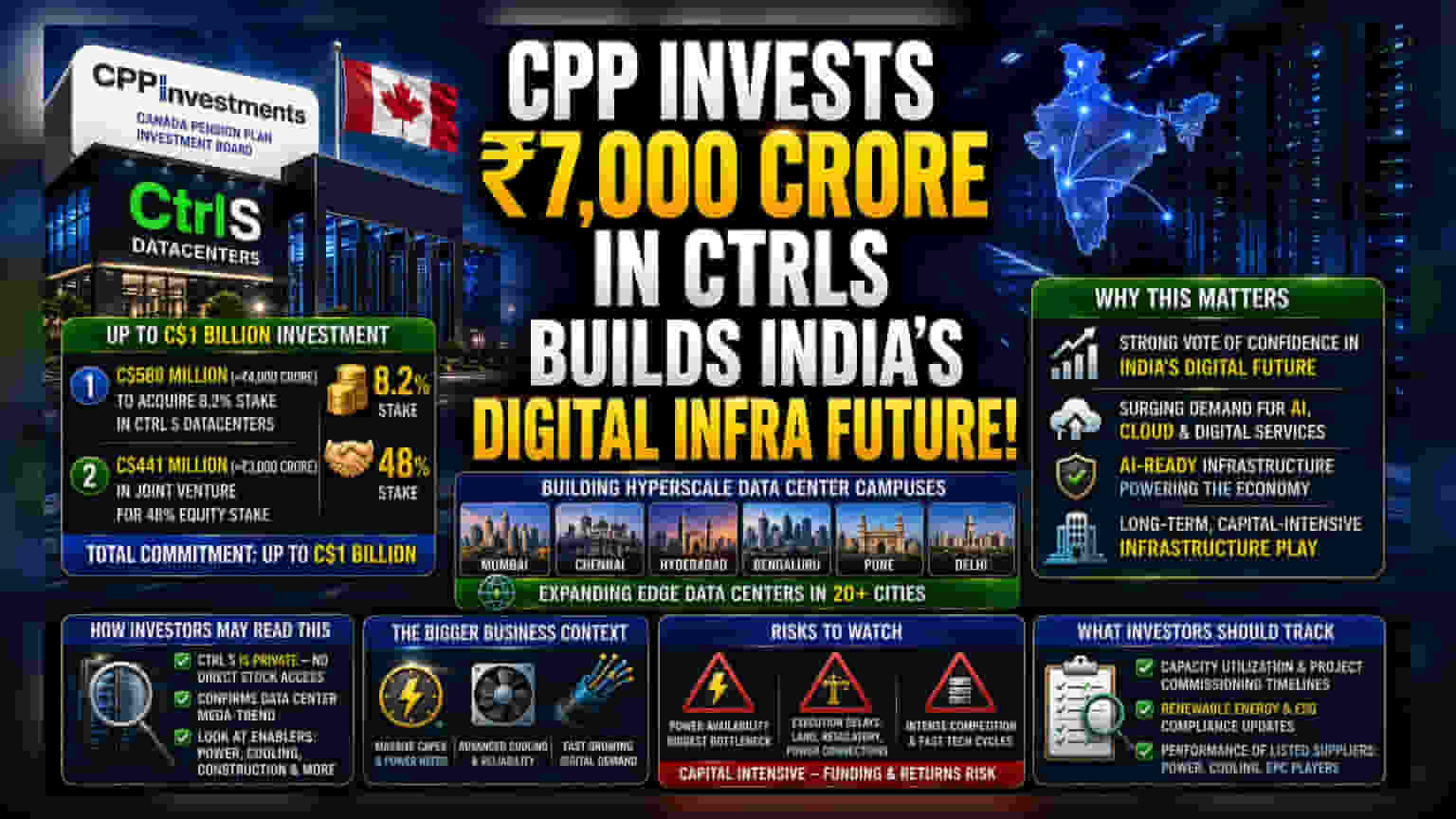


CPP Investments has committed ₹7,000 crore to CtrlS Datacenters via an equity stake and a new joint venture. This massive inflow highlights the explosive growth in India’s AI and cloud infrastructure sector. Since CtrlS remains a private company, retail investors should view this as a clear signal of the industry's massive expansion potential rather than a direct stock opportunity.
What Happened
Canada Pension Plan Investment Board (CPP Investments) has announced a significant strategic partnership with CtrlS Datacenters, committing up to C$1 billion (approximately ₹7,000 crore) to expand digital infrastructure in India. The deal is structured in two parts. First, the pension fund has invested C$588 million (about ₹4,000 crore) to acquire an 8.2% stake in the company. Second, both parties are forming a joint venture to build hyperscale data center campuses across the country, with CPP Investments contributing an additional C$441 million (about ₹3,000 crore) for a 48% equity stake in this new entity. The funds are earmarked for building facilities in major digital hubs like Mumbai, Chennai, Hyderabad, Bengaluru, Pune, and Delhi, alongside an expansion into edge data centers in 20 additional cities.
Why This Matters For Investors
This investment acts as a powerful vote of confidence in India’s digital future. Global investors like CPP Investments typically conduct deep due diligence on market potential before committing such large sums. Their entry into the Indian data center space validates the rapidly growing demand for AI, cloud computing, and digital storage. As India transitions toward becoming a global data hub, the need for 'AI-ready' infrastructure is skyrocketing. Large, always-on data centers are becoming the backbone of the economy, and this deal signals that smart money sees this sector as a long-term winner.
How Investors May Read This
It is important for investors to note that CtrlS Datacenters is currently a private, unlisted company. This means there is no direct way for retail investors to buy shares of CtrlS on the stock exchange. While this might be disappointing for those looking for a direct entry, the deal offers a valuable lesson in sectoral trends. It confirms that the data center theme is in a serious, capital-intensive growth phase. Investors often look for indirect plays in this space, such as companies involved in power, cooling equipment, or precision construction—components that are essential for the operation of these massive data centers. When looking at this sector, understand that it is not a 'get rich quick' industry but a long-term infrastructure play.
The Bigger Business Context
India's data center capacity is undergoing a massive transformation. With the country moving from a fragmented market to one dominated by large, integrated players, the shift is driven by the need for speed, reliability, and power. Data centers are not just empty buildings; they require massive, consistent power supplies, high-end cooling systems, and secure connectivity. The sector is seeing significant capex, with billions of rupees being spent on building out capacity to stay ahead of the demand from hyperscalers and enterprises. This partnership is just one of many that will be needed to meet India's projected capacity targets over the next few years.
What Could Go Wrong
Investing in or watching the data center sector comes with specific risks. The biggest challenge is execution. Building a data center is complex and prone to delays related to land acquisition, regulatory clearances, and securing high-voltage power connections. Power availability is arguably the biggest bottleneck; these centers require massive, uninterrupted electricity. Furthermore, the industry is highly competitive, and technology cycles are fast. An operator must constantly upgrade its facilities to stay 'AI-ready.' If a company fails to keep up with these technological demands, its facilities can quickly become obsolete, affecting their value and revenue generation. Investors should also be mindful that this is a capital-intensive business, meaning companies require continuous access to funding, which can put pressure on their balance sheets if growth does not materialize as expected.
What Investors Should Track
For those watching the sector, the key monitorables are capacity utilization rates and the timeline for commissioning new projects. Keep an eye on the broader digital infrastructure space for how these players secure renewable energy sources, as ESG compliance is becoming a non-negotiable part of these large-scale investments. Additionally, look for updates from listed companies that supply power, precision cooling, or engineering services to data center operators, as they are often the ones providing the 'picks and shovels' for this gold rush.