

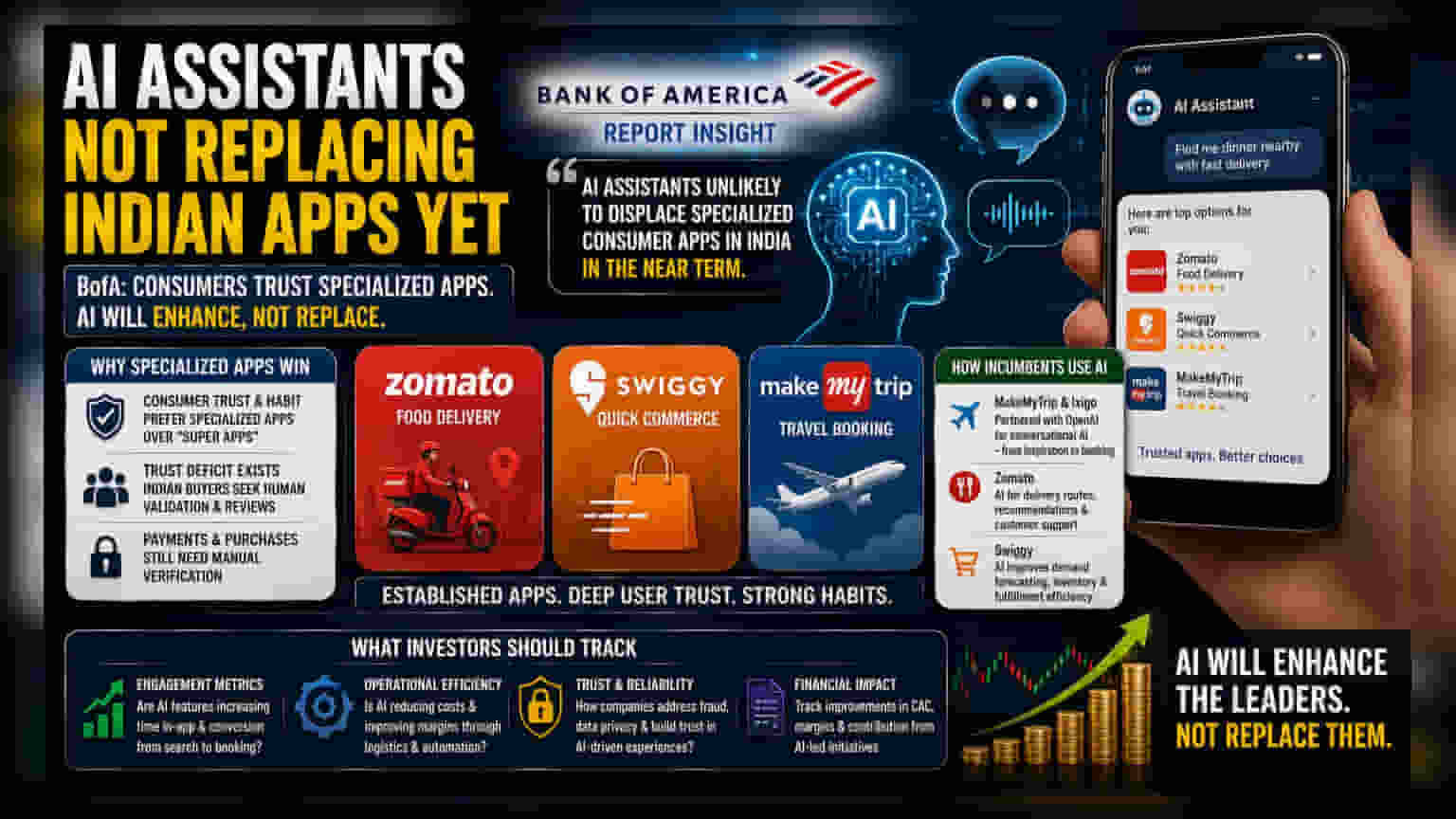
Bank of America notes that while India leads in AI adoption, specialized apps like Swiggy and Zomato will likely remain dominant over AI-only assistants. Trust barriers and deep-rooted consumer habits in India make full AI-driven automation difficult. Instead, established platforms are integrating AI to enhance services, suggesting AI acts more as an enabler for incumbents than a disruption risk.
What Happened
A recent report from Bank of America (BofA) indicates that artificial intelligence assistants are unlikely to replace specialized Indian consumer applications in the near term. Despite India having one of the world's most active populations for AI usage, the firm suggests that established vertical-specific platforms—such as Zomato for food delivery, MakeMyTrip for travel, and Swiggy for quick commerce—remain the consumer's preferred choice. BofA notes that while AI will be heavily used, it will be integrated into these existing platforms rather than acting as a standalone, automated replacement for them.
Why This Matters For Investors
For investors, this insight challenges the "AI disruption" narrative that has dominated tech discussions. If consumers continue to trust and use their familiar apps, then incumbents like Zomato, MakeMyTrip, and Ixigo are not necessarily at risk of being displaced by new, AI-only startups. Instead, these companies are positioning themselves as beneficiaries of AI by embedding it directly into their own user interfaces. This strategic integration helps them improve efficiency, personalize customer service, and deepen user engagement, effectively using AI to protect their market share rather than lose it.
The Consumer Trust and Habit Barrier
BofA highlights a significant nuance in the Indian market: the preference for specialized services over the "super-app" model. While markets like China saw rapid adoption of all-in-one super-apps, Indian consumers have historically stuck to dedicated applications for different tasks.
Furthermore, the report identifies a significant "trust deficit." Indian buyers are generally cautious about online transactions, often seeking human validation, reading multiple reviews, or consulting family before completing complex purchases. Entrusting an AI agent to handle payments or critical purchases without manual verification remains a hurdle that technology alone cannot yet overcome.
How Incumbents Are Using AI
Rather than fearing AI, leading Indian platforms have already begun incorporating it to refine their operations:
- MakeMyTrip and Ixigo: Both have formed partnerships with OpenAI to integrate advanced conversational AI. This allows users to move from "inspiration" (e.g., "where should I go for a weekend?") to booking within the same ecosystem, reducing the drop-off rate.
- Zomato: The company has utilized AI for years to optimize delivery routes, personalize restaurant recommendations, and automate customer support. In 2026, these efforts continue to drive operational efficiency and cost savings, allowing the platform to scale its delivery fleet and quick-commerce operations more effectively.
What Investors Should Track Next
Investors should monitor how effectively these companies convert AI integration into tangible financial metrics, such as reduced customer acquisition costs (CAC) or improved operating margins.
Key monitorables include:
- Engagement Metrics: Are AI-driven features like conversational search actually increasing the time spent in-app or the conversion rate of searches to bookings?
- Operational Efficiency: Watch for company commentary on how AI is impacting margins—specifically through reduced support costs or optimized logistics.
- Trust and Reliability: Track if the industry successfully addresses consumer concerns regarding fraud and data privacy as AI agents become more prevalent, as any failure here could dampen adoption rates.