

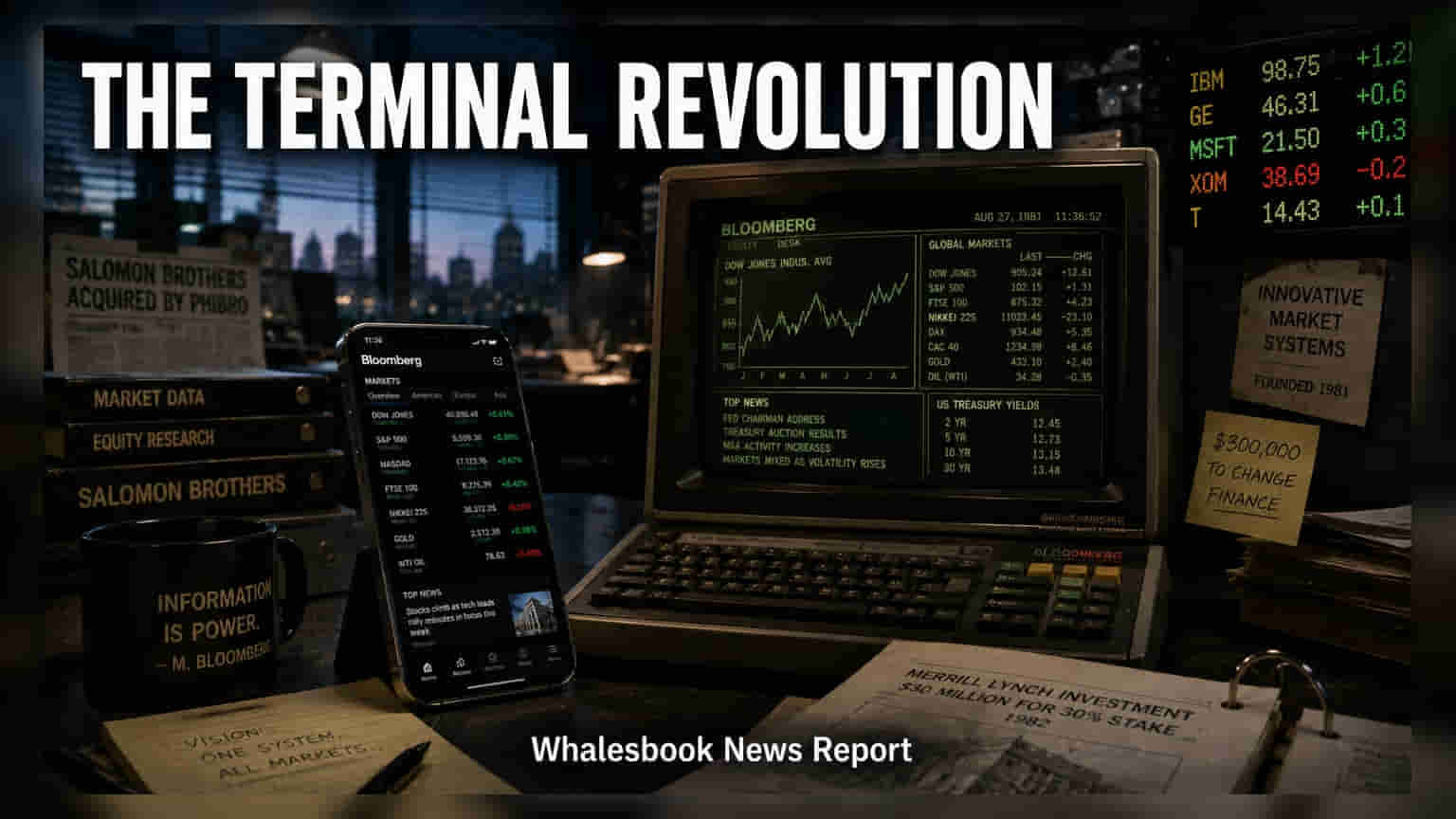
Michael Bloomberg founded his data empire after a 1981 layoff, creating the Bloomberg Terminal that transformed finance. While the firm is a dominant global player, it remains a privately held company. There is currently no stock to trade on public exchanges like the NSE or BSE, despite periodic market speculation regarding a potential future public offering.
The story of Bloomberg L.P. is a cornerstone of modern financial technology, beginning not in a boardroom, but in the aftermath of a career-ending layoff. In 1981, after the acquisition of investment bank Salomon Brothers by Phibro Corporation, Michael Bloomberg found himself at a crossroads after 15 years of service. He walked away with a $10 million partnership payout and a clear observation: financial professionals were struggling with slow, fragmented, and inefficient access to market data.
The Birth of a Terminal
Bloomberg used $300,000 of his own capital to launch Innovative Market Systems. His vision was to create a centralized platform that could aggregate data, analytics, and news in one place. The project gained critical momentum when Merrill Lynch agreed to test the prototype, eventually investing $30 million for a 30% stake in the firm. This partnership provided the institutional validation needed to scale the concept. By 1982, the system—the precursor to the modern Bloomberg Terminal—was operational. It fundamentally changed how traders worked, allowing them to interact with data streams rather than relying on phone calls and paper bulletins.
Private Ownership and Market Status
For investors following global financial news, it is important to clarify the company’s ownership structure. Despite its massive influence on global markets and daily use by institutional investors, Bloomberg L.P. remains a private company. It is not listed on the National Stock Exchange (NSE), the Bombay Stock Exchange (BSE), or any other public stock exchange.
Founder Michael Bloomberg retains a majority stake of approximately 88% in the company. While there have been recurring reports and market speculation regarding a potential Initial Public Offering (IPO), the company has not initiated any formal public listing process. As of August 2026, the company continues to operate as a private entity, and there is no public stock available for purchase by individual investors.
Competitive Landscape and Risks
Bloomberg L.P. operates in a high-stakes, competitive environment. Its core product, the Terminal, faces constant pressure from rivals such as LSEG (Refinitiv), FactSet, and S&P Global, as well as newer, AI-driven fintech solutions. The company’s heavy reliance on the Terminal for revenue makes it vulnerable to shifts in how financial data is consumed, particularly as automation and artificial intelligence reduce the cost and technical barriers for data access.
Furthermore, the firm must navigate a complex web of global regulations, including data privacy laws, environmental and social governance (ESG) reporting requirements, and AI governance standards. While the company maintains a dominant position in the industry, its status as a private, closely held firm means it is not subject to the same public disclosure requirements as its listed competitors. Investors tracking the financial services sector should understand that while Bloomberg influences market movements through its data and news, it is not an asset that can be directly traded on public markets.