

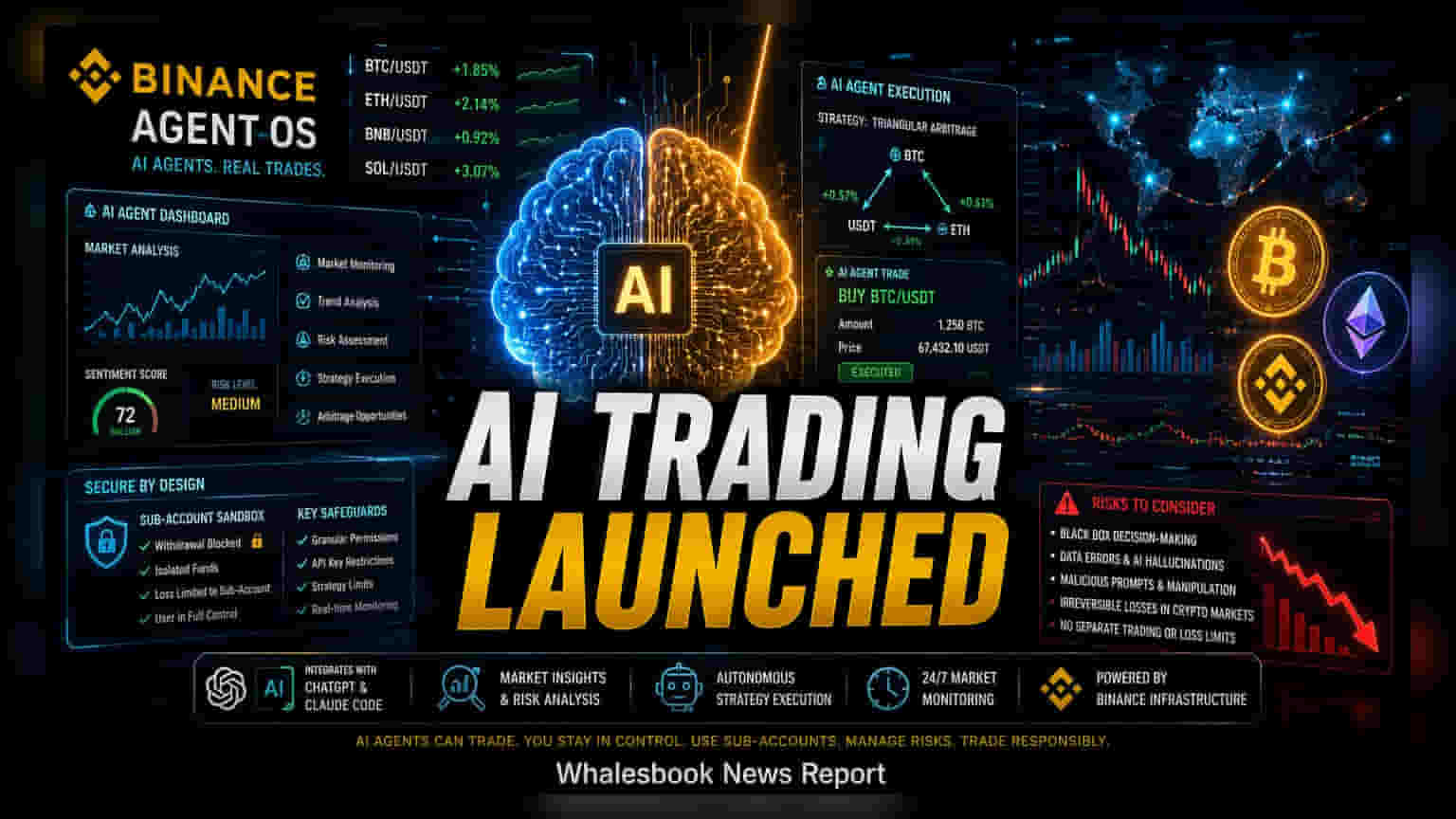
Binance has introduced 'Agent OS,' a platform allowing AI agents to perform autonomous trades on its exchange. While this enables new automation options, the company is using sub-accounts with restricted permissions to manage security. Users face significant risks regarding how these AI tools make decisions, as their reasoning remains external and not visible to the exchange.
Binance has unveiled Agent OS, a new platform designed to let artificial intelligence agents analyze market trends and execute trades directly on its cryptocurrency exchange. This rollout marks a shift toward integrating AI agents that can interact with the exchange's financial infrastructure, including wallets and transaction services.
The platform supports integration with popular AI tools like OpenAI’s ChatGPT and Anthropic’s Claude Code. Binance intends for this to be used not only for trading but also for tasks like market monitoring, risk analysis, and executing complex strategies such as arbitrage.
Security Measures and Sub-Accounts
Because this system grants AI agents access to funds, Binance is relying on user-controlled safeguards to manage risk. The company requires users to utilize dedicated sub-accounts, which act as a digital sandbox. A key security feature is that withdrawal permissions for these sub-accounts are blocked by default. This structure is intended to protect main account balances, as the funds allocated to these specific sub-accounts serve as a hard limit on potential losses if an AI agent makes a poor trading decision.
Risks of Autonomous Trading
Investors and traders should be aware of the operational risks. The decision-making process of an AI agent is typically a 'black box' that occurs outside the exchange’s environment. Binance has stated that it cannot see the reasoning behind specific AI actions. This creates a significant risk of errors, whether arising from faulty data, 'hallucinations,' or malicious prompts that could manipulate an AI into making unintended or unprofitable trades. In the world of cryptocurrency, where transactions are generally irreversible, these technical or logical errors can lead to immediate and permanent loss of assets.
Industry and Regulatory Context
Binance is operating in a highly competitive environment where peer exchanges like Coinbase, Kraken, and OKX have also been launching AI-based trading tools. However, Binance continues to operate under strict regulatory scrutiny, having previously paid a $4.3 billion fine in 2023 for anti-money laundering violations. While Agent OS aims to modernize trading capabilities, the responsibility for vetting the AI’s behavior and setting strict access limits rests entirely with the user. The platform is not listed on any stock exchange, and users should approach these tools with caution, as the exchange does not enforce separate trading or loss limits beyond the funds allocated to the sub-account.
Moving forward, the effectiveness of Agent OS will depend on how securely users configure their permissions. Traders should prioritize monitoring the performance of their AI agents during volatile market conditions and regularly review the access rights granted to these tools.