

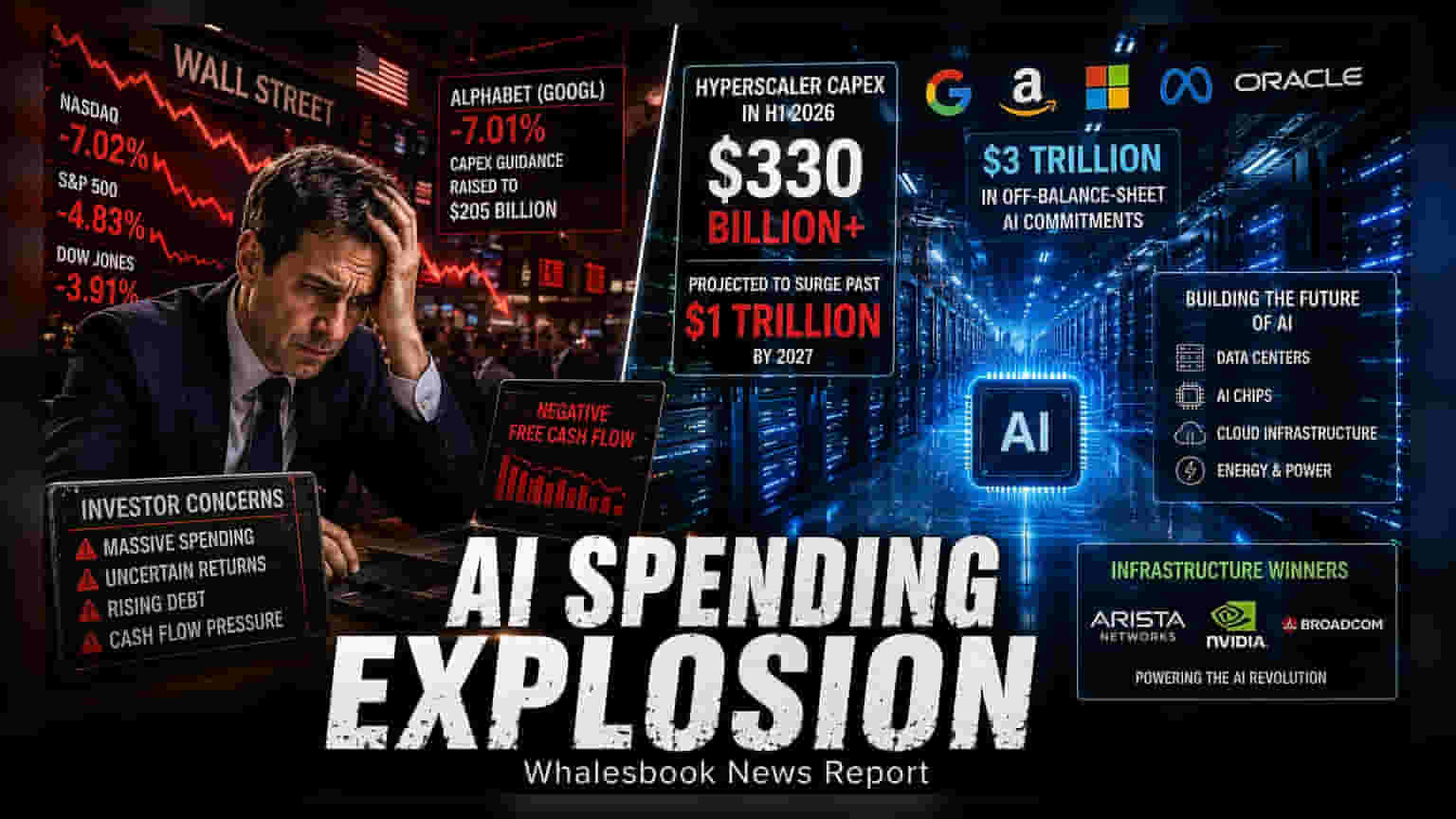
Major tech companies are aggressively increasing their AI infrastructure budgets, with annual capital spending projected to exceed $1 trillion by 2027. While companies like Alphabet and Microsoft race to build capacity, investors are increasingly concerned about when these massive outlays will translate into real profits.
The global race for artificial intelligence dominance is entering a new phase of intense spending that is consistently beating Wall Street expectations. Major tech companies, often referred to as hyperscalers—including Alphabet, Amazon, Microsoft, Meta, and Oracle—have collectively invested over $330 billion in the first half of 2026 alone. Analysts now project that this annual capital expenditure could climb past the $1 trillion mark by 2027, a figure that is forcing a re-evaluation of how these businesses are valued.
Impact on Market Sentiment
This rapid escalation in costs has begun to weigh on stock prices. For example, Alphabet recently faced a sharp market reaction, with its shares dipping by 7% after the company raised its annual capital expenditure guidance to as much as $205 billion. This highlights a growing disconnect: while tech giants are doubling down on infrastructure like data centers and AI chips, investors are becoming more selective. The market is shifting its focus from simple growth potential to how these companies will eventually generate returns from their massive upfront investments.
Beyond traditional spending figures, analysts have identified about $3 trillion in off-balance-sheet commitments related to AI development. This suggests that the true financial burden on these companies may be higher than what is immediately visible in standard quarterly reports. Concerns over negative free cash flow are mounting, as investors question if the current level of spending is sustainable without clear evidence of monetization.
The Challenge of Returns
For investors, the primary concern is the gap between spending and profitability. While companies argue that this infrastructure is necessary to capture future AI demand, the returns remain uncertain. Unlike past technology cycles, the market is no longer rewarding indiscriminate spending. There is a distinct shift in sentiment, where investors are increasingly looking for financial discipline and proof that AI services can actually pay for the hardware and energy costs involved.
Infrastructure Suppliers vs. Hyperscalers
While the hyperscalers face pressure on their cash flow and profit margins, companies that supply the underlying infrastructure have seen a different trend. Firms involved in data center networking, such as Arista Networks, and chip manufacturers have benefited from this spending spree. These suppliers are essentially providing the tools for the AI race, making their revenue growth less dependent on the immediate profitability of the AI models themselves. As a result, some investors are finding these infrastructure-focused companies to be a more direct way to gain exposure to the AI boom.
Looking ahead, the primary concern for shareholders will be the execution of these projects. Investors will be closely watching for signs that this infrastructure is being utilized efficiently. Key monitorables in the coming quarters include whether these tech giants can show improvements in their cash flow, how they manage their rising debt levels, and if they can demonstrate that enterprise demand for AI tools is growing fast enough to justify the current scale of investment.