

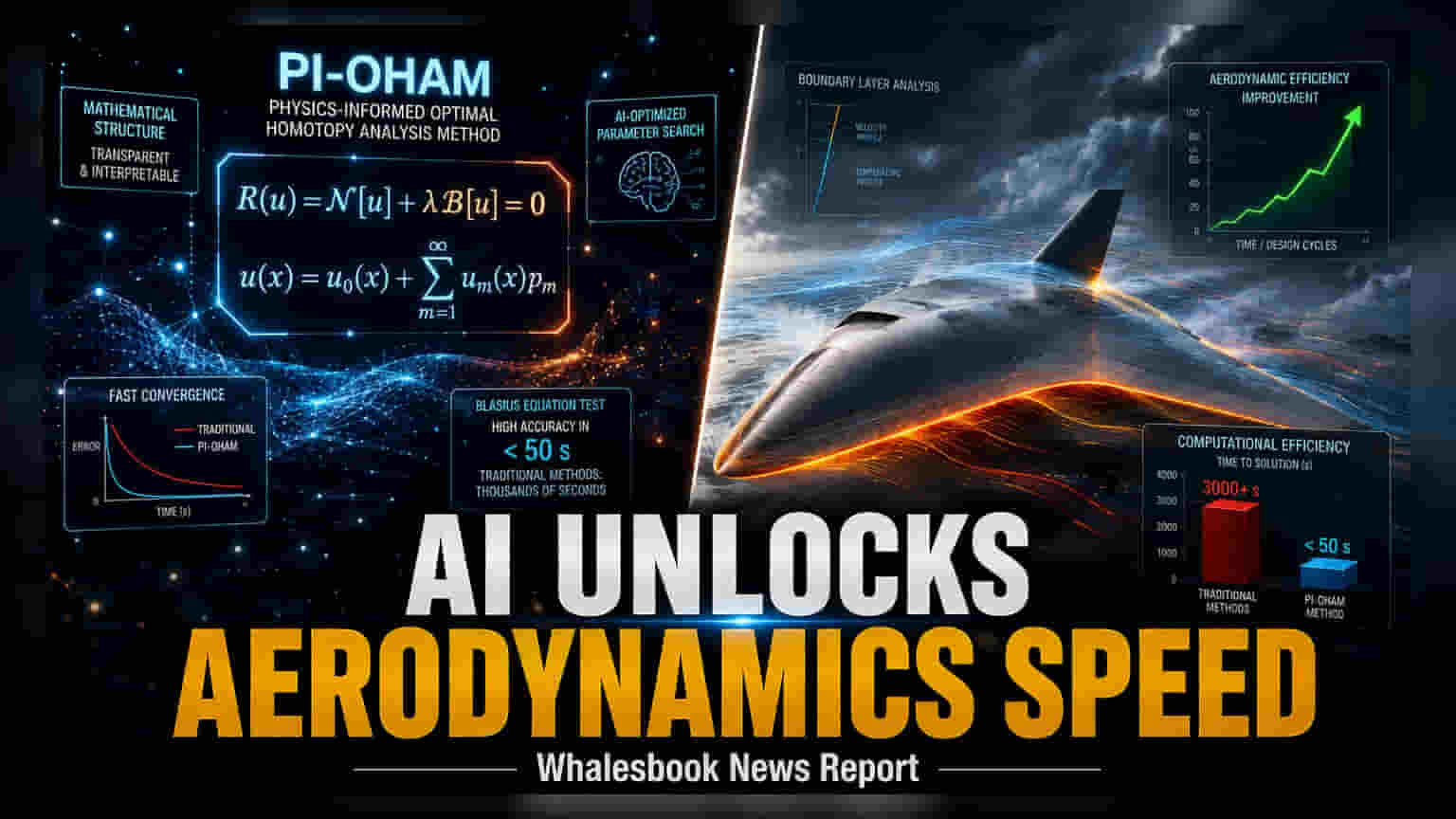
Researchers at BML Munjal University have introduced a new mathematical method, PI-OHAM, that accelerates complex fluid dynamics calculations. While currently an academic innovation, the tool offers potential long-term efficiency benefits for sectors like aerospace, automotive, and thermal management by speeding up critical aerodynamic and heat transfer simulations.
Researchers at the School of Engineering and Technology, BML Munjal University, have developed a new computational method aimed at improving how engineers simulate fluid dynamics. The technique, named Physics-Informed Optimal Homotopy Analysis Method (PI-OHAM), combines traditional mathematical approaches with AI-driven parameter selection. This development is designed to address the complex non-linear equations required to model air flow near surfaces, a process crucial for designing efficient aircraft, vehicles, and electronic cooling systems.
In aerodynamics and heat transfer, the boundary layer—the thin region of air immediately surrounding a surface—is a key factor in determining drag and energy efficiency. Modeling this layer has traditionally been computationally heavy and slow. Existing methods, such as standard Physics-Informed Neural Networks (PINNs), can act as black boxes with limited transparency, while traditional mathematics can be slow to converge on an accurate solution.
The new PI-OHAM approach attempts to bridge this gap. By retaining the structured mathematical transparency of the classic Homotopy Analysis Method while using AI to automate and optimize the search for parameters, the researchers report significant efficiency gains. In initial testing on the Blasius equation, a standard problem in fluid dynamics, the method reportedly achieved high accuracy in under 50 seconds, compared to thousands of seconds for traditional methods.
For investors and industry observers, this development serves as an update on academic R&D trends rather than a direct stock market event. The technology is currently in an early research and testing phase. Its real-world utility will depend on future adoption by industrial sectors that rely heavily on fluid dynamics, such as hypersonic vehicle development, solar thermal system design, and advanced electronics manufacturing.
The next step for this technology involves moving from theoretical testing on classic equations to complex industrial scenarios. Industry observers may watch for whether such methods are eventually adopted in engineering software or integrated into the design processes of major manufacturing and aerospace firms, which could contribute to lower design costs and improved product efficiency over the long term.