

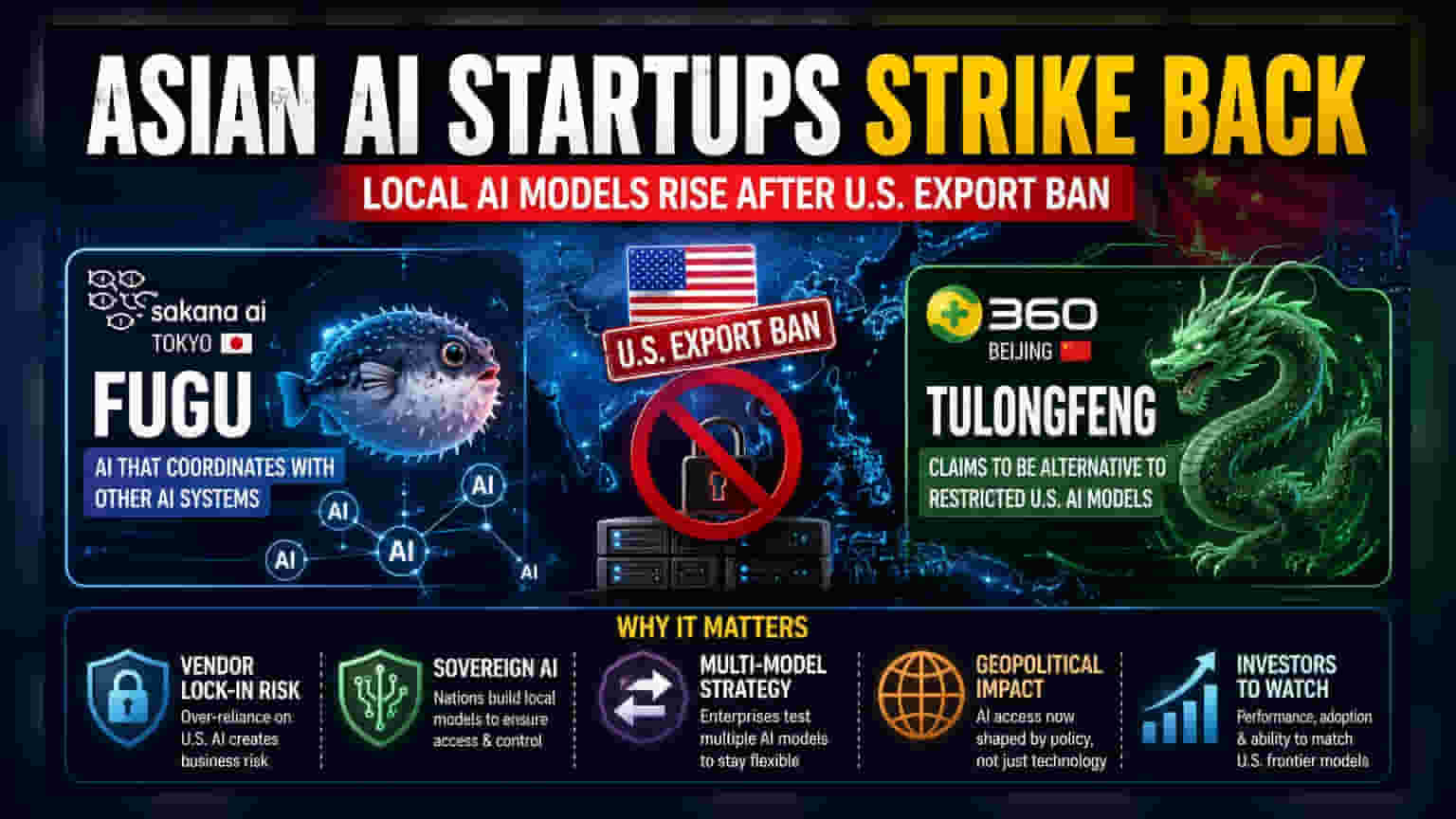
Asian firms Sakana AI and 360 have unveiled advanced AI models following U.S. export restrictions on Anthropic’s tools. This shift signals a growing move toward 'sovereign AI,' as businesses globally seek to reduce dependency on single U.S. providers and mitigate the risk of sudden regulatory bans on critical technology.
What Happened
Asian artificial intelligence startups are rapidly responding to recent U.S. government export restrictions that limit access to Anthropic's powerful AI models, such as Mythos and Fable 5. Tokyo-based Sakana AI has launched 'Fugu,' a model capable of coordinating with other AI systems, while Chinese cybersecurity firm 360 has introduced 'Tulongfeng,' which it claims can serve as a direct alternative to restricted U.S. tools. These developments come just two weeks after the U.S. enacted bans preventing non-American entities from accessing certain high-end Anthropic models. The move effectively creates an immediate demand for localized or alternative AI solutions in regions affected by these controls.
The Shift Toward 'Sovereign AI'
The emergence of these alternatives highlights a major strategic pivot in the global technology sector. Businesses and government agencies are increasingly worried about 'vendor lock-in,' where they rely entirely on a single foreign provider for critical infrastructure. When U.S. export policies change, international firms using these tools face the risk of losing access, which can disrupt their core operations.
Sakana AI’s leadership has framed this not as a total break from U.S. technology, but as a necessary hedge. By developing localized models that can be run independently, these startups aim to provide 'frontier capabilities' without the threat of being cut off by sudden geopolitical policy shifts. This approach, often called 'sovereign AI,' focuses on creating models tailored to local languages and cultural nuances, which can also be a business advantage.
Implications for Global Businesses
For global companies and IT service providers, this trend changes how they approach AI adoption. If a company builds its business logic on a single U.S.-based model, its long-term viability becomes tied to the political and regulatory relationship between the U.S. and the host country.
As a result, many large enterprises are moving toward a 'multi-model' strategy. Instead of sticking with one supplier, they are testing several AI models—some from the U.S. and others from local providers—to ensure they can switch if access is restricted or if costs rise. This strategy increases flexibility but also adds complexity to managing AI systems, as different models may perform differently or require unique infrastructure.
What Investors Should Track
Investors tracking the AI sector should look at how these alternative models perform in real-world business scenarios. While the announcement of new models is a clear signal of market response, the long-term success of these companies will depend on whether they can match the accuracy, speed, and safety of the U.S. models they aim to replace.
Additionally, the focus for investors should be on how major IT services firms adapt. Companies that provide AI integration and consulting services will likely face pressure to become 'model-agnostic,' meaning they must be capable of working with various global and local AI tools. The ability of these service providers to help their clients navigate these regulatory and supply-chain risks will be an important factor in the coming quarters.