

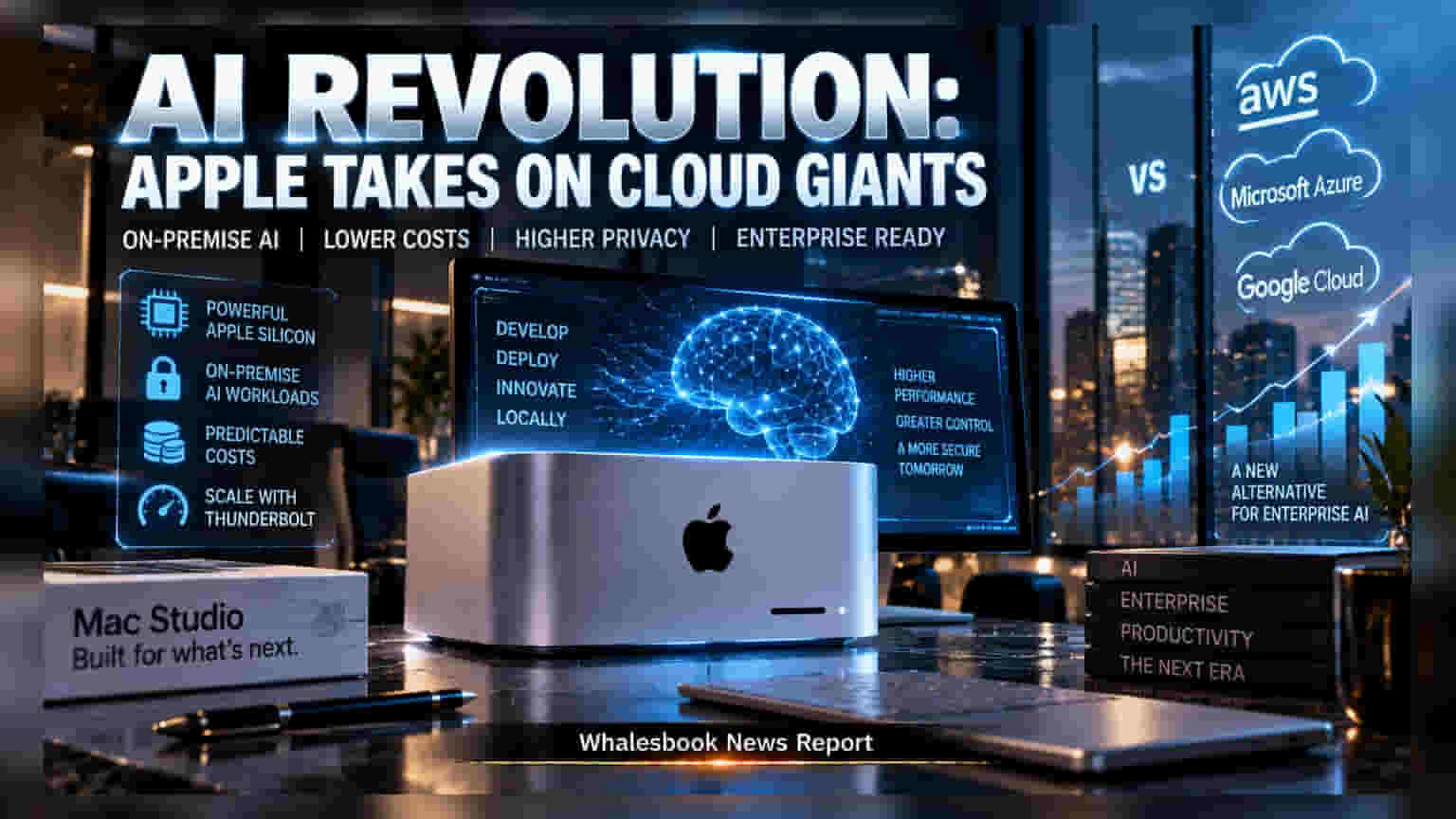
Apple is marketing its high-end Mac Mini and Mac Studio desktops as a cost-effective alternative to cloud-based AI processing. By allowing firms to run models locally, the company aims to help businesses avoid ongoing per-token fees charged by cloud providers. Investors should watch if this hardware-focused strategy can challenge Apple’s 4.6% enterprise market share against the dominant Windows ecosystem.
Apple is actively attempting to capture a larger share of the corporate AI sector by positioning its Mac Mini and Mac Studio hardware as a substitute for cloud-based computing infrastructure. The company is encouraging businesses to shift their intensive AI workloads from external cloud services to local, on-premise Mac hardware. This move is designed to provide companies with a more predictable cost structure for AI development.
The core economic argument rests on how businesses pay for AI. Most cloud providers charge users based on usage, often through recurring per-token fees—the cost incurred each time a piece of text or data is processed. These variable costs can become significant as AI projects scale. By contrast, Apple is proposing a model where companies purchase high-performance hardware, turning a continuous operating expense into a one-time capital expenditure.
Technically, Apple is relying on its proprietary silicon to make this possible. The company has integrated computing and memory units into a unified architecture, which was originally optimized for mobile power efficiency but is now being used to handle complex AI tasks. Additionally, the company has added high-speed communication features, such as RDMA over Thunderbolt, which allow multiple Mac Studio units to cluster together and run large AI models that would typically require a massive data center.
Despite the technical capabilities, Apple faces a major challenge in the enterprise sector. According to data from IDC, Apple holds only 4.6% of the enterprise desktop market, while the Windows ecosystem commands 91.3%. Microsoft remains a powerful competitor and is pushing its own initiative, termed "unmetered intelligence," which focuses on embedding AI features directly into the widely used Windows software suite. While Microsoft relies on a broad network of hardware partners—which can create optimization hurdles—its deep integration with corporate workflows provides a significant advantage.
Meanwhile, Nvidia continues to hold a dominant position in the data center market, which is the primary area Apple is attempting to disrupt with its localized approach. For corporate buyers, the decision is becoming increasingly split between the scalability of the cloud and the fixed, predictable performance of local hardware. The success of Apple’s strategy will depend on whether its hardware can offer enough efficiency and speed to convince large organizations to move away from their existing cloud-first and Windows-based setups. Investors and industry followers will likely monitor the adoption rates of these Mac configurations in corporate environments to see if this shift can gain meaningful traction.