

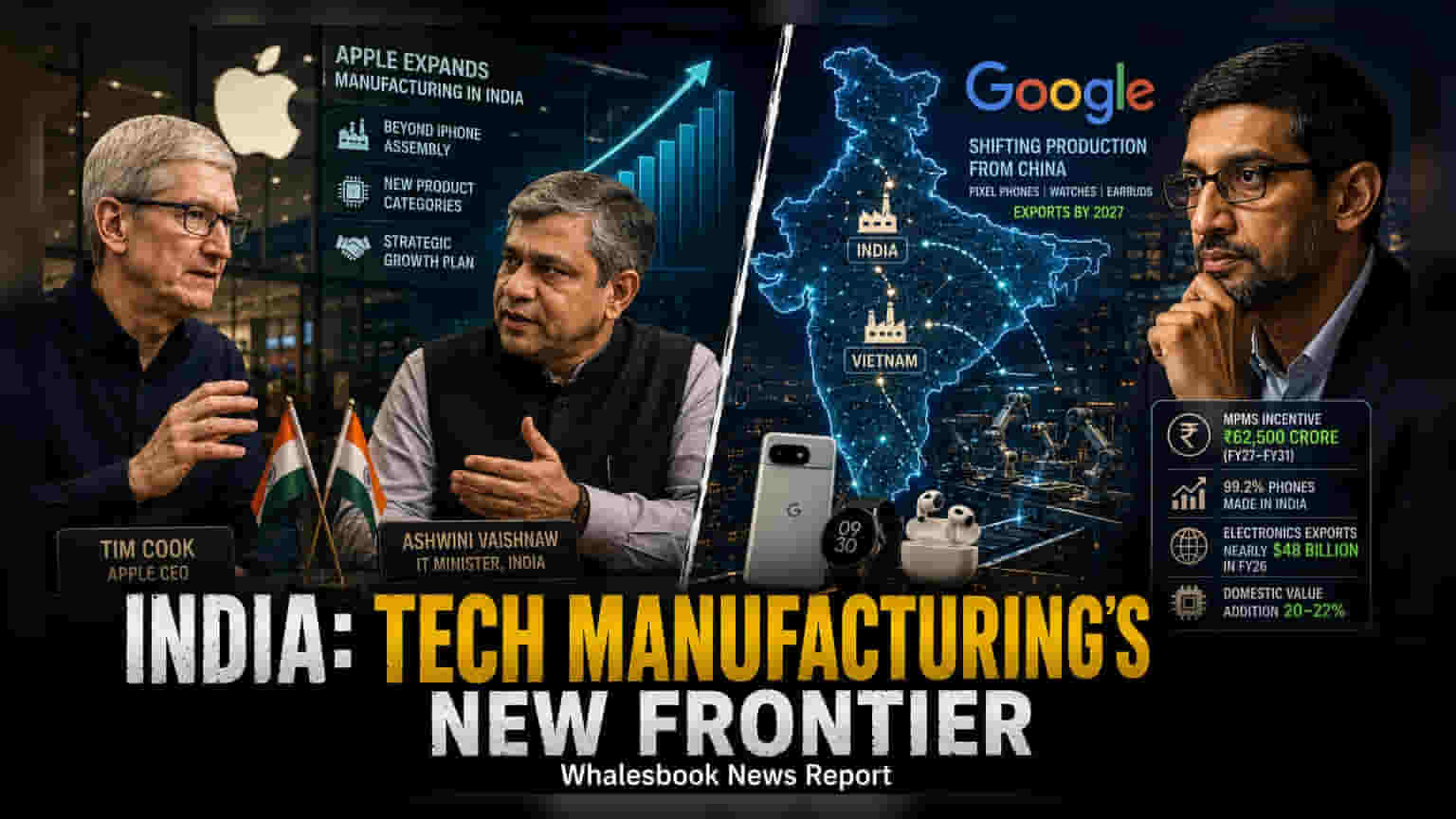
Global tech giants Apple and Google are scaling up operations in India as manufacturing shifts away from China. Union IT Minister Ashwini Vaishnaw confirmed Apple is discussing broader product assembly, while Google targets moving its export-oriented device production to India and Vietnam. Investors are tracking this supply chain shift, though low domestic value addition remains a key operational risk.
India is increasingly becoming a strategic hub for global electronics manufacturing, with tech giants Apple and Google moving to expand their footprints within the country. On August 21, 2026, Union Electronics and IT Minister Ashwini Vaishnaw confirmed that the government is in discussions with Apple to widen its manufacturing scope beyond the current iPhone assembly lines. This move suggests a potential diversification into new product categories, marking a significant evolution in Apple’s India strategy.
Simultaneously, Google is reportedly planning to shift its export-oriented manufacturing for Pixel smartphones, smartwatches, and wireless earbuds away from China. If executed, this transition is expected to be completed by 2027, with India and Vietnam serving as the primary production bases. Google has already begun initial Pixel production in India, with local firms like Dixon Technologies acting as manufacturing partners. This development follows a broader global industry trend known as the "China plus one" strategy, where companies diversify their supply chains to reduce concentration risk in China.
Policy Support and Manufacturing Incentives
The government is actively supporting this expansion through targeted policy measures. A central pillar of this strategy is the Mobile Phone Manufacturing Scheme (MPMS), with an allocation of ₹62,500 crore earmarked for the FY27–FY31 period. This funding is designed to encourage both global players to set up bases and to nurture domestic manufacturers.
Authorities are also focusing on creating three new Indian smartphone companies within the next 10 to 14 months, aiming to foster brands capable of competing in high-volume market segments. Current data shows that 99.2% of mobile phones used within India are manufactured domestically, indicating a strong baseline for the current ecosystem. In fiscal year 2026, India’s electronics exports reached a record of nearly $48 billion, signaling the country's growing integration into global value chains.
Operational Risks and Future Monitorables
Despite the rapid growth in assembly capacity, the sector faces distinct structural challenges. A primary monitorable for investors is the level of domestic value addition, which currently hovers between 20% and 22%. Much of the manufacturing activity in India is currently focused on assembly, meaning the country remains heavily dependent on imported components, such as memory chips and advanced semiconductors.
Competing with the deep, mature electronics supply chain ecosystem in China will require significant improvements in domestic infrastructure and component sourcing capabilities. Additionally, the industry is sensitive to potential changes in trade policies, tariffs, and the competitive landscape of the PLI (Production Linked Incentive) scheme. Investors will likely track how effectively companies can scale up local component manufacturing and whether global firms can maintain profit margins while navigating the rising costs of raw materials and complex logistics associated with establishing new manufacturing hubs.