

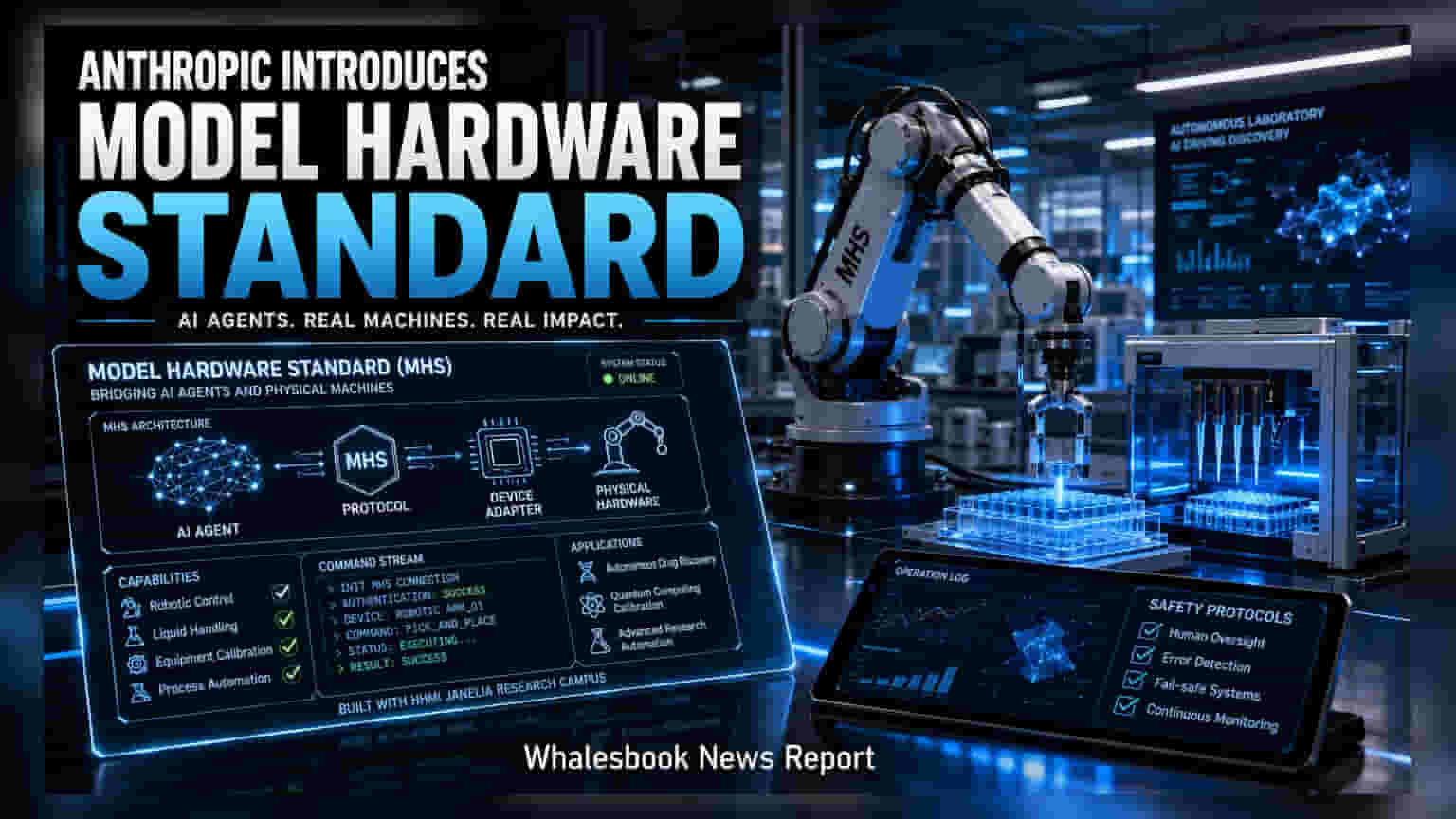
Anthropic has unveiled its 'Model Hardware Standard' to allow AI agents to directly control physical laboratory and manufacturing equipment. This shift from text-based models to operational physical control marks a significant expansion for the AI company, which recently filed confidential IPO paperwork as it scales toward a potential public listing.
Anthropic has introduced the Model Hardware Standard (MHS), a technical framework designed to enable its artificial intelligence agents to operate physical machines directly. By creating a standardized way for digital intelligence to communicate with programmable hardware, the company is attempting to bridge the gap between AI software and the physical factory floor or research laboratory.
The framework allows AI agents to control specialized equipment, such as robotic arms and automated liquid handlers, through a networked connection. Developed with the HHMI Janelia Research Campus, the system is designed to accelerate complex tasks, such as autonomous drug discovery and the calibration of quantum computers, by removing the need for manual inputs for every step of a process.
While this development showcases the company's push toward 'agentic' AI—where software performs actions rather than just generating text—it brings distinct operational challenges. Unlike a simple chatbot, an AI controlling physical machinery in a laboratory or factory presents significant safety risks. Errors in this environment could lead to damaged equipment, failed experiments, or physical safety issues, meaning that maintaining rigorous human oversight remains a critical necessity for any organization adopting these tools.
For investors monitoring the broader AI sector, this move underscores the intensifying competition among major AI labs to move beyond the cloud and into industrial applications. Anthropic is currently a privately held company and is not listed on Indian exchanges like the NSE or BSE. However, the company filed confidential IPO paperwork with the U.S. Securities and Exchange Commission on June 1, 2026, with market reports suggesting a potential public listing could occur later in the autumn of 2026. As of July 2026, the company reported an annualized revenue run rate exceeding $65 billion, highlighting its rapid financial scaling.
Despite this growth, the path ahead carries clear financial and competitive risks. The cost of running high-end AI infrastructure is substantial, and the company faces heavy pressure from well-funded rivals like OpenAI and Google. Additionally, the company operates under a public benefit corporation structure, which creates a unique governance model that may influence how future public shareholders view its strategic priorities versus profit motives. Investors interested in the company’s trajectory should look for updates on the progress of its IPO filings and the real-world performance results of this hardware framework as it moves from research preview to wider deployment.