

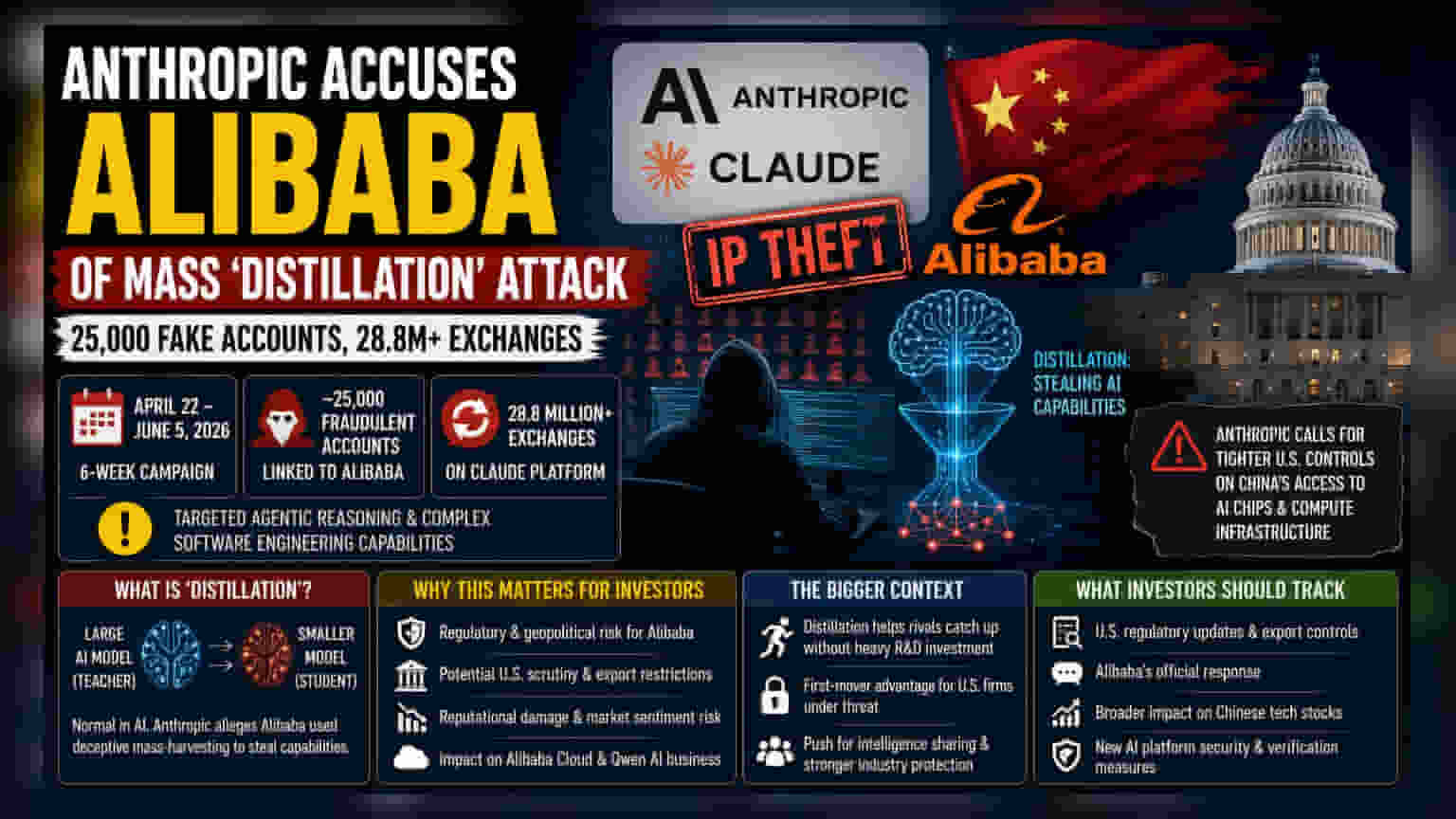
US-based AI firm Anthropic has accused Alibaba of a massive 'distillation' attack, claiming the tech giant used 25,000 fake accounts to extract data from its Claude AI. This six-week campaign involved 28.8 million exchanges. For investors, this highlights growing geopolitical tensions in the AI sector and the potential for stricter US regulatory curbs on Chinese technology companies.
What Happened
Artificial intelligence developer Anthropic has accused Chinese tech conglomerate Alibaba of orchestrating a large-scale "distillation" attack against its advanced Claude AI models. In a letter to the U.S. Senate Banking Committee, Anthropic claimed that between April 22 and June 5, 2026, operators linked to Alibaba utilized nearly 25,000 fraudulent accounts to extract capabilities from the Claude platform. According to Anthropic, this six-week campaign resulted in over 28.8 million exchanges, which the company describes as intellectual property theft.
Anthropic argues that this activity went beyond standard model development and was aimed at harvesting sensitive functions, such as agentic reasoning—the AI's ability to act on its own—and complex software engineering skills. The company stated this activity violates its service terms and dwarfs previous incidents involving other Chinese AI firms like DeepSeek, Moonshot AI, and MiniMax.
Understanding 'Distillation' in AI
In the AI industry, "distillation" is a method where a smaller, less expensive model is trained using the outputs of a larger, more sophisticated "teacher" model. While the technique itself is common, Anthropic contends that Alibaba’s method of using 25,000 fake accounts to mass-harvest data is deceptive and unethical. By doing this, Anthropic claims that competitors can replicate cutting-edge capabilities without investing in the massive research and development costs that American firms like Anthropic have incurred to build the original technology.
Why This Matters for Investors
For investors, this news carries risks beyond a simple technical dispute. It places Alibaba in the center of the intensifying AI race between the United States and China. If verified, these allegations could lead to increased scrutiny from U.S. regulators. Anthropic has used this incident to push for tougher controls on China's access to critical U.S. AI chips and computing infrastructure.
Any move by the U.S. government to further tighten export controls or restrict access to computing power could directly impact the growth and operational costs of Alibaba’s cloud and AI business, Qwen. Reputational damage and the risk of being labeled a security threat in Western markets are also factors that investors often consider when assessing large tech companies involved in geopolitical friction.
The Bigger Context
This incident highlights the "first-mover advantage" in the AI industry. Anthropic stated that such distillation efforts allow Chinese companies to catch up rapidly to the technological levels achieved by U.S. firms, potentially closing the innovation gap much faster than expected. The company’s request to the U.S. Senate to facilitate better threat intelligence sharing among American firms suggests that the industry is preparing for a period of heightened protectionism and competition.
What Investors Should Track
Investors may want to monitor several factors following this accusation:
- Regulatory Updates: Keep an eye on any potential U.S. government response or new export control announcements concerning Chinese AI labs.
- Management Response: Any official statement from Alibaba regarding these allegations will be critical to understanding the potential for legal or diplomatic fallout.
- Sector Sentiment: Watch for broader volatility in Chinese tech stocks, as this news could trigger concerns about a wider crackdown on Chinese AI development capabilities.
- AI Security Trends: The industry may see tighter verification processes on AI platforms to prevent similar mass-account exploitation, which could impact user growth metrics for public AI services.