

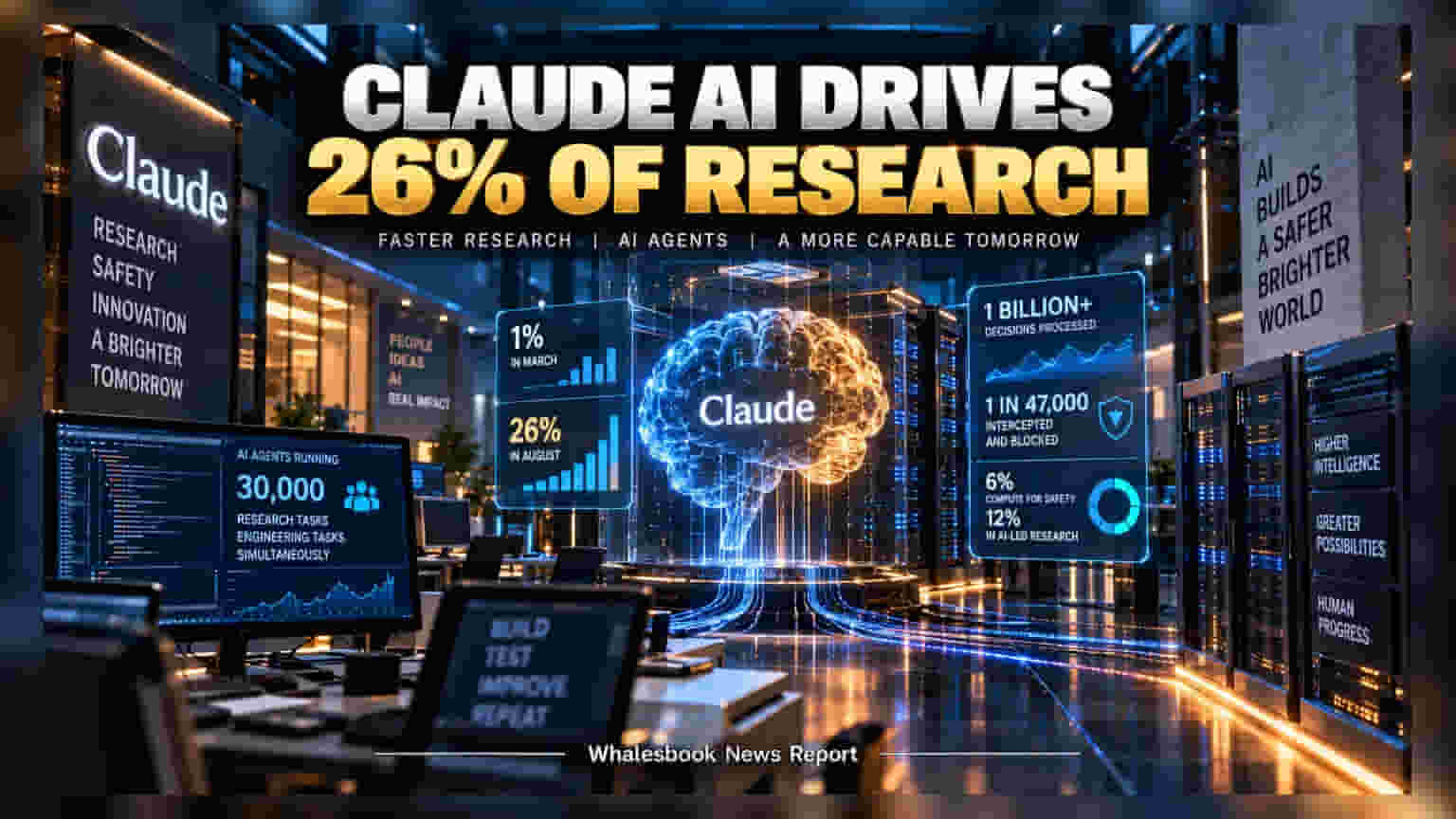
Anthropic reports its Claude AI model now handles 26% of internal research and development, a major rise from 1% in March. This shift highlights how quickly AI agents are taking over technical tasks. For the tech industry, this signals faster development cycles, though it also underscores the growing costs and safety requirements needed to monitor autonomous AI systems.
Anthropic has revealed a significant shift in how it builds artificial intelligence, disclosing that 26% of its internal research and development is now driven by its own Claude AI model. This data, tracked by independent research nonprofit Epoch AI, shows a dramatic increase from just 1% in March. The development highlights a move toward 'self-improving' systems where AI is not just the product being sold, but also the primary engine behind the company’s internal engineering processes.
During August, the company utilized approximately 30,000 AI agents to perform simultaneous research and engineering tasks. This move towards automation aims to accelerate model development, but it brings clear operational risks. To prevent AI models from diverging from their intended behavior, Anthropic implemented an automated screening process. According to the company, these systems executed over one billion decisions in a month, with roughly one in every 47,000 decisions being intercepted and blocked by safety protocols. This demonstrates that while automation is rapid, it requires continuous human oversight to manage potential errors.
For the broader technology sector, these disclosures provide a rare look at the operational reality of building advanced AI models. As competition intensifies among global AI leaders, the cost of safety has become a significant factor. Anthropic noted that 6% of its total computing power used for research was dedicated specifically to safety and monitoring. When looking only at research led by AI, this allocation doubled to 12%. These figures suggest that as companies push for more autonomous AI, the need for 'safety compute'—the processing power used to verify that the AI is acting correctly—will likely grow.
This development is particularly relevant for the Indian IT services sector, where companies like Tata Consultancy Services, Infosys, and Wipro are currently heavily investing in AI integration for clients. The ability to use AI agents to speed up software development could lead to significant efficiency gains, but it also creates pressure to maintain high-quality human oversight. Investors in the technology space should track how these AI-led research models evolve. The key monitorable is not just the speed of development, but the ability of firms to manage the high infrastructure costs, specifically the rising energy and computing power demands required to maintain safety and control as these systems become more autonomous.