

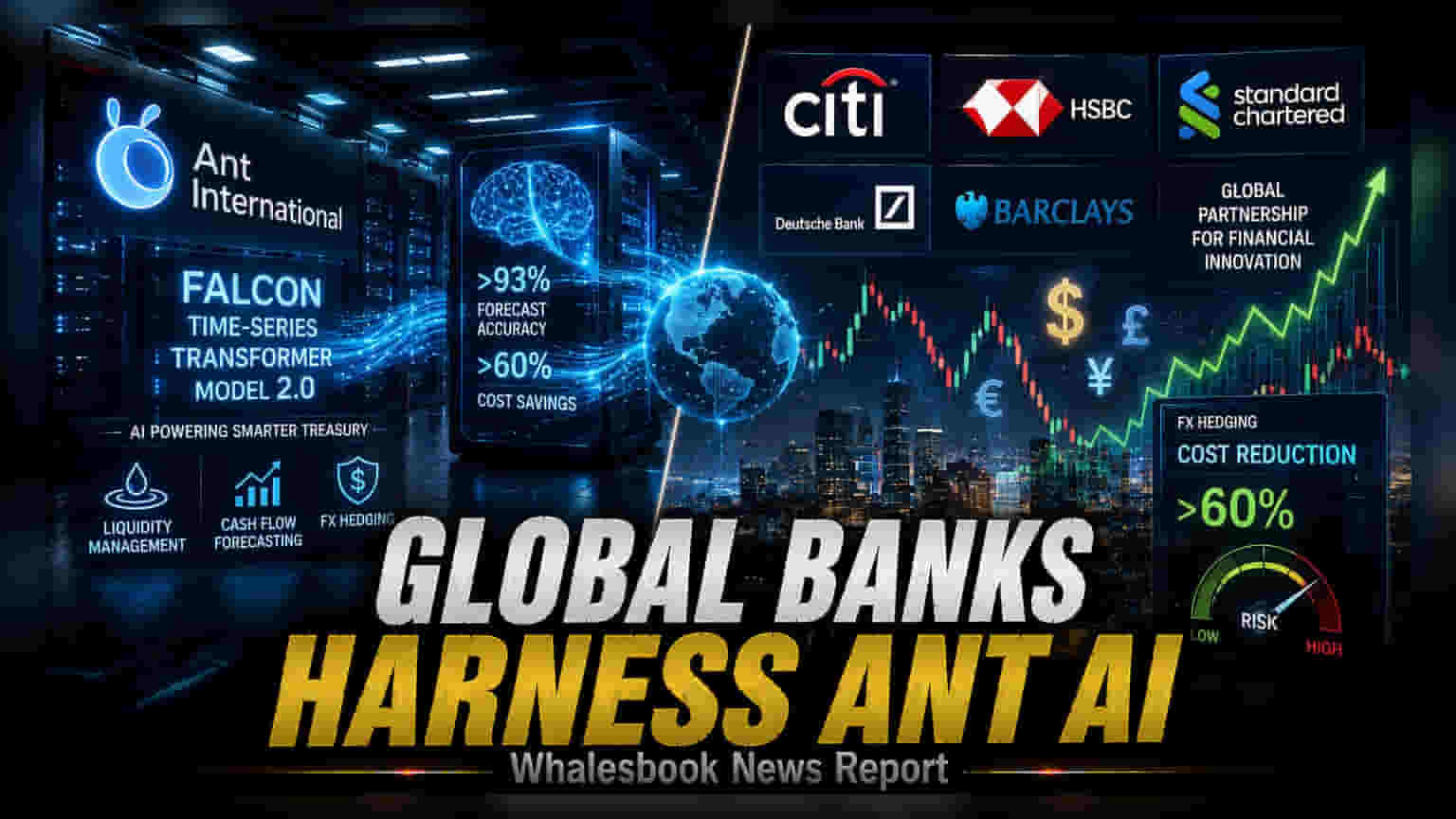
Ant International has released its 'Falcon Time-Series Transformer Model 2.0' to help banks manage foreign exchange risks. Major financial institutions, including Citi and HSBC, have partnered to adopt this AI tool, which claims to cut hedging and allocation costs by over 60%. This rollout follows the firm's recent $1.2 billion fundraising round.
Ant International, the Singapore-based fintech firm, officially launched its upgraded artificial intelligence platform, the Falcon Time-Series Transformer Model 2.0, on Thursday. The tool is designed to assist global financial institutions with critical treasury functions, such as liquidity management, cash flow forecasting, and foreign exchange (FX) hedging.
Six prominent global banks have already confirmed their participation to integrate this technology into their operations: Citi, HSBC, Deutsche Bank, Standard Chartered, and Barclays. By moving away from traditional forecasting methods to this specialized AI, the company claims that banks can achieve forecast accuracy exceeding 93%. This, according to the firm, could reduce the costs of foreign exchange hedging and capital allocation by more than 60%.
This development comes shortly after Ant International successfully raised approximately $1.2 billion in an equity funding round in July 2026. The capital is aimed at supporting the firm's global expansion, specifically in areas like merchant payment services and financial AI tools. The collaboration with established banks suggests that the company is aiming to secure a strong foothold in the international banking infrastructure.
While the potential for significant cost reductions is a clear benefit, the shift toward using third-party AI for sensitive financial operations does bring specific challenges. Banks typically have strict requirements for security and regulatory compliance when managing cross-border data. There is also the inherent risk of relying on an AI model for critical financial decision-making, where market volatility might occasionally exceed the predictive capabilities of even advanced algorithms.
Furthermore, the financial sector is currently seeing a rapid rise in competition. Many major banks and fintech rivals are investing heavily in developing their own proprietary AI solutions, which could impact the long-term adoption rate of third-party tools like Ant’s model. Regulatory scrutiny over the use of artificial intelligence in finance remains a major factor that authorities will continue to monitor closely.
For investors and market observers, the next steps will be to monitor how effectively these banks implement the new technology in their day-to-day operations and whether the projected cost savings materialize in their quarterly financial reports. The ability of the company to navigate global data privacy regulations and maintain security standards will also be a key monitorable in the coming months.