

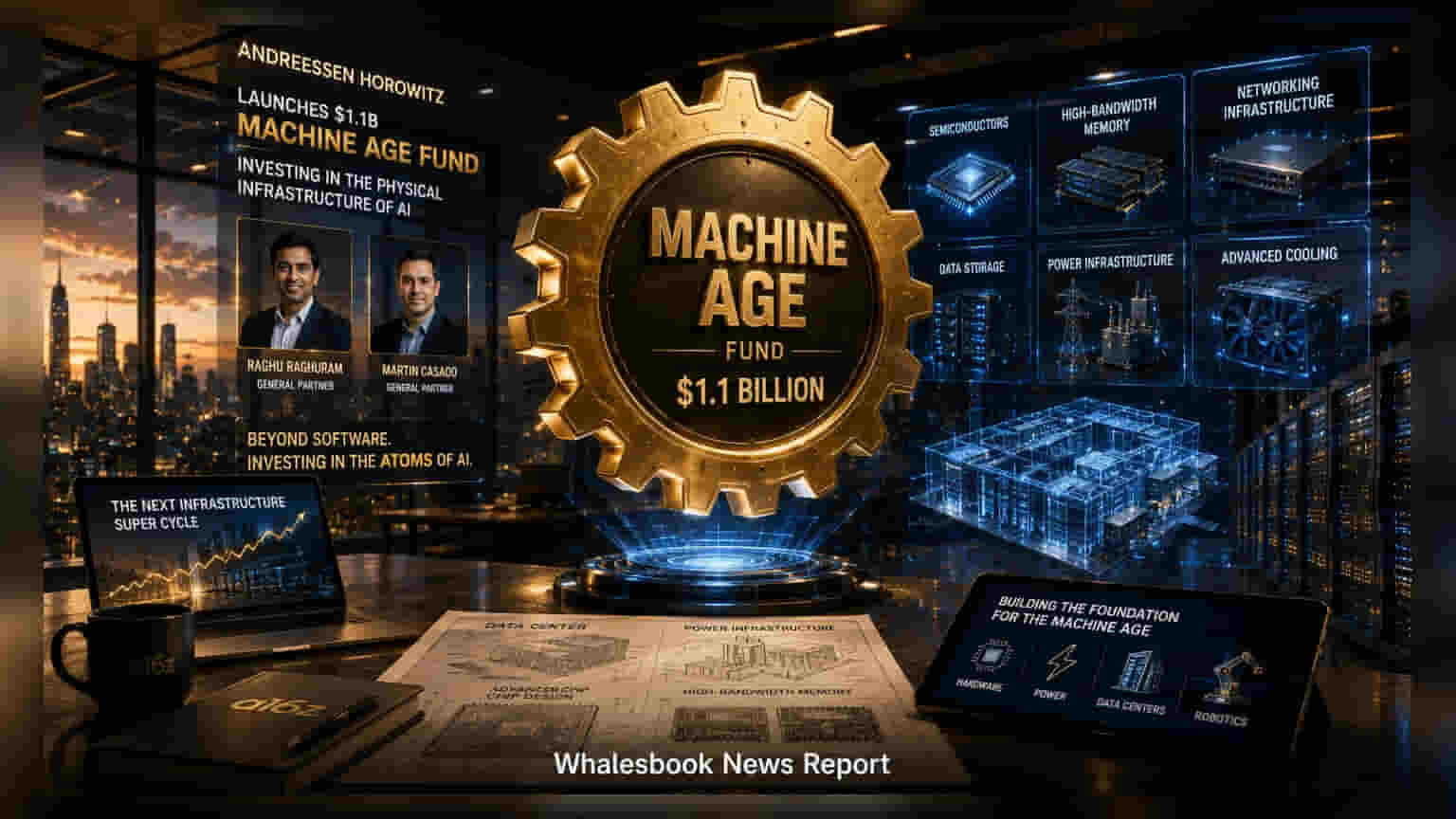
Venture capital firm Andreessen Horowitz has raised $1.1 billion for its new 'Machine Age' fund, targeting the physical infrastructure of artificial intelligence. This move represents a strategic pivot for the firm, which is shifting focus from traditional software investments to the hardware, data centers, and power systems required to scale AI development.
Andreessen Horowitz, the prominent venture capital firm often associated with software-led growth, has officially launched its $1.1 billion 'Machine Age' fund. This new investment vehicle is dedicated entirely to financing the physical infrastructure—often referred to as 'atoms'—needed to build and maintain modern artificial intelligence systems. The fund is led by general partners Raghu Raghuram and Martin Casado, marking a significant evolution in the firm’s investment strategy.
Investing in the Physical AI Stack
For years, venture capital interest in AI has been dominated by software applications, large language models, and cloud-based platforms. However, Andreessen Horowitz is now focusing on the foundational hardware layer that powers these technologies. The 'Machine Age' fund aims to invest in companies involved in high-bandwidth memory, specialized semiconductors, networking equipment, and data storage systems.
Beyond compute hardware, the fund’s scope extends to the massive energy and real estate requirements of the sector. As AI models become more complex, they require significantly more power and specialized cooling solutions, leading to investments in power infrastructure and advanced facility design. The fund also plans to explore robotics and other physical systems that are increasingly becoming integrated with AI.
Addressing Supply Chain Constraints
This capital allocation is a direct response to the supply chain bottlenecks currently facing the AI industry. Many institutional investors and industry leaders now argue that the computational requirements for training and running advanced AI models are outstripping the current physical capacity of global data centers and hardware manufacturing. By funding companies that produce the underlying systems, the firm intends to capture value in the 'picks and shovels' of the AI revolution rather than just the end-user software applications.
Understanding the Investment Risk
Investors and market participants should note that this fund is a private venture capital vehicle, meaning it carries the inherent risks associated with early-stage and growth-stage investments. Unlike liquid assets, venture capital commitments are often locked up for long periods, and there is no guarantee that these investments will yield successful returns.
Furthermore, the physical infrastructure sector presents different challenges compared to the software industry. Building hardware, data centers, and power grids involves capital-intensive projects, longer timelines, and complex regulatory hurdles. The success of this fund will depend on whether these infrastructure companies can scale efficiently and overcome the operational challenges that often affect hardware manufacturing and large-scale industrial projects. While the fund is not listed on any exchange, its activities provide a clear signal about where the smart money expects the next wave of technological growth to occur.