

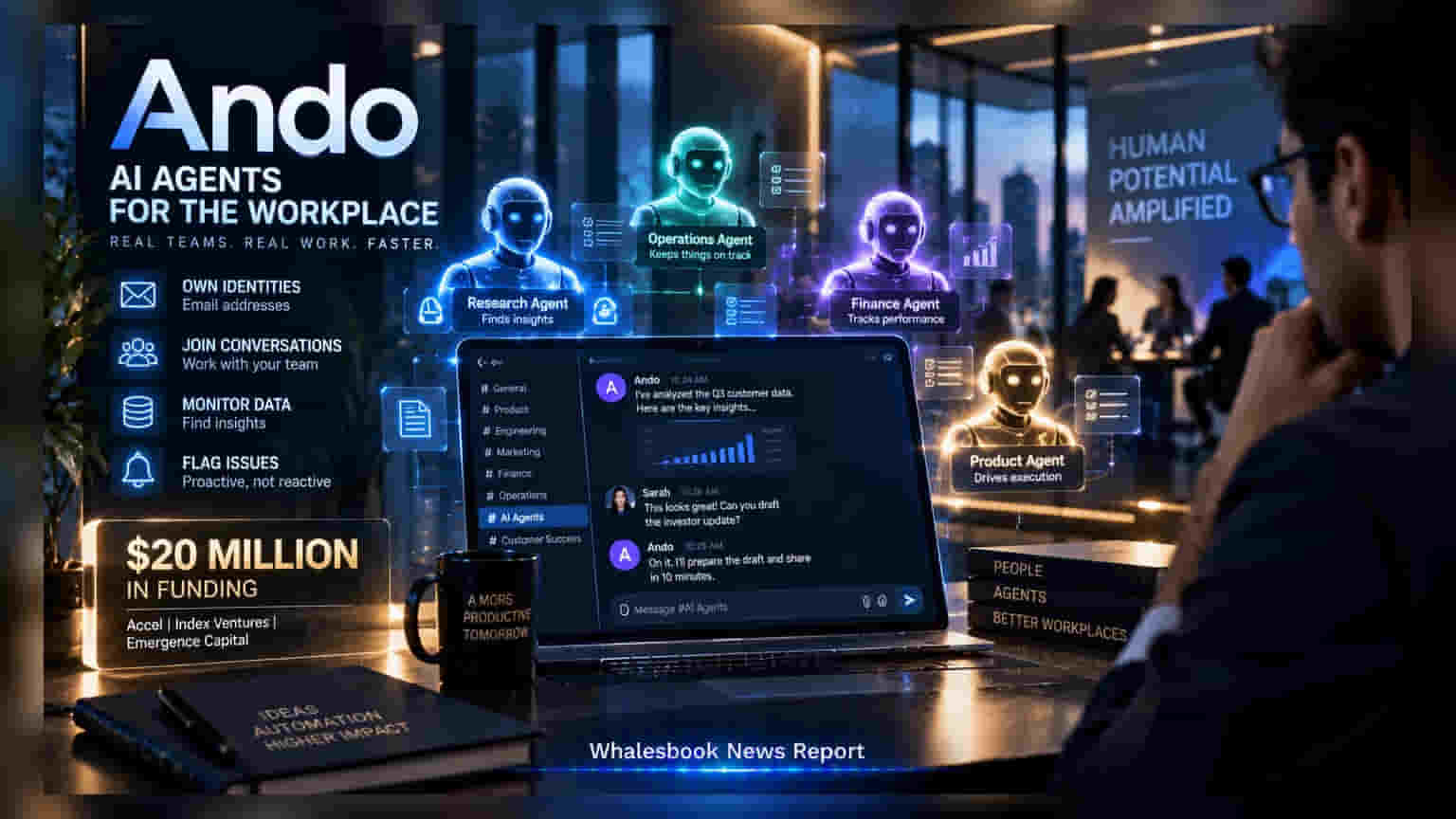
Startup Ando has exited stealth with $20 million in funding from investors like Accel and Index Ventures. The company is building an AI-native messaging platform where AI agents act as team members with their own identities. While it targets established tools like Slack and Microsoft Teams, the platform faces the challenge of convincing enterprises to switch from familiar legacy workflows.
Ando, a new software startup, has officially emerged from stealth mode with $20 million in funding. The round was backed by venture capital firms including Accel, Index Ventures, and Emergence Capital. The company, founded by Sara Du, aims to change how workplaces use artificial intelligence by shifting from simple chatbots to autonomous AI agents that operate as part of the team.
Moving Away from Manual AI Integrations
The core idea behind Ando is that current workplace communication tools, such as Slack and Microsoft Teams, treat AI as an external add-on. In most office settings, humans currently act as the bridge between AI tools and team communication channels, manually copying or translating data. Ando calls these human bridges meat proxies. The company’s platform is designed to eliminate this by giving AI agents their own identities, email addresses, and the ability to join conversations, monitor data threads, and flag issues without waiting for human input for every step.
A Competitive Landscape
Ando is entering a highly competitive market currently dominated by giants like Salesforce-owned Slack and Microsoft. These incumbents have already integrated AI assistants into their existing product suites. The challenge for Ando is whether companies, especially large enterprises, will choose to switch to a new, specialized platform rather than sticking with the broad ecosystem tools they already pay for. While the platform claims to handle high-volume, machine-led workflows more efficiently than legacy tools, success will depend on its ability to prove that this specific architecture offers a significant productivity advantage over the AI features already embedded in tools like Microsoft 365.
Enterprise Adoption Risks
Beyond the competitive pressure, the company faces significant hurdles in the enterprise software space. Large corporations are typically slow to adopt new messaging platforms due to strict data privacy regulations, internal security protocols, and the complexity of moving teams to new software. Additionally, while the promise of autonomous agents is attractive, businesses often prioritize reliability and integration with their existing software stack. Ando will need to prove that its system can integrate seamlessly with the diverse range of tools that modern companies use, from customer relationship management software to project management systems. The new capital will be used for hiring talent and upgrading computational resources, which are essential for scaling the platform to support more concurrent AI agents. Investors will be monitoring how quickly the company can expand its client base beyond its current footprint in sectors like finance and software development, and whether it can maintain its value proposition as AI capabilities continue to evolve rapidly.