

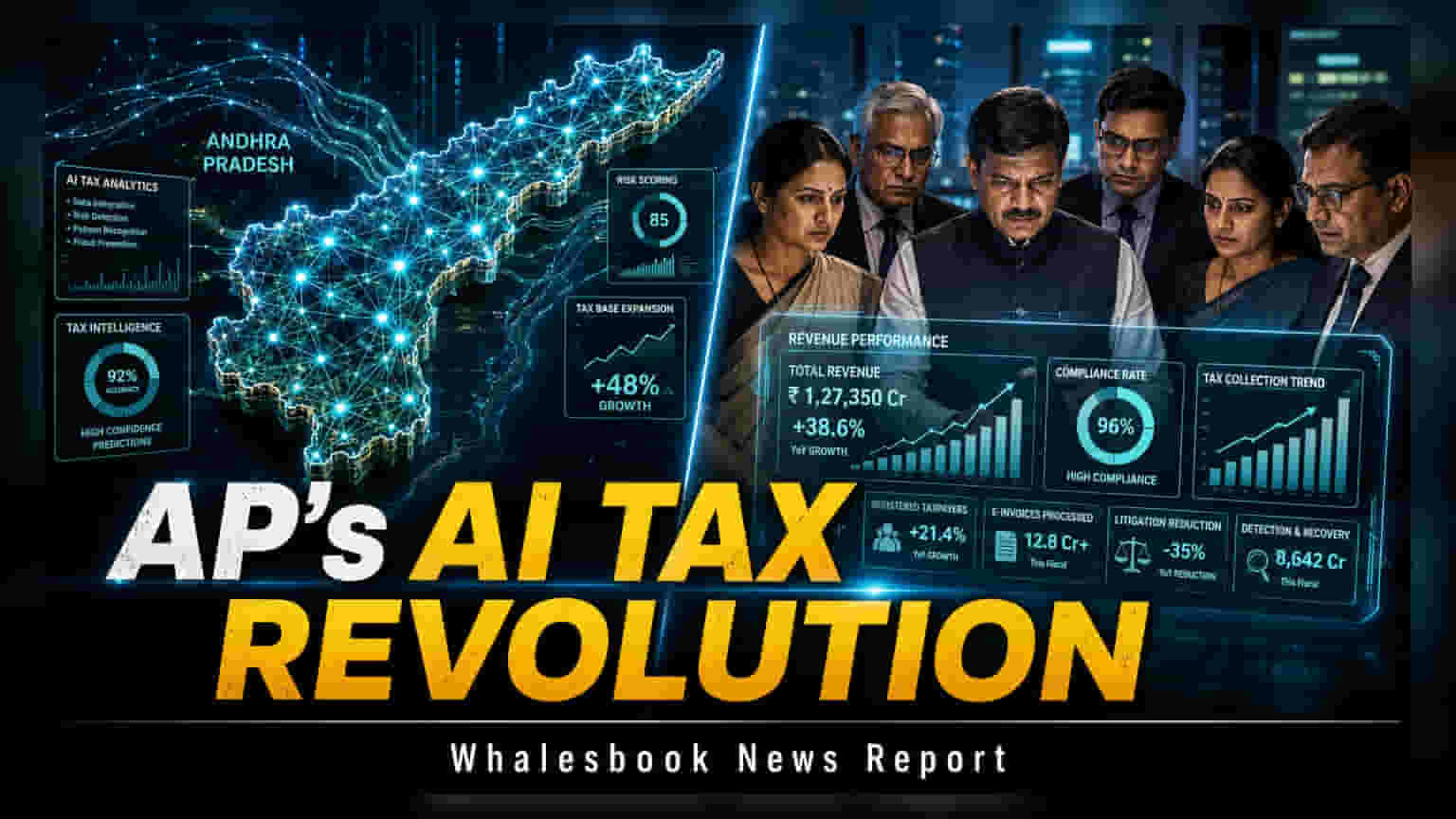
Andhra Pradesh’s Commercial Taxes Department has successfully implemented AI-driven systems to monitor GST compliance and detect tax fraud. A GST Council delegation recently reviewed these tools, which offer real-time revenue tracking and GSDP estimation. This initiative highlights a major shift toward digital governance, aiming to reduce tax leakage and improve the state's financial oversight.
Andhra Pradesh has emerged as a leader in digital governance within the tax sector by integrating Artificial Intelligence into its commercial tax administration. A delegation from the GST Council Secretariat recently visited Amaravati to review the state's advanced tax monitoring systems, marking a significant step toward modernizing revenue administration across India.
The initiative, managed by the State Commercial Taxes Department, utilizes AI-enabled dashboards to oversee critical functions such as taxpayer registration, return filing, and revenue collection. These systems allow officials to monitor tax arrears, audits, and scrutiny processes in real-time. By automating these tasks, the department aims to improve operational efficiency and ensure better compliance from taxpayers.
A key focus of the AI deployment is the analysis of e-way bill data. This provides the state with real-time insights into the movement of goods, which is instrumental for forecasting State Goods and Services Tax (SGST) payments and managing IGST settlements. Furthermore, the department is using these data sets to estimate the Gross State Domestic Product (GSDP) more accurately, providing a clearer picture of the state's economic health.
The administrative model also features a custom-built AI agent designed to assist with report generation and complex data analysis, supported by knowledge hubs. According to official disclosures, the department leverages AI engines from technology providers like Microsoft and Google to power these analytics. This integration supports the entire lifecycle of tax administration, from the initial selection of files for audit to the final decision-making process, helping officials identify irregularities that might otherwise go unnoticed.
Following the visit, the GST Council delegation, including Additional Secretary Pankaj Kumar Singh and Joint Secretary D.P. Mishra, described the model as exemplary. The success of this digital transformation is drawing attention from other states looking to adopt similar technologies to curb tax evasion and plug revenue leaks.
While the initiative offers clear administrative benefits, the implementation of such large-scale government AI projects does involve challenges. The reliance on third-party technology providers requires stringent vendor management and robust data security protocols to ensure taxpayer information remains protected. Additionally, as tax evasion methods become more sophisticated, the state will need to continuously update its algorithms to maintain the effectiveness of these oversight tools. For stakeholders, the primary monitorable will be the eventual impact on state revenue stability and the potential for this model to be scaled or adopted by other states across the country.