

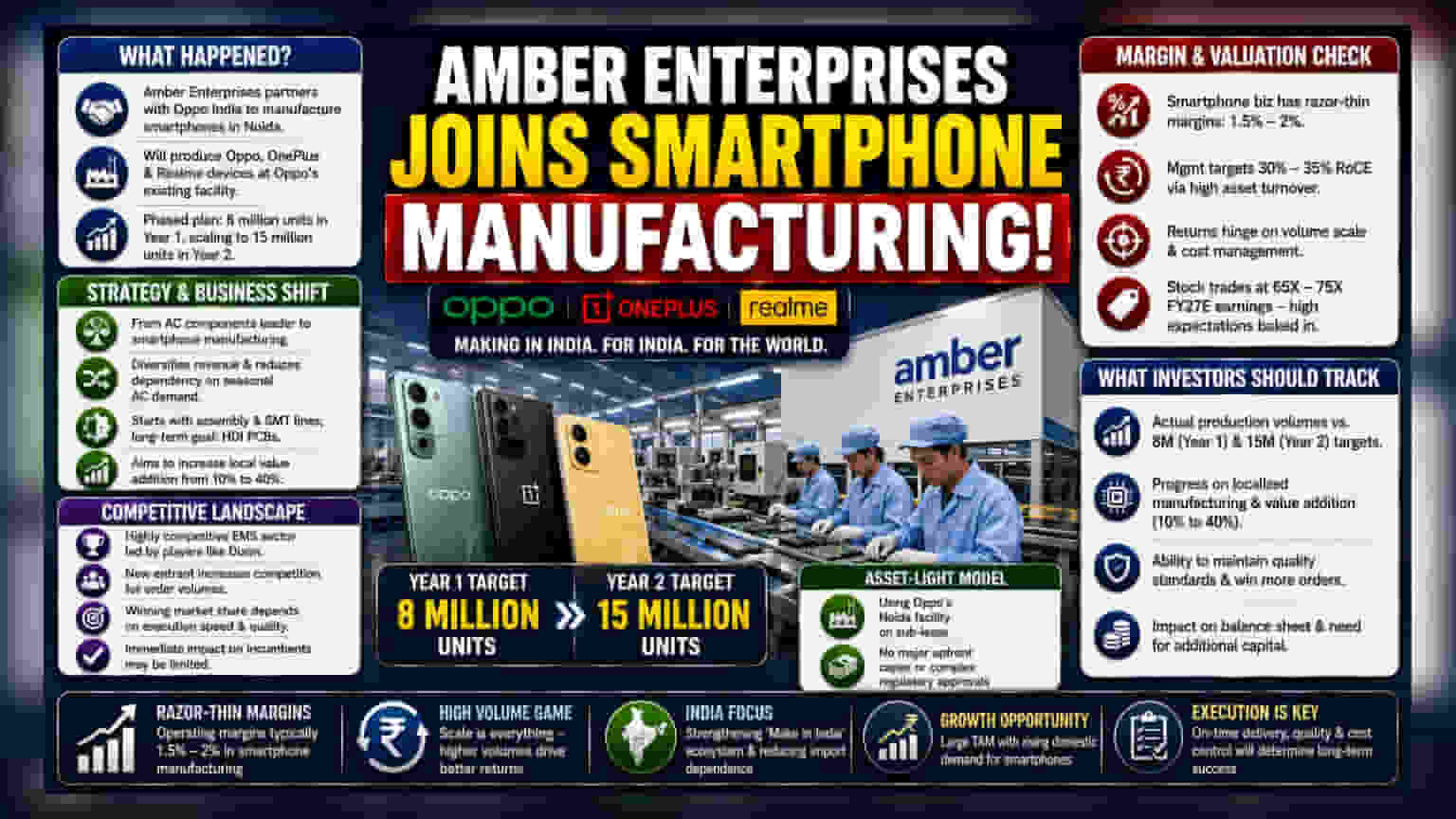
Amber Enterprises is diversifying into smartphone assembly through a partnership with Oppo India to produce Oppo, OnePlus, and Realme devices. While the company aims for high return on capital through an asset-light model, investors are monitoring the risks of thin profit margins and intense competition in the mobile manufacturing sector.
What Happened
Amber Enterprises has officially entered the smartphone manufacturing arena through a strategic collaboration with Oppo India. Under this agreement, the company will produce Oppo, OnePlus, and Realme devices at Oppo's existing manufacturing facility in Noida on a sub-lease basis. This arrangement allows Amber to begin operations without incurring significant upfront capital spending or needing complex regulatory clearances for setting up new plants. The company has laid out a phased production plan, targeting 8 million units in the first year and aiming to scale this to 15 million units by the second year.
The Strategy and Business Shift
Amber Enterprises is traditionally known for its leadership in the consumer durables sector, particularly in air conditioner components. By entering the mobile segment, the company is attempting to diversify its revenue stream and reduce its historical dependency on seasonal demand for AC products. The business model for this new venture is designed to be asset-light, utilizing existing infrastructure to minimize financial burden. The company plans to start with assembly and surface-mount technology (SMT) lines, with a long-term goal of manufacturing high-density interconnect printed circuit boards (HDI PCBs) to boost local value addition from 10% to 40%.
The Margin and Valuation Challenge
Investors should note that the smartphone manufacturing business operates on a different financial model compared to component manufacturing. This sector is characterized by high volumes but razor-thin operating profit margins, usually between 1.5% and 2%. While the management has expressed optimism about achieving a return on capital employed (RoCE) of 30% to 35% due to high asset turnover, realizing these returns depends entirely on the company's ability to ramp up volumes quickly and manage costs tightly. The company's stock currently trades at a valuation of 65 to 75 times its estimated FY27 earnings, suggesting that the market has priced in significant growth expectations for this new business line.
Competitive Landscape
The Indian electronics manufacturing services (EMS) sector is highly competitive and dominated by established players like Dixon Technologies, which has already scaled its operations significantly. The entry of a new, large-scale manufacturer like Amber increases the competition for order volumes. Whether Amber can capture market share without triggering price wars will depend on its execution speed and ability to meet the quality standards of major smartphone brands. Analysts have noted that while the entry is a potential growth lever, the immediate impact on established EMS incumbents may be limited until Amber proves its operational capability at scale.
What Investors Should Track
For the coming quarters, the primary focus for investors should be the company’s ability to hit its production milestones and its progress in localized manufacturing. Key monitorables include the actual level of value addition achieved in the mobile segment, as this will determine if the business can expand its profit margins. Furthermore, investors should keep an eye on how this expansion impacts the overall balance sheet and whether the company needs to deploy additional capital to support higher production levels in the future.