

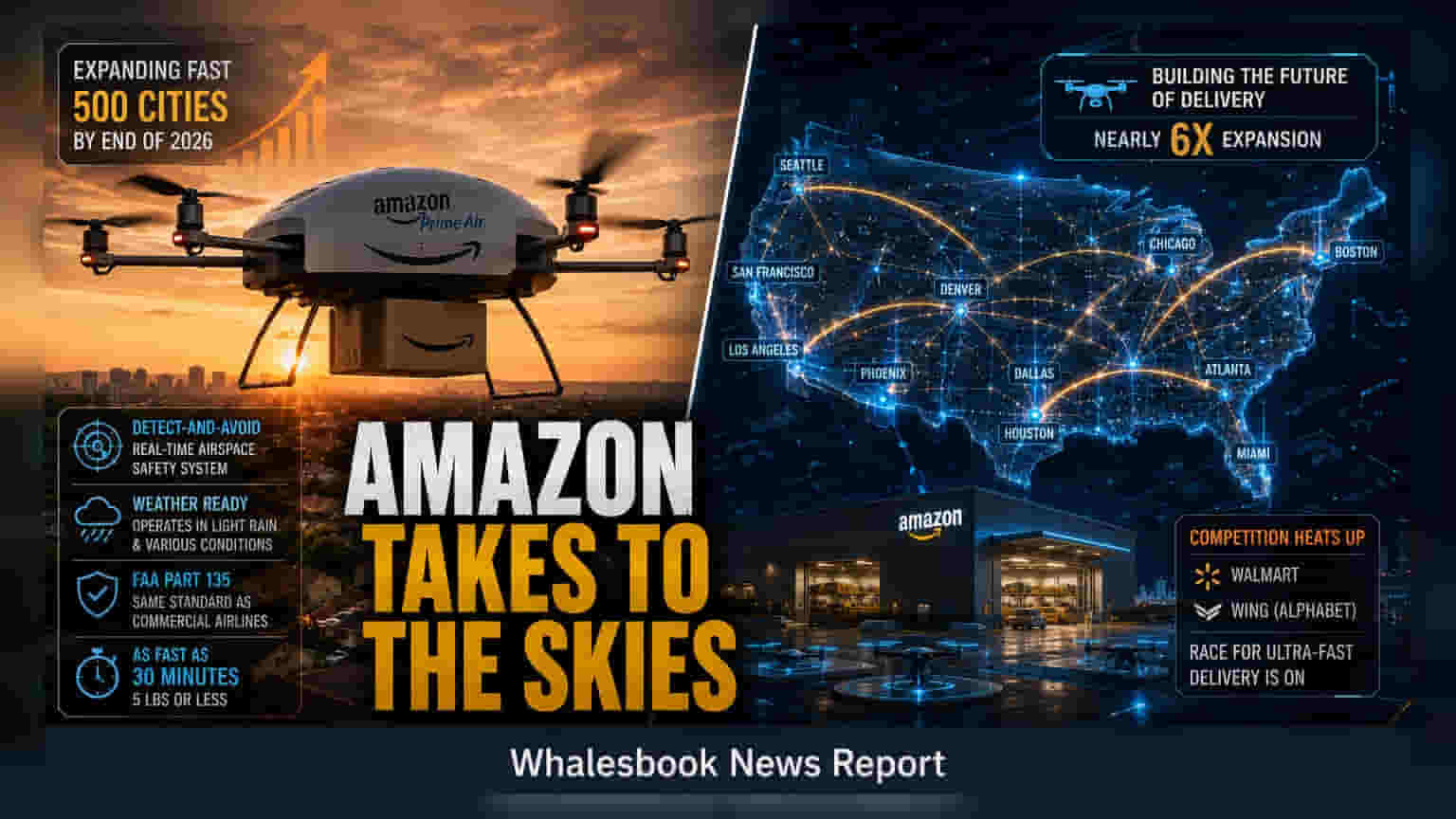
Amazon is aggressively expanding its Prime Air drone delivery service to reach nearly 500 U.S. cities by the end of 2026. While the goal is to cut delivery times to under 30 minutes, the massive infrastructure cost and strict safety regulations remain key factors for investors to track.
Amazon has announced a significant acceleration of its Prime Air drone delivery initiative, with plans to operate in nearly 500 U.S. cities and towns by the end of 2026. This expansion marks a sixfold increase in the service’s current operational footprint. The company aims to leverage this technology to deliver packages weighing 5 pounds or less in as fast as 30 minutes, a move intended to bolster its same-day and next-day delivery capabilities.
Technological and Operational Framework
To facilitate this growth, Amazon is emphasizing its proprietary Detect-and-Avoid system. This technology is designed to monitor airspace in real-time, allowing drones to navigate around obstacles and operate under various weather conditions, such as light rain. The service operates under the Federal Aviation Administration’s (FAA) Part 135 certification, which is the same rigorous standard that applies to commercial airlines. This regulatory approval is essential for the service to scale across different metropolitan areas.
Financial and Operational Risks
For investors, the primary consideration is the substantial capital spending required to build such an extensive logistics infrastructure. Developing and maintaining a fleet of delivery drones, along with the necessary ground control and safety systems, involves significant upfront costs. While the company is pushing for faster delivery times, the project has historically faced operational hurdles. Previous incidents, including a drone collision with a crane and other navigation issues near residential properties, have previously drawn scrutiny. Maintaining consistent safety performance will be critical as the service expands into new, densely populated urban areas.
Competitive Landscape
Amazon is not the only company racing to capture the ultra-fast delivery market. Major retailers, including Walmart and Alphabet’s Wing, are also building their own drone delivery networks in the U.S. This competition creates pressure on companies to refine their logistics models, manage high operational costs, and prove the reliability of their systems to both regulators and customers. The race for efficient last-mile delivery is intense, and the ability to execute this at scale without compromising on safety or profit margins will be a long-term challenge for all players in the sector.
Future Monitorables
Moving forward, investors and industry observers may monitor several key areas. First, the pace of regulatory approvals will dictate how quickly these 500 cities can be brought online. Second, the company’s ability to manage the high costs of this infrastructure expansion will be reflected in its logistics spending. Finally, performance metrics—such as delivery success rates, the actual cost per delivery, and the ability to operate safely in diverse environments—will determine whether drone delivery becomes a sustainable and profitable part of the broader e-commerce business model.