

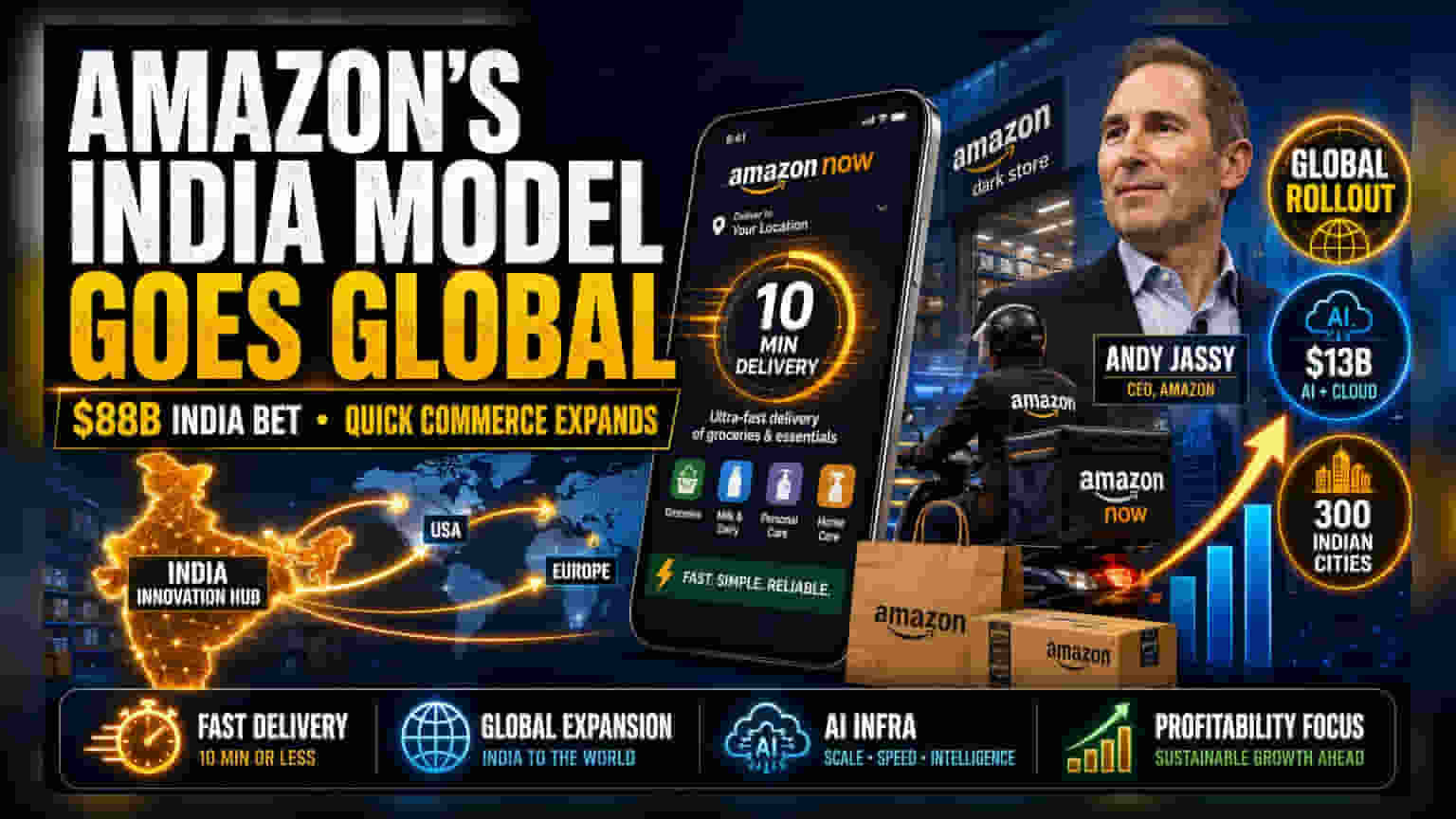
Amazon CEO Andy Jassy announced that the company is adopting its India-tested quick commerce model for global markets, including the US and Europe. While the strategy highlights India’s role as an innovation hub, the core challenge remains balancing rapid delivery speeds with economic sustainability in a highly competitive sector.
What Happened
Amazon has announced that it is exporting its quick commerce delivery model—pioneered and refined in India—to its global operations, including markets in the United States and Europe. CEO Andy Jassy stated that the strategy, which has seen rapid adoption across 300 Indian cities, is now being rolled out internationally. The company also reaffirmed its commitment to India, with total planned investments expected to reach $88 billion by 2030, including a $13 billion allocation specifically for artificial intelligence and cloud infrastructure. For Amazon, India has moved beyond a local market to become a testing ground for business innovations that the company now intends to implement globally.
Why The Economic Equation Matters
For investors and market observers, the shift toward quick commerce is not just about speed; it is about the cost of doing business. Quick commerce involves complex logistics, local warehousing, and short delivery windows, which are notoriously expensive to manage. Jassy emphasized that Amazon spent years experimenting with various formats to ensure the model makes sense from an economic standpoint. The key question for shareholders in any retail-focused business is whether the company can deliver goods in minutes without significantly hurting profit margins. Amazon’s focus on finding an "economic equation" that resonates with customers while remaining profitable is a critical monitorable as it scales this service worldwide.
The India Innovation Context
India has become a unique proving ground for quick commerce due to high population density and evolving consumer expectations. With Prime members in India already using quick commerce at a high frequency—reportedly purchasing three times more often than non-quick commerce users—the model appears to drive customer loyalty. However, this success is heavily dependent on execution. The ability to deliver thousands of items in minutes requires high inventory turnover and efficient supply chain management. By taking this model to mature markets like the US and Europe, Amazon is betting that the efficiencies it learned in India can overcome the different labor and logistical challenges present in Western markets.
Competition and Market Realities
While Amazon is scaling its model, it is entering a space that is already crowded and highly competitive, particularly in India. Local players like Blinkit, Zepto, and Swiggy Instamart have built aggressive quick commerce networks, forcing Amazon to adapt its strategy. The intense competition in this segment has historically led to high cash burn as companies subsidize deliveries to gain market share. Investors may watch how Amazon maintains its price competitiveness while ensuring that its investments in technology, such as the $13 billion AI and cloud push, actually help lower the cost of operations over time.
What Investors Should Track Next
As Amazon integrates these Indian innovations globally, the focus will be on the sustainability of this model. The key monitorables for the business include whether the company can maintain unit profitability as it expands to more cities, how it manages the pressure on delivery costs, and whether the adoption rate in the US and Europe matches the trends seen in India. Management commentary on the margins of the quick commerce segment versus traditional e-commerce will also be important for understanding the long-term impact on the company's financial performance.