

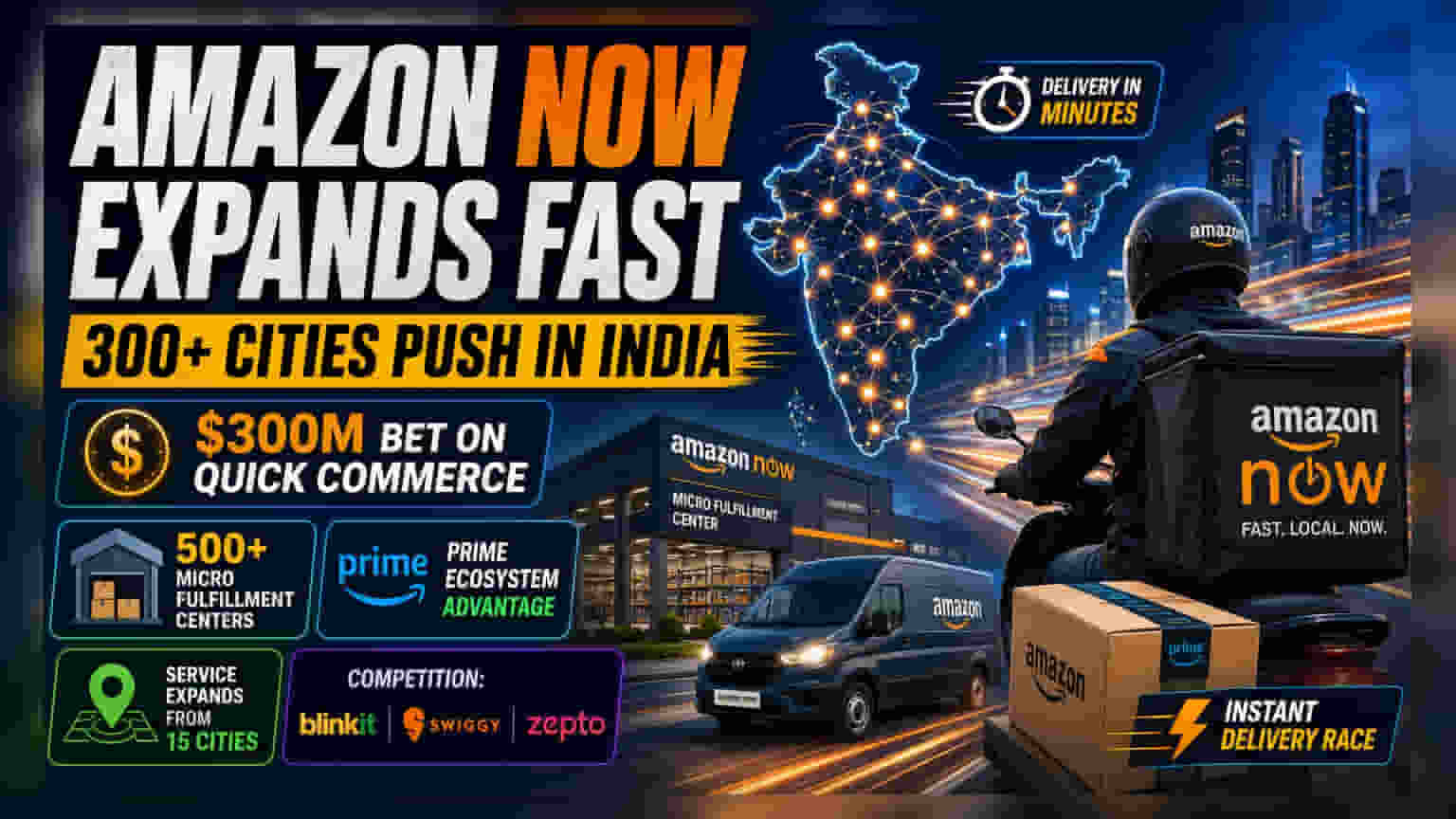
Amazon plans to scale its 'Amazon Now' service to over 300 cities, investing $300 million to challenge local players like Blinkit and Zepto. The strategy leans on Prime membership to drive user retention, though the company faces stiff competition in a sector known for high operational costs and intense growth pressure.
What Happened
Amazon is significantly scaling its quick-commerce operations in India, aiming to expand its 'Amazon Now' instant delivery service to over 300 cities. This move, announced by CEO Andy Jassy during his visit, is backed by a $300 million investment. The company is actively building its infrastructure, with a network of over 500 micro-fulfillment centers and stores to facilitate rapid deliveries. This expansion marks a shift from a limited presence in 15 cities to a nationwide push, directly targeting the high-growth segment currently dominated by local rivals.
The Strategic Push For Market Share
Amazon is effectively playing catch-up in the Indian quick-commerce market. While rivals like Zomato-owned Blinkit, Swiggy Instamart, and Zepto have established themselves as early leaders, Amazon is attempting to leverage its existing ecosystem—specifically its Prime membership program—to gain traction. The goal is to convert its massive base of marketplace shoppers into frequent users of its instant delivery service. According to company leadership, the frequency of shopping triples among Prime members once they begin utilizing the quick-commerce service, indicating that Amazon views 'Amazon Now' as a critical tool for increasing customer stickiness rather than just a standalone delivery service.
Competitive Reality Check
The Indian quick-commerce sector is characterized by intense competition and high capital requirements. Local incumbents have built significant leads: Blinkit currently commands a substantial market share with millions of monthly transacting users, while Zepto has also scaled operations rapidly across major urban centers. Flipkart has similarly entered the fray with 'Flipkart Minutes.' For Amazon, the challenge is not just expanding geographical reach, but managing the unit economics in a business model that relies on high-density urban networks. Operating a vast network of micro-fulfillment centers involves heavy capital expenditure and ongoing operational costs, which can impact margins.
Why The Business Model Matters
Quick commerce is distinct from traditional e-commerce because it requires a hyper-local approach. Success depends on the speed of delivery—often promised in minutes—which necessitates a high number of small, localized warehouses located within city limits. This model typically requires a high volume of orders to break even. While Amazon has the financial muscle to sustain the $300 million investment, the long-term viability of this expansion will depend on whether it can replicate the efficient delivery networks that competitors have already optimized.
What Investors Should Track
For observers of this space, the primary monitorables include the company's ability to maintain service quality at such an accelerated scale and the impact on Prime subscriber retention. Investors will watch whether Amazon's late entry allows it to capture a significant portion of the market or if the high cost of customer acquisition in the quick-commerce space proves to be a long-term pressure point. Additionally, the evolution of unit economics—specifically, the balance between delivery speed, operational costs, and the basket size of orders—will be key indicators of the segment's future performance.